홍보물
The Vision of KOREA 한국지도 (2006)
The Vision of Korea Map (2006)
한국어
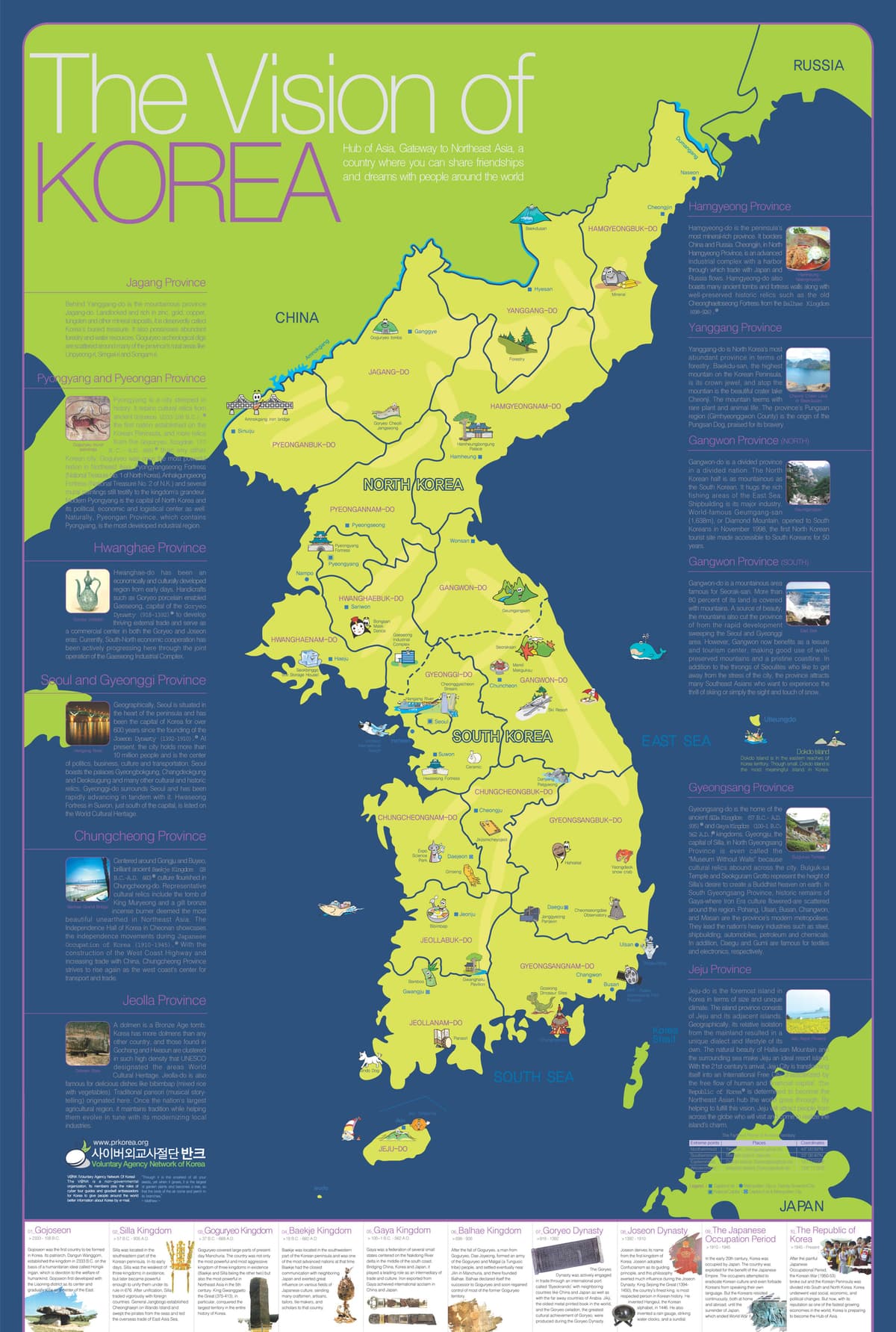
The Vision of KOREA 한국지도는 남한과 북한 각 지역의 역사와 문화를 소개하는 지도다. 북한의 평양·평안도 등 5개 지역과, 남한의 서울·경기·충청·전라·강원·경상·제주 지역을 다루며, 지역별 문화와 관광지, 특산물을 그림으로 표시했다.
EnglishThe Vision of Korea Map introduces the history and culture of regions in both South and North Korea. It covers five North Korean regions, including Pyongyang and Pyeongan-do, as well as South Korean regions such as Seoul, Gyeonggi-do, Chungcheong-do, Jeolla-do, Gangwon-do, Gyeongsang-do, and Jeju-do. The map uses illustrations to show each region's culture, tourist sites, and local specialty products.
자료 원고 · English
영문 원고_지역소개
The Vision of KOREA
Hub of Asia, Gateway to Northeast Asia, a country where you can share friendships and dreams with people around the world
Jagang Province
Behind Yanggang-do is the mountainous province Jagang-do. Landlocked and rich in zinc, gold, copper, tungsten and other mineral deposits, it is deservedly called Korea’s buried treasure. It also possesses abundant forestry and water resources. Goguryeo archeological digs are scattered around many of the province’s rural areas like Unpyeong-ri, Simgwi-ri and Songam-ri.
Hamgyeong Province
Hamgyeong-do is the peninsula’s most mineral-rich province. It borders China and Russia. Cheongjin, in North Hamgyeong Province, is an advanced industrial complex with a harbor through which trade with Japan and Russia flows. Hamgyeong-do also boasts many ancient tombs and fortress walls along with well-preserved historic relics such as the old Cheonghaetoseong Fortress from the Balhae Kingdom (698-926).❻
Pyongyang and Pyeongan Province
Pyongyang is a city steeped in history. It retains cultural relics from ancient Gojoseon (2333-108 BC),❶ the first nation established on the Korean Peninsula, and more relics from the Goguryeo Kingdom (37 BC- AD 668)❸ than any other Korean city. Goguryeo was once the most powerful nation in Northeast Asia. Pyongyangseong Fortress (National Treasure No. 1 of North Korea), Anhakgungseong Fortress (National Treasure No. 2 of N.K.) and several mural paintings still testify to the kingdom’s grandeur. Modern Pyongyang is the capital of North Korea and its political, economic and logistical center as well. Naturally, Pyeongan Province, which contains Pyongyang, is the most developed industrial region.
Hwanghae Province
Hwanghae-do has been an economically and culturally developed region from early days. Handicrafts such as Goryeo porcelain enabled Gaeseong, capital of the Goryeo Dynasty (918-1392)❼ to develop thriving external trade and serve as a commercial center in both the Goryeo and Joseon eras. Currently, South-North economic cooperation has been actively progressing here through the joint operation of the Gaeseong Industrial Complex.
Yanggang Province
Yanggang-do is North Korea’s most abundant province in terms of forestry. Baekdu-san, the highest mountain on the Korean Peninsula, is its crown jewel, and atop the mountian is the beautiful crater lake Cheonji. The mountain teems with rare plant and animal life. The province’s Pungsan region (Gimhyeonggwon County) is the origin of the Pungsan Dog, praised for its bravery.
Gangwon Province (NORTH)
Gangwon-do is a divided province in a divided nation. The North Korean half is as mountainous as the South Korean. It hugs the rich fishing areas of the East Sea. Shipbuilding is its major industry. World-famous Geumgang-san (1,638m), or Diamond Mountain, opened to South Koreans in November 1998, the first North Korean tourist site made accessible to South Koreans for 50 years.
Gangwon Province (SOUTH)
Gangwon-do is a mountainous area famous for Seorak-san. More than 80 percent of its land is covered with mountains. A source of beauty, the mountains also cut the province of from the rapid development sweeping the Seoul and Gyeonggi area. However, Gangwon now benefits as a leisure and tourism center, making good use of well- preserved mountains and a pristine coastline. In addition to the throngs of Seoulites who like to get away from the stress of the city, the province attracts many Southeast Asians who want to experience the thrill of skiing or simply the sight and touch of snow.
Seoul and Gyeonggi Province
Geographically, Seoul is situated in the heart of the peninsula and has been the capital of Korea for over 600 years since the founding of the Joseon Dynasty (1392-1910).❽ At present, the city holds more than 10 million people and is the center of politics, business, culture and transportation. Seoul boasts the palaces Gyeongbokgung, Changdeokgung and Deoksugung and many other cultural and historic relics. Gyeonggi-do surrounds Seoul and has been rapidly advancing in tandem with it. Hwaseong Fortress in Suwon, just south of the capital, is listed on the World Cultural Heritage.
Chungcheong Province
Centered around Gongju and Buyeo, brilliant ancient Baekje Kingdom (18 BC-AD 660)❹ culture flourished in Chungcheong-do. Representative cultural relics include the tomb of King Muryeong and a gilt bronze incense burner deemed the most beautiful unearthed in Northeast Asia. The Independence Hall of Korea in Cheonan showcases the independence movements during Japanese Occupation of Korea (1910-1945).❾ With the construction of the West Coast Highway and increasing trade with China, Chungcheong Province strives to rise again as the west coast’s center for transport and trade.
Jeolla Province
A dolmen is a Bronze Age tomb. Korea has more dolmens than any other country, and those found in Gochang and Hwasun are clustered in such high density that UNESCO designated the areas World Cultural Heritage. Jeolla-do is also famous for delicious dishes like bibimbap (mixed rice with vegetables). Traditional pansori (musical story-telling) originated here. Once the nation’s largest agricultural region, it maintains tradition while helping them evolve in tune with its modernizing local industries.
Gyeongsang Province
Gyeongsang-do is the home of the ancient Silla Kingdom (57 BC- AD 935)❷ and Gaya Kingdom (42-562)❺ kingdoms. Gyeongju, the capital of Silla, in North Gyeongsang Province is even called the “Museum Without Walls” because cultural relics abound across the city. Bulguksa Temple and Seokguram Grotto represent the height of Silla’s desire to create a Buddhist heaven on earth. In South Gyeongsang Province, historic remains of Gaya-where Iron Era culture flowered-are scattered around the region. Pohang, Ulsan, Busan, Changwon, and Masan are the province’s modern metropolises. They lead the nation’s heavy industries such as steel, shipbuilding, automobiles, petroleum and chemicals. In addition, Daegu and Gumi are famous for textiles and electronics, respectively.
Jeju Province
Jeju-do is the foremost island in Korea in terms of size and unique climate. The island province consists of Jeju and its adjacent islands. Geographically, its relative isolation from the mainland resulted in a unique dialect and lifestyle of its own. The natural beauty of Halla-san Mountain and the surrounding sea make Jeju an ideal resort island. With the 21st century’s arrival, Jeju City is transforming itself into an International Free City characterized by the free flow of human and financial capital. The Republic of Korea❿ is determined to become the Northeast Asian hub the world goes through. By helping to fulfill this vision, Jeju will attract people from across the globe who will visit and come to realize the island’s charm.
더 보기 ▾