홍보물
 1
1 2
2 3
3 4
4 5
5 6
6 7
7 8
8 9
9 10
10한국역사 엽서세트 (2003)
Korean History Postcard Set (2003)
한국어
한국역사 엽서세트는 대한민국 오천 년 역사를 고조선부터 대한민국까지 10개 시대로 나누어 소개하는 엽서 세트다. 홍익인간 이념으로 세운 고조선, 해상무역을 이끈 신라, 5세기 동아시아 강국이었던 고구려, 일본과 활발히 교류한 백제 등 각 시대의 특징을 담았다. 엽서 케이스에는 한국 역사 연표도 함께 실려 있어 전체 흐름을 한눈에 볼 수 있다.
EnglishThis postcard set introduces 5,000 years of Korean history through 10 periods, from Gojoseon to the Republic of Korea. Each postcard captures the character of its era: Gojoseon, founded on the ideal of Hongik Ingan; Silla, a leader in maritime trade; Goguryeo, a major power in East Asia in the 5th century; and Baekje, known for its active exchange with Japan. The postcard case also includes a timeline of Korean history, giving a full view of the story at a glance.
자료 원고 · English
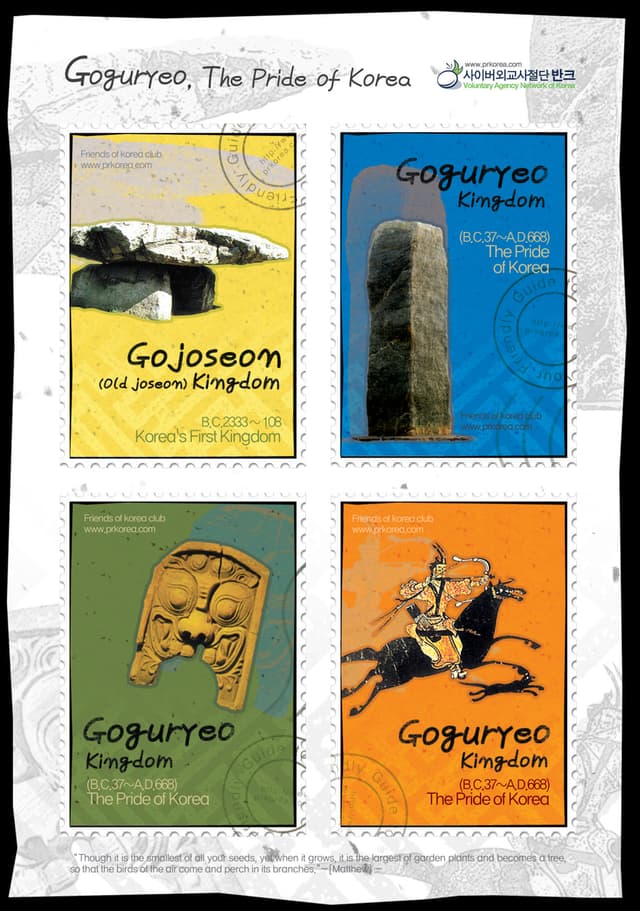
Gojoseon Kingdom 고조선 (2333-108 B.C.)
Gojoseon was the first country to be formed in Korea. Its patriarch, Dangun Wanggeom, established the kingdom in 2333 B.C. on the basis of a humanitarian ideal called Hongik Ingan, which is devotion to the welfare of humankind. Gojoseon first developed with the Liaoning district as its center and gradually rose as a center of the East.
Silla Kingdom 신라 (57 B.C. – A.D. 935 )
Silla was located in the southeastern part of the Korean peninsula. In its early days, Silla was the weakest of three kingdoms in existence, but later became powerful enough to unify them under its rule in 676. After unification, Silla traded vigorously with foreign countries. Jang Bogo established Cheonghaejin on Wando Island and swept the pirates from the seas and led the overseas trade of East Asia Sea.
Goguryeo Kingdom 고구려 (37 B.C. – A.D.668)
Goguryeo covered large parts of present-day Manchuria. The country was not only the most powerful and most aggressive kingdom of three kingdoms in existence (Baekje and Silla being the other two) but also one of the powerful kingdoms in Northeast Asia in the 5th century. King Gwanggaeto the Great (375-413), in particular, conquered the largest territory in the entire history of Korea.
Baekje Kingdom 백제 (18 B.C. – A.D. 660)
Baekje was located in the southwestern part of the Korean peninsula and was one of the most advanced nations at that time. Baekje had the closest communication with neighboring Japan and exerted great influence on various fields of Japanese culture, sending many craftsmen, artisans, tailors, tile makers, and scholars to that country.
Gaya Kingdom 가야 (42-562)
Gaya was a federation of several small states centered on the Nakdong River delta in the middle of the south coast. Bridging China, Korea and Japan, it played a leading role as an intermediary of trade and culture. Iron exported from Gaya achieved international acclaim in China and Japan.
Balhae Kingdom 발해 (698-926)
After the fall of Goguryeo, a man from Goguryeo, Dae Joyeong, formed an army of the Goguryeo and Malgal (a Tungusic tribe) people, and settled eventually near Jilin in Manchuria, and there founded Balhae. Balhae declared itself the successor to Goguryeo and soon regained control of most of the former Goguryeo territory.
Goryeo Dynasty 고려 (918-1392)
The Goryeo Dynasty was actively engaged in trade through an international port called ‘Byeokrando’ with neighboring countries like China and Japan as well as with the far away countries of Arabia. Jikji, the oldest metal printed book in the world, and the Goryeo celadon, the greatest cultural achievement of Goryeo, were produced during the Goryeo Dynasty.
Joseon Dynasty 조선 (1392-1910)
Joseon derives its name from the first kingdom of Korea. Joseon adopted Confucianism as its guiding principle, and this philosophy exerted much influence during the Joseon Dynasty. King Sejong the Great (1394-1450), the country’s finest king, is most respected person in Korean history. He invented Hangeul, the Korean alphabet, in 1443. He also invented a rain gauge, striking water clocks, and a sundial.
The Japanese Occupation Period 일제강점기 (1910-1945)
In the early 20th century, Korea was occupied by Japan. The country was exploited for the benefit of the Japanese Empire. The occupiers attempted to eradicate Korean culture and even forbade Koreans from speaking their own language. But the Koreans resisted continuously, both at home and abroad, until the surrender of Japan, which ended World War II.
The Republic of Korea 대한민국 (1948-Present)
After the painful Japanese Occupation Period, the Korean War (1950-53) broke out, and the Korean Peninsula was divided into South and North Korea. Korea has undergone vast social, economic, and political changes. But the country has grown into a vibrant part of the international community and proven itself a good host through the 1988 Seoul Olympics and 2002 FIFA World Cup Korea/Japan.
Now, Korea is one of the most connected countries in the world, carried by the rapid growth of its online and telecommunication sectors. With a reputation as one of the fastest growing economies, it is also setting international standards in related industries. Korea is actively working to develop into the hub of Asia, the gateway to Northeast Asia, and a loved country that shares friendship and dreams with people from all over the world.
더 보기 ▾