홍보물
거꾸로 세계지도 (2011)
Upside-Down World Map (2011)
한국어
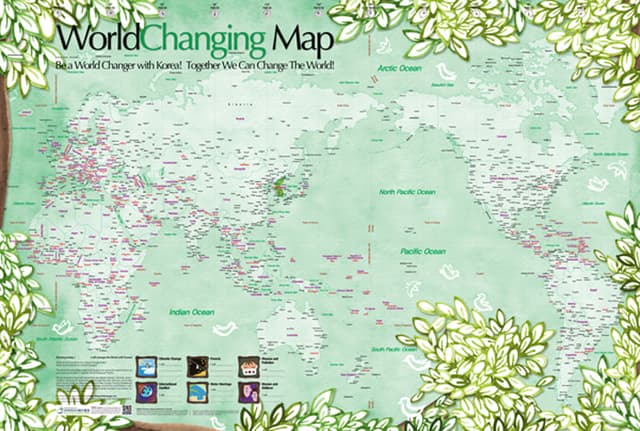
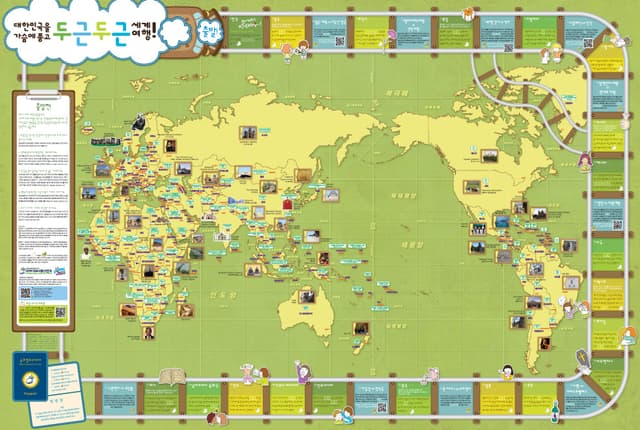
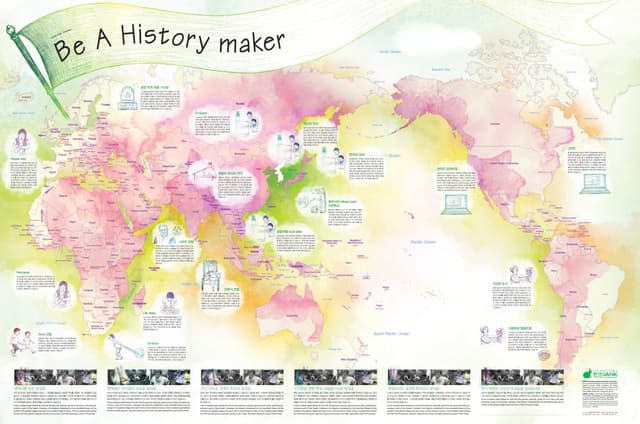
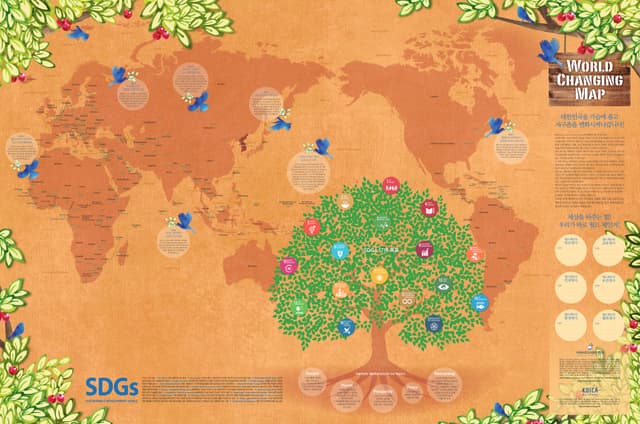
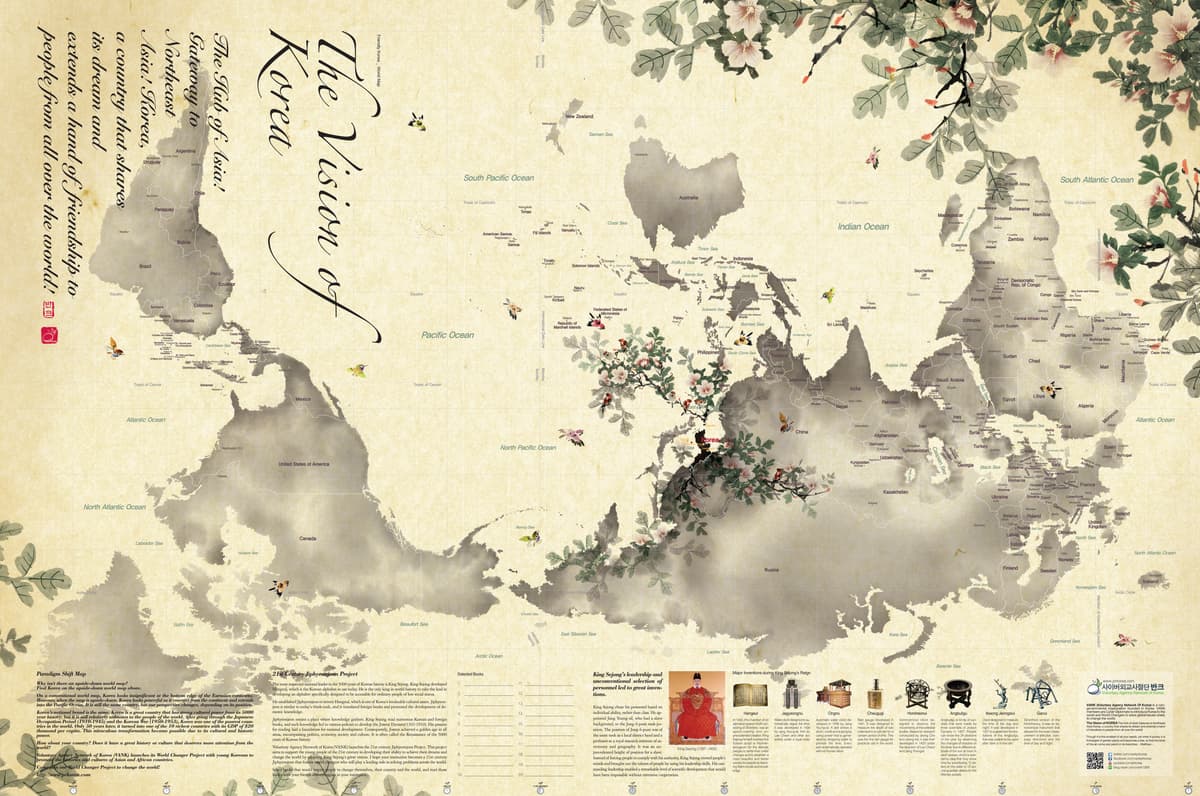
거꾸로세계지도는 세계의 변화와 성장을 위한 인식 전환을 제안하는 홍보물이다. 지도를 거꾸로 배치하고, 조선의 황금기를 이끈 세종대왕과 그의 싱크탱크였던 집현전을 소개하며, 독서를 통한 실천으로 세계인의 창조적 변화를 이끌어내고자 한다.
EnglishThis promotional material presents an upside-down world map to suggest a shift in perspective for global change and growth. By flipping the map, it introduces King Sejong the Great, who led Joseon's golden age, and Jiphyeonjeon, his think tank of scholars, encouraging people around the world to bring about creative change through reading.
자료 원고 · English
The Vision of Korea!
The Hub of Asia!
Gateway to Northeast Asia! Korea, a country that shares its dream and extends a hand of friendship to people from all over the world!
Paradigm Shift Map
Why isn’t there an upside-down world map?
Find Korea on the upside-down world map above.
On a conventional world map, Korea looks insignificant at the bottom edge of the Eurasian continent. However, when the map is upside-down, Korea looks powerful as it emerges from the continent and extends into the Pacific Ocean. It is still the same country, but our perspective changes, depending on its position.
Korea’s national brand is the same. Korea is a great country that has strong cultural power from its 5000 year history, but it is still relatively unknown to the people of the world. After going through the Japanese Occupation Period (1910-1945) and the Korean War (1950-1953), Korea was one of the poorest countries in the world. Only 50 years later, it turned into one of the 10 richest countries with its GDP of $20 thousand per capita. This miraculous transformation became possible due to its cultural and historic power.
How about your country? Does it have a great history or culture that deserves more attention from the world?
Voluntary Agency Network of Korea (VANK) launches its World Changer Project with young Koreans to promote the histories and cultures of Asian and African countries.
Come join our World Changer Project to change the world!
http://www.prkorea.com
21st Century Jiphyeonjeon Project
The most respected national leader in the 5000 years of Korean history is King Sejong. King Sejong developed Hangeul, which is the Korean alphabet in use today. He is the only king in world history to take the lead in developing an alphabet specifically designed to be accessible for ordinary people of low social status.
He established Jiphyeonjeon to invent Hangeul, which is one of Korea’s invaluable cultural assets. Jiphyeonjeon is similar to today’s think-tank, and it translated foreign books and promoted the development of domestic knowledge.
Jiphyeonjeon means a place where knowledge gathers. King Sejong read numerous Korean and foreign books, and such knowledge led to various policies to develop the Joseon Dynasty(1392-1910). His passion for reading laid a foundation for national development. Consequently, Joseon achieved a golden age in all areas, encompassing politics, economy, society and culture. It is often called the Renaissance of the 5000 years of Korean history.
Voluntary Agency Network of Korea (VANK) launches the 21st century Jiphyeonjeon Project. This project aims to support the young people of the 21st century in developing their ability to achieve their dreams and change the world by adopting King Sejong’s great visions. I hope your institution becomes a 21st century Jiphyeonjeon that fosters world changers who will play a leading role in solving problems across the world.
Select books that would inspire people to change themselves, their country and the world, and read those books with your friends and colleagues in your institution.
Selected Books
King Sejong’s leadership and unconventional selection of personnel led to great inventions.
King Sejong chose his personnel based on individual ability, rather than class. He appointed Jang Young-sil, who had a slave background, to the Jong 6-pum rank position. The position of Jong 6-pum was of the same rank as a local district head and a professor at a royal research institute of astronomy and geography. It was an unprecedented height of position for a slave. Instead of forcing people to comply with his authority, King Sejong moved people’s minds and brought out the talents of people by using his leadership skills. His outstanding leadership enabled a remarkable level of scientific development that would have been impossible without extensive cooperation.
Major Inventions during King Sejong’s Reign
Hangeul
In 1443, the invention of an alphabet system itself consisting of 28 letters, was an epoch-making and unprecedented creation. King Sejong himself invented the Korean script or Hunminjeongeum for the illiterate people to settle their unfair charges and to establish a more beautiful and better society for people by teaching them morals and knowledge.
Jagyeongnu
Water clock designed to automatically signal the time. It was developed in 1434 by Jang Young-sil, Kim Jo, Lee Cheon and other scientists under a royal order.
Ongnu
Automatic water clock developed in 1438 by Jang Young-sil. A doll strikes a drum, a bell and a gong by using power that is generated by dropping water to provide the time. Every part automatically operates without human labor.
Cheugugi
Rain gauge developed in 1441. It was designed to measure the depth of rain collected in a cylinder for a certain period of time. This was the first rain gauge for practical use in the world.
Honcheonui
Astronomical clock designed to observe the movements of the celestial bodies. Based on research conducted by Jeong Cho and Jeong Inji, it was then developed in 1433 under the direction of Lee Cheon and Jang Youngsil.
Angbuilgu
Angbuilgu is kinds of sundials that were made by three scientists of Joseon Dynasty in 1437. People can know the 24 divisions of the year by observing the changes of shadow on the lines due to different altitude of the sun at noon in each season. And it is wonderful idea that they show time by substituting 12 letters on the plate to 12 animal guardian deities for the illiterate people.
Ilseong Jeongsiui
Clock designed to measure the time of the day and night. It was developed in 1437 to supplement the limitations of the Angbuilgu that was unable to be used after dark or in the rain.
Ganui
Simplified version of the Honcheonui. It was an astronomical instrument that allowed for the exact measurement of altitudes, compass directions and the time of day and night.
더 보기 ▾