홍보물
인물 한국지도카드 (2012)
Historical Figures of Korea Map Cards (2012)
한국어
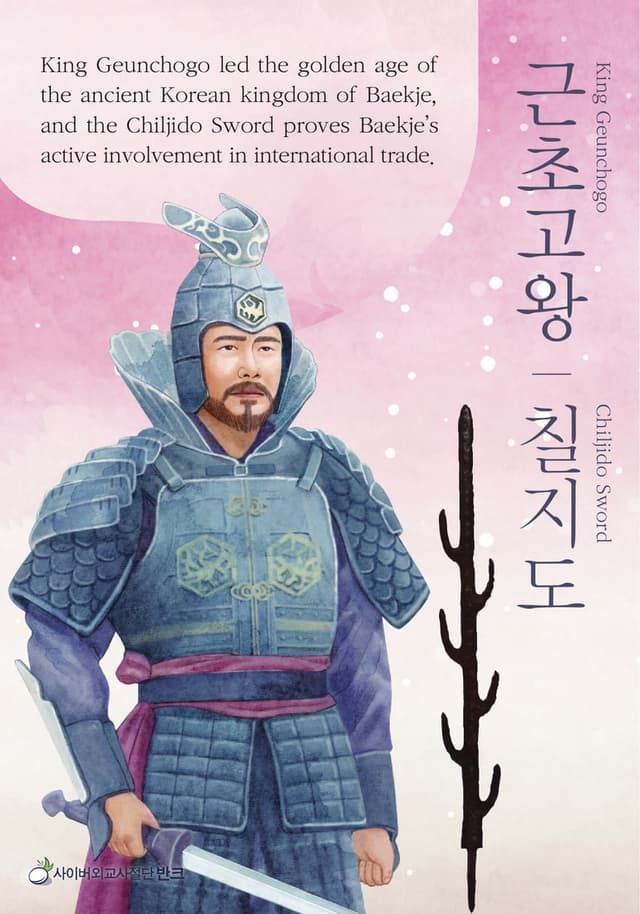
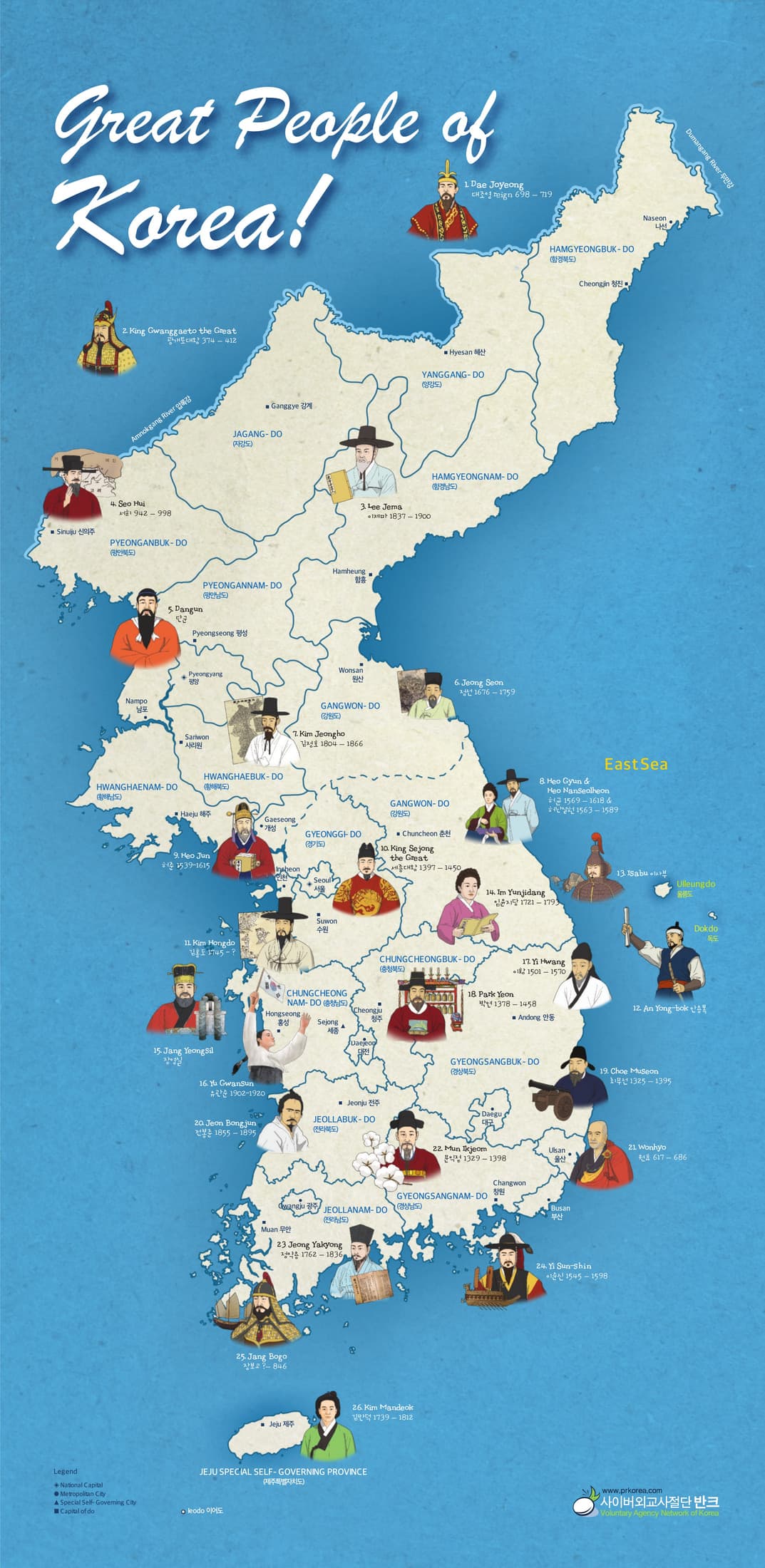
인물한국지도카드는 한국 역사 속 인물들을 한국지도와 함께 소개하는 홍보물이다. 한국의 위인 26명을 앞면에는 그림으로, 뒷면에는 간략한 설명으로 담았다. 발해를 세운 대조영, 한글을 만든 세종대왕, 독도를 지킨 민간외교가 안용복, 나눔을 실천한 김만덕 등 신분과 성별의 어려움을 극복하고 자취를 남긴 인물들을 소개한다.
EnglishThese promotional cards introduce historical figures of Korea alongside a map of Korea. They feature 26 great figures from Korean history, with an illustration on the front and a short description on the back. The cards introduce people who left their mark despite the challenges of status and gender, including Dae Joyeong, who founded Balhae; King Sejong the Great, who created Hangeul; An Yong-bok, a civilian diplomat who protected Dokdo; and Kim Man-deok, who practiced generous giving.
자료 원고 · English
Great People of Korea
1. 대조영 Dae Joyeong reign 698 – 719
Dae Joyeong was the founder of the Balhae kingdom. After the fall of Goguryeo kingdom, he gathered the refugees and some Malgal tribes and established Balhae. Upon its founding in 698, he proclaimed that it was the successor of Goguryeo, both domestically and internationally, and began to regain control over former Goguryeo territories.
2. 광개토대왕 King Gwanggaeto the Great 374 – 412
King Gwanggaeto was Goguryeo kingdom’s nineteenth king, who achieved political supremacy in 5 th century Northeast Asia. He used the name of his own reign for the first time in Korean history, and established a great empire that occupied the present-day Liaodong peninsula and a part of Inner Mongolia. A monument was built in honor of his distinguished achievements, and it still remains in Jian, China.
3. 이제마 Lee Jema 1837 – 1900
Lee Jema was a physician who created a unique Korean medical theory called “Sasanguihak”. This theory is based on Eastern philosophy, and its basic principle is that treatments should vary, depending on patients’ particular constitutions. He spent his entire life studying medicine, and established his own medical theory based on extensive clinical data.
4. 서희 Seo Hui 942 – 998
Seo Hui was a diplomat of the Goryeo dynasty. He is best known for his role in a negotiation in 993 where he persuaded the invading Khitan army to retreat by arguing for the legitimacy of Goryeo as the successor of the Goguryeo kingdom. Through the negotiation, he also regained control over the Pyeonganbukdo area. For this reason, his actions are regarded as the most successful example of diplomacy in Korean history.
5. 단군 Dangun
Dangun was the founder of the first Korean kingdom of Gojoseon in 2333 BC. Korea’s first history book about its ancient kingdoms, Samgukyusa, contains a story about his founding of the nation and his basic principle of Hongik Ingan. The principle means to promote the benefit of humanity, and it forms the basis of the strong Korean national identity that has functioned to unite Koreans on occasions of national crisis.
6. 정선 Jeongseon 1676 – 1759
Jeongseon was a painter who developed a unique Korean style of landscape painting during the late Joseon dynasty. He portrayed Joseon’s scenery with his own creative touches, breaking off from the strong influence of China. His major painting “Geumgangjeondo” provided great inspiration for other painters in their drawings of Mt. Geumgangsan.
7. 김정호 Kim Jeongho 1804 – 1866
Kim Jeongho was a geographer who made many maps during the late Joseon dynasty. “Daedongyeojido” in particular is a masterpiece that he created by integrating Eastern cartographic traditions. The map is very accurate and precise, even compared to contemporary maps.
8. 허균 Heo Gyun 1569 – 1618 | 허난설헌 Heo Nanseolheon 1563 – 1589
Heo Gyun and Heo Nanseolheon were famous sibling writers during the Joseon dynasty. Heo Gyun authored the first Korean language novel, “The Tale of Hong Gildong”. His sister Nanseolheon wrote many poems that were highly commended by writers in Korea, China and Japan. Her accomplishments as a poet are particularly noteworthy, considering the social status of women during her time.
9. 허준 Heo Jun 1539 – 1615
Heo Jun was a doctor during Joseon who wrote “Donguibogam”, the first medical book for commoners. For 14 years, he researched hundreds of medical books and included a list of common names of medicinal herbs that were readily accessible to ordinary Koreans. This book was published in over 30 editions abroad, including in China and Japan.
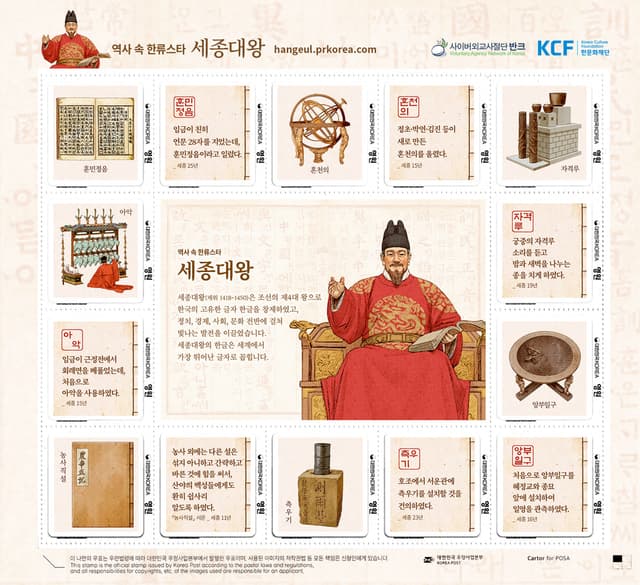
10. 세종대왕 King Sejong the Great 1397 – 1450
King Sejong was the fourth king of Joseon dynasty, who is best known for the invention of the Korean alphabet Hangeul. Hangeul is the only alphabet in the world in which the inventor, principles of invention and dates of promulgation are known. During his reign, he made many impressive accomplishments in all areas, including politics, economics, culture and defense. The basis of his rule was always his love and sympathy for ordinary people.
11. 김홍도 Kim Hongdo 1745 – ?
Kim Hongdo was a famous court painter during the Joseon dynasty. He exhibited exceptional artistic talent since his childhood. His drawings were quite varied, ranging from people, scenery, gods and Buddhist subjects. He created many different kinds of artistic work, including king’s portraits and folk paintings. His genre paintings in particular are well known for their realistic depiction of ordinary people’s lives, and are still loved by Koreans.
12. 안용복 An Yong-bok
An Yong-bok was a fisherman and citizen diplomat who defended a territory of Joseon under the reign of King Sukjong (1661-1720). He visited Japan twice, in 1693 and in 1696, to clarify Joseon’s sovereignty over Ulleungdo and Dokdo. Dokdo in the East Sea is the most meaningful territory to the Korean people.
13. 이사부 Isabu
Isabu was a renowned general of Silla kingdom, who is widely known for his conquest and annexation of Usanguk for Silla in 512. Usan-guk was a small kingdom that occupied the present-day Ulleungdo and Dokdo. He also advised the king to compile history books, and made a major contribution to Silla’s territorial expansion.
14. 임윤지당 Im Yunjidang 1721 – 1793
Im Yunjidang was a female scholar, who achieved a high level of knowledge in Neo-Confucianism during the Joseon dynasty. Joseon put limitations on women’s rights to gain formal education and to work outside the home. For this reason, she was unable to exhibit her academic talent in Joseon society, but she still pursued her scholarly interests until her death.
15. 장영실 Jang Yeong-sil
Jang Yeong-sil was a genius engineer during Joseon. He was born a slave but was brought to the royal palace due to his extraordinary talent. He invented Korea’s first self-striking water clock called Jagyeongnu in 1434 and also many other scientific instruments, including Joseon’s first astronomical observatory Ganuidae.
16. 유관순 Yu Gwan-sun 1902-1920
Yu Gwan-sun was a Korean freedom fighter. Yu, then a student, participated in the historic March 1 st Independence movement in Seoul and later led the movement in her hometown of Cheonan. She was arrested and tortured to death at the age of 18.
17. 이황 Yi Hwang 1501 – 1570
Yi Hwang was an eminent scholar, who laid the foundation for the development of Neo-Confucianism in Joseon dynasty. He committed his entire life to developing knowledge and educating students. Consequently, he was highly respected as a sage. His philosophy had a significant influence on scholars both inside and outside of Korea, including China and Japan.
18. 박연 Park Yeon 1378 – 1458
Park Yeon is regarded as one of the three greatest musicians in Korea’s 5000 years of history, along with Goguryeo kingdom’s Wang Sanak and Silla kingdom’s Ureuk. Under the order of King Sejong the Great, he organized court music, tuned musical instruments, and compiled music for royal events.
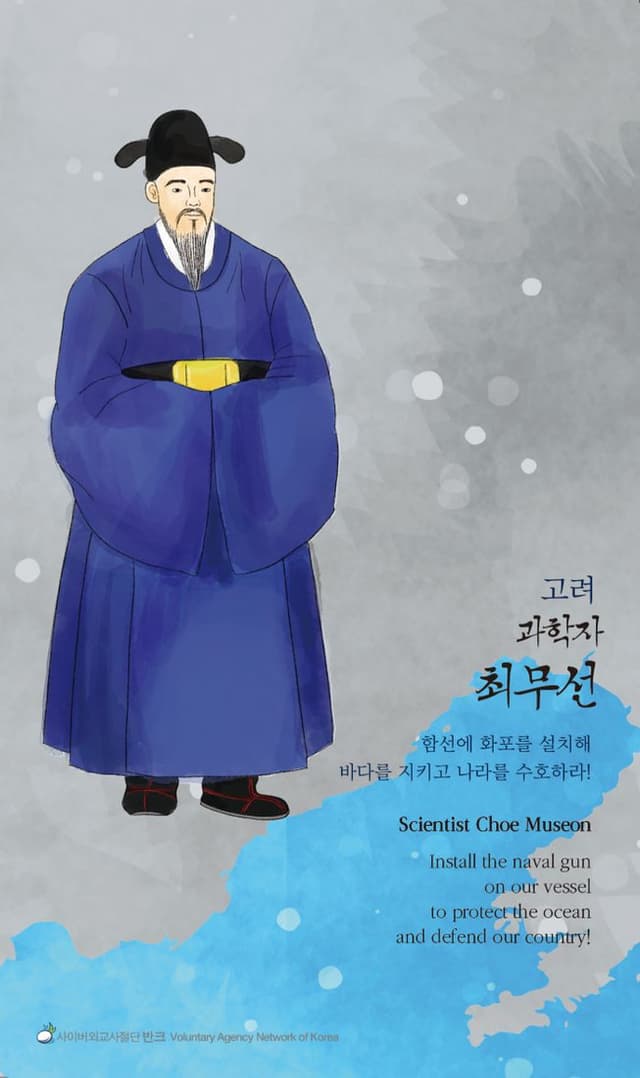
19. 최무선 Choe Museon 1325 – 1395
Choe Museon was an inventor best known for the production of Korea’s first gunpowder and cannons. During the Goryeo dynasty, he had already recognized the importance of gunpowder weapons, and suggested the establishment of a state institution committed to producing them. His inventions played a crucial role in defeating Japanese raiders.
20. 전봉준 Jeon Bongjun 1855 – 1895
Jeon Bongjun was a leader of the Donghak Peasant Movement, which was a large-scale resistance movement against traditional feudalism and foreign invasions. His first uprising was in 1894 against corrupt local bureaucrats. He also led a nationwide protest against Japanese invasions until his eventual arrest and execution.
21. 원효 Wonhyo 617 – 686
Wonhyo was a respected Buddhist monk of Silla kingdom, who made a great contribution to the development of Korean Buddhism. Buddhism is a religion that has long influenced the life and thoughts of Koreans. He created extensive written work about Buddhism, and committed his life to disseminating the religion among the people.
22. 문익점 Mun Ikjeom 1329 – 1398
Mun Ikjeom is recognized as “a person who improved people’s lives” because he brought great benefits to people by cultivating and distributing cotton. The introduction of cotton cloth made fabric production simpler and more efficient. The previous methods of fabric production were time-consuming and labor-intensive. Due to its high production efficiency, cotton cloth became Korea’s major export, and contributed to the national economy.
23. 정약용 Jeong Yakyong 1762 – 1836
Jeong Yakyong, also known by his pen-name Dasan, was a prominent Confucian scholar and official during the late Joseon dynasty. He is highly recognized for his contribution to compiling Silhak literature, which emphasized practical learning and social reform. He spent many years living in exile, but he used the time to organize and develop his philosophy. He wrote over 500 books in broad areas, including politics, economics and society.
24. 이순신 Admiral Yi Sun-sin 1545 – 1598
Admiral Yi Sun-sin was an admiral and Korean national hero, who protected the country against Japanese invaders during the national crisis of the Imjin War. Throughout his career, he had to overcome extreme adversities in battles and personal challenges, such as vicious slanders against him and subsequent political ordeals. His life provides an endless source for Korean novels, dramas and movies, and he has become immortal in the minds of Koreans.
25. 장보고 Jang Bogo ?– 846
Jang Bogo was a general of Silla kingdom, who established the Cheonghaejin naval base in today’s Wondo Island. Using Cheonghaejin, he was able to defeat pirates, gain control of the ocean, and secure safe trade routes that connected Silla with China and Japan.
26. 김만덕 Kim Mandeok 1739 – 1812
Kim Mandeok was a successful and altruistic businesswoman in Jejudo Island, who saved numerous people’s lives during the Joseon dynasty. As a woman and a slave, she had to overcome many disadvantages before finally becoming a great merchant. However, she decided to spend her entire fortune to save people from a famine caused by an extreme drought in 1795.
더 보기 ▾