홍보물
 1
1 2
2 3
3 4
4 5
5 6
6 7
7 8
8 9
9 10
10 11
11 12
12한국인물유산엽서 (2018)
Postcards of Korean Historical Figures and Heritage (2018)
한국어
한국인물·유산 엽서세트는 오천 년 한국 역사 속 인물 12명과 그와 관련된 유산을 소개하는 자료다. 앞면에는 인물과 유산의 모습, 뒷면에는 영문 설명을 실어, 신분과 계층을 넘어 자신만의 재능으로 역사에 자취를 남긴 한국의 영웅들을 소개한다.
EnglishThis postcard set introduces 12 figures from Korea's 5,000-year history, along with the heritage connected to each of them. Each card shows the figure and related heritage on the front, with an English description on the back. Together, they tell the stories of Korean heroes who left their mark on history through their own talents, no matter their social status.
자료 원고 · English
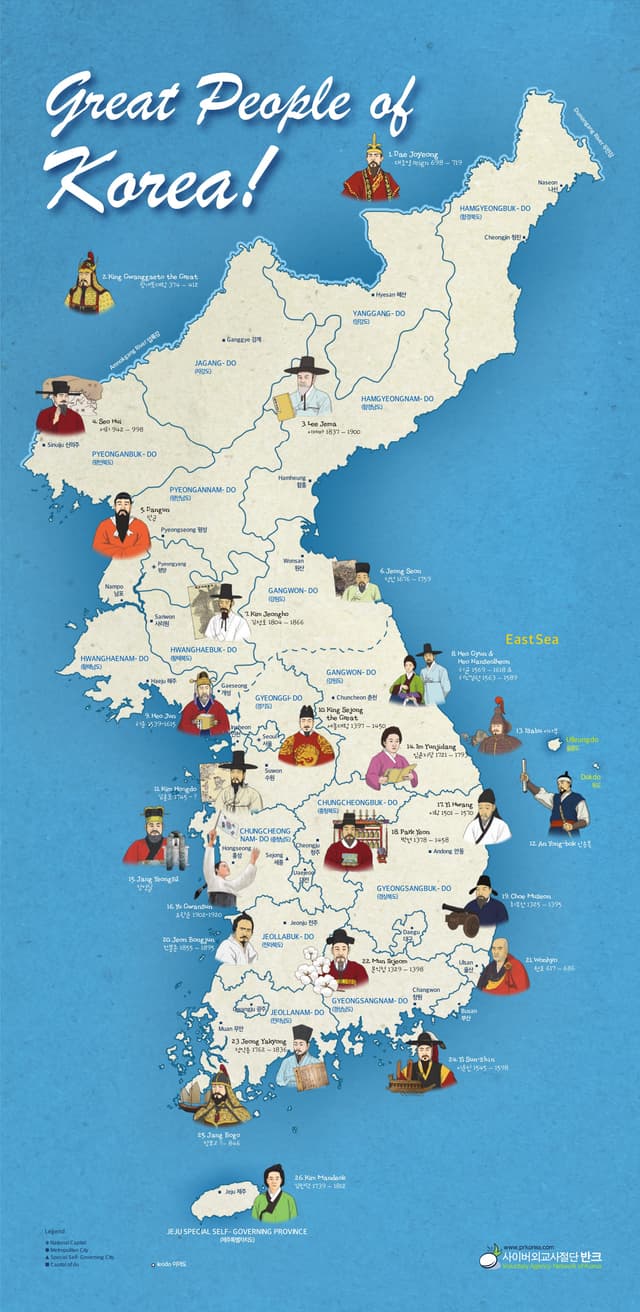
Stories of Beloved Heroic Figures in Korean History
Korea has 5000 years of history. In this long history, there are many heroes that are still respected by the Korean people today. Some are kings who led the golden age of their kingdoms. However, not all heroes were in the high class. There were an inventor and a doctor who struggled due to their low-class status despite their extraordinary talents. There were also a scientist, an admiral, and a painter who challenged existing knowledge. There were many great Koreans who came from humble backgrounds but changed history by overcoming challenges with their great ambition.
Voluntary Agency Network of Korea (VANK) has launched a project to discover Korean heroes from Korean history and promote their accomplishments to the world. We hope their stories give you the inspiration to take on challenges. Also, find heroes from your country’s history and introduce their stories to the world. Our efforts will shed new light on the inspiring stories of many heroes from world history. Friends from all around the world, join our great journey to make a difference!
◎ King Geunchogo and Chiljido Sword
King Geunchogo led the golden age of the ancient Korean kingdom of Baekje, and the Chiljido Sword proves Baekje’s active involvement in international trade.
King Geunchogo (Reign: 346 - 375) was the 13th ruler of the ancient Korean kingdom of Baekje (18 BC - AD 660). He led the golden age of Baekje. He expanded its capital and enriched the kingdom culturally and economically by leading military campaigns, engaging in maritime trade, and publishing history books. According to Chinese records, King Geunchogo expanded its territory to include the Liaoxi area in Northeast China. Baekje and Japan had a reciprocal relationship. Baekje passed advanced culture to Japan while Japan sent mercenaries to Baekje. Their relationship is evidenced by the Chiljido or Seven-branched sword. Designated as a Japanese national treasure and housed in Japan’s Isonokami Shrine, the sword was given as a gift to a Japanese king from Baekje’s king in 369. This 74.9cm-long sword is engraved with characters in gold, and the sword itself shows Baekje’s advanced iron-working skills.
“Baekje’s King ordered that this sword be made for Shi, King of Japan. The sword shall be passed down through the generations.” – From the Inscription on the Chiljido Sword
◎ King Gwanggaeto the Great and Gwanggaeto Monument
King Gwanggaeto conquered the largest territory in Korean history, and his accomplishments were carved in stone on the Gwanggaeto Monument.
King Gwanggaeto the Great (374 - 412) was the 19th ruler of the ancient Korean kingdom of Goguryeo (37 BC - AD 668). He was the most successful conqueror in Korean history. Armed with a strong ironclad cavalry, Goguryeo conquered the northern Korean peninsula and a large portion of northeastern China. Gwanggaeto was the most respected king of Goguryeo who adopted an independent era name and occupied the largest territory in Korean history. His accomplishments are well-documented on the Gwanggaeto Monument. The monument was erected after his death by his son. Located in Jian in China’s Jilin Province, the monument is a 6.39-meter-tall stele engraved with 1,775 characters on its four sides.
“King’s grace reached heaven and his power reached the whole world.” – From the Inscription on the Gwanggaeto Monument
◎ Queen Seondeok and Cheomseongdae Observatory
Queen Seondeok was the first Korean queen, and Cheomseongdae, the world’s oldest extant astronomical observatory, was built during her reign.
Queen Seondeok (Reign: 632 - 647) was the 27th ruler of the ancient Korean kingdom of Silla (57 BC - AD 935) and the first woman to rise to the throne in Korean history. Being a woman, she had to fight many stereotypes and confronted with revolts and attacks from Baekje and Goguryeo. She overcame all the challenges and laid the foundation for Silla to unify the three kingdoms. She is described as a wise queen in Korean history books. Cheomseongdae is the oldest extant astronomical observatory, built during her reign. This 9.5-meter-tall observatory remains in Silla’s capital, Gyeongju. It is assumed that the observatory was used to observe stars and astronomical events for the prediction of the kingdom’s fate.
“Servants were moved by the queen’s excellent wisdom.” – Excerpt from 『Samgukyusa』 (Memorabilia of the Three Kingdoms)
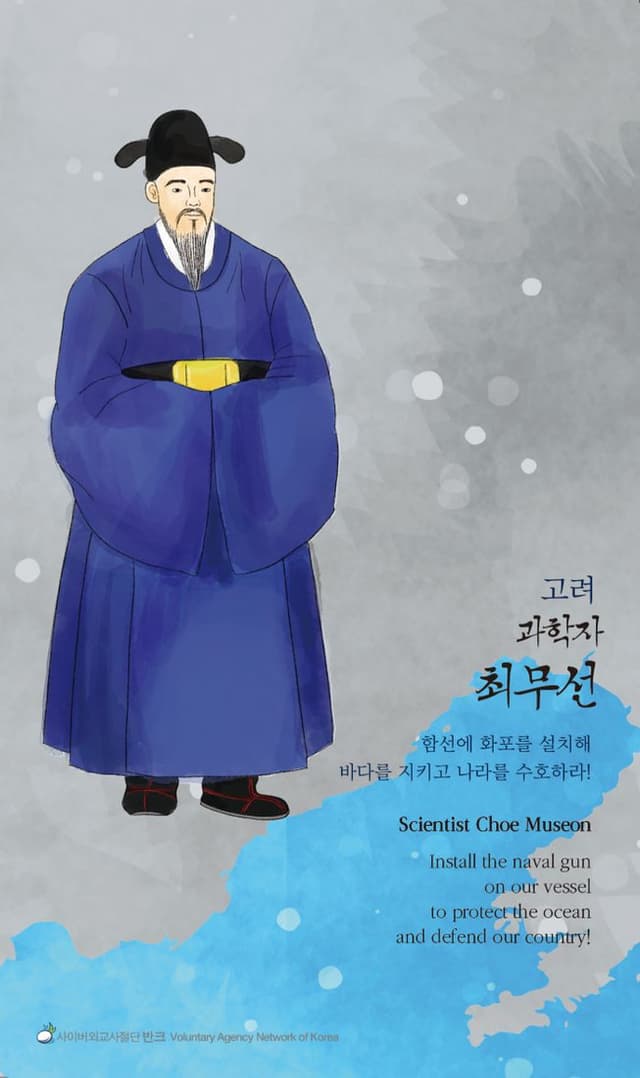
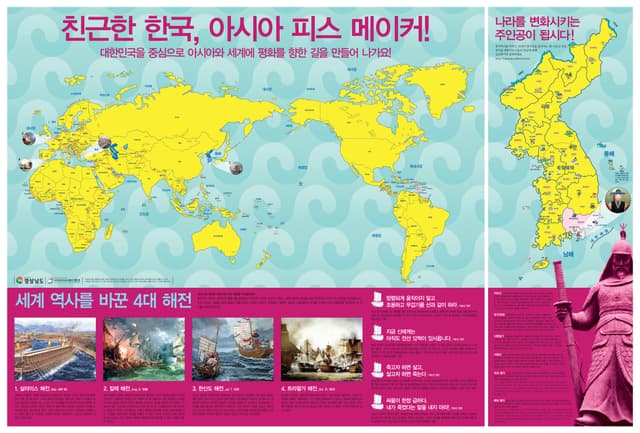
◎ Choe Museon and Naval Gun
Choe Museon invented the first Korean domestic gunpowder, and throughout Korean history, his naval gun defended the Korean people.
Choe Museon (1325 – 1395) was a military commander during Goryeo (918 - 1392) who produced the first domestic gunpower in Korean history. In recognition of the importance of gunpowder, Choe produced gun powders and cannons by learning the necessary techniques and persuading the government to establish a firearms production office. Goryeo produced more than 20 kinds of firearms. Choe’s cannons played a crucial role in defeating hundreds of Japanese vessels in the Jinpo Naval Battle in 1380. The Jinpo Naval Battle was the first naval gun battle, over 190 years earlier than the Battle of Lepanto (1571), the first naval gun battle in the West. Goryeo’s firearm-production techniques were passed down to Joseon (1392 - 1910) and contributed to defeating Japan during the Imjin War (1592 - 1598).
“Choe took great effort to get information about gunpowder from Lee Yuan. His loyalty to the country deserves great respect.” – Excerpt from 『Hwayakgogi』 (Records of Firearms)
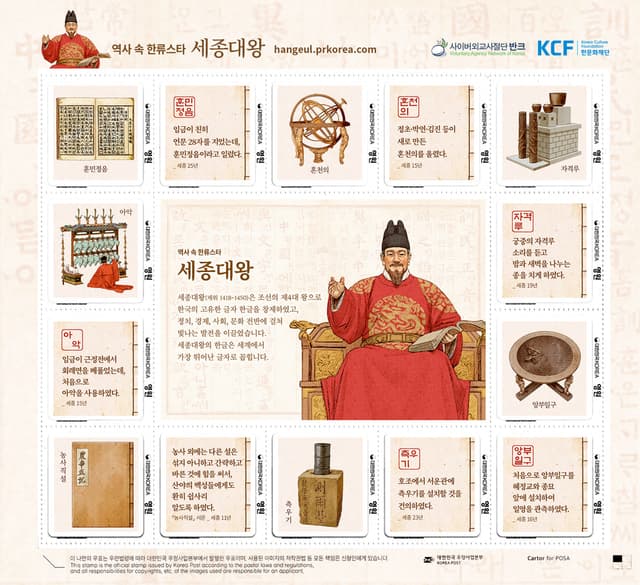
◎ King Sejong the Great and Hangeul
King Sejong invented the Korean alphabet Hangeul, and Hangeul is considered the world’s most scientific alphabet.
King Sejong the Great (1397 - 1450) was the 4th ruler of Joseon (1392 - 1910), who is best known for inventing the Korean alphabet of Hangeul. His reign (1418 – 1450) was one of the most prosperous periods in Korea’s 5000 years of history. During his reign, Joseon made significant accomplishments in all areas of politics, economy, society, culture, and national defense. The invention of Hangeul in particular made a lasting impact on the Korean society. He created Hangeul in 1443 to help commoners express their thoughts and feelings in writing. Creating an alphabet specifically designed to benefit commoners was unprecedented in history. Hangeul is regarded as one of the best alphabets for being logical, scientific, and easy-to-learn. Its inventor and the date, purpose, and principles of invention are clearly stated in the Hunminjeongum Manuscript.
“The Korean language is different from Chinese, and it is not properly expressed in Chinese characters. For this reason, our people have difficulty expressing their thoughts and feelings in writing. I sympathize with them, and thus I created 28 letters in the hope that everyone can learn and use them easily every day.” – Preface to 『Hunminjeongeum』
◎ Jang Yeong-sil and Jagyeongnu Water Clock
Jang Yeong-sil was the greatest inventor in Korean history, and his invention Jagyeongnu is considered the best water clock of the time.
Jang Yeong-sil was a genius engineer during Joseon (1392 – 1910). He was born a slave but was brought to the royal palace due to his extraordinary talent. In recognition of his talent, King Sejong the Great (1397 - 1450) supported his career development. The king sent Jang to China in 1421 to study astronomical instruments. Despite his class, Jang was given an official position and tasked with developing scientific instruments. On the king’s command, he invented Korea’s first self-striking water clock called Jagyeongnu in 1434. He also invented many other scientific instruments, including Joseon’s first astronomical observatory Ganuidae and various astronomical tools, sundials, and copper types.
“Jang Yeong-sil is a man born for our time.” – Excerpt from 『Pilwonjapgi』 by Seo Geojeong
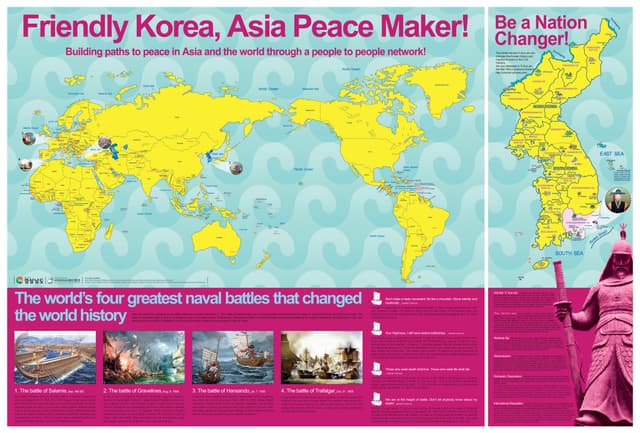
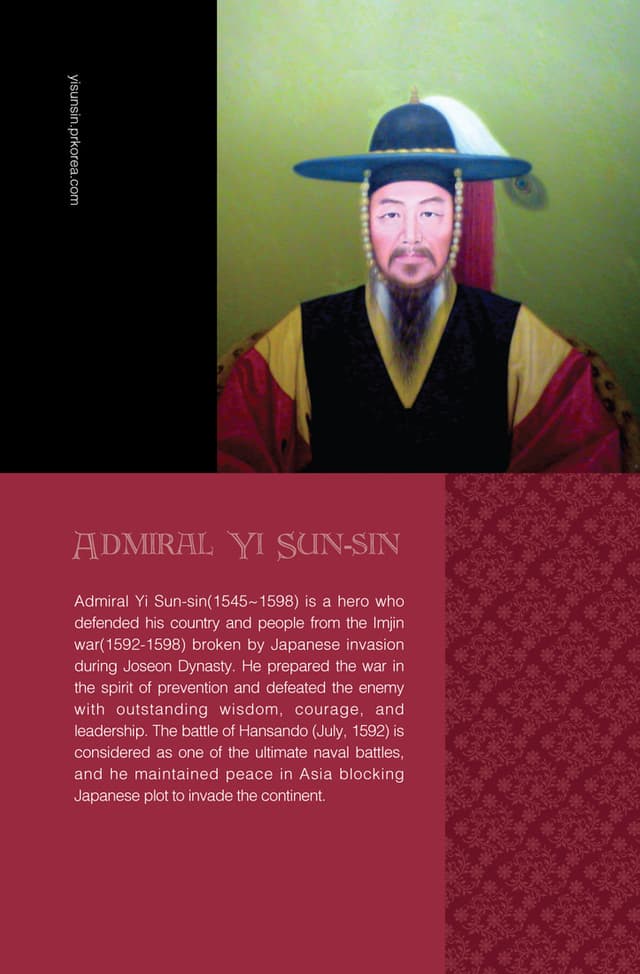
◎ Admiral Yi Sun-sin and Geobukseon
Admiral Yi Sun-sin was a naval commander who saved the country from a national crisis with a revolutionary warship - the turtle ship or Geobukseon in Korean.
Admiral Yi Sun-sin (1545-1598) was a naval commander during Joseon (1392-1910), who defended the country from Japan. Japan invaded Joseon twice with large forces from 1592 to 1598. Yi led victories in all naval battles against the Japanese forces. He built a turtle-shaped battleship called Geobukseon in preparation for the battles. Its deck was covered with metal spikes to shield itself while being able to strike the enemy with arrows and cannonballs. His grit and thorough preparation made him an unbeatable commander. His statue stands in the middle of Gwanghwamun Square in the South Korean capital of Seoul.
“If you risk your life, you shall live. If you try to save your life, you shall die.” – Admiral Yi Sun-sin
◎ Heo Jun and Donguibogam
Heo Jun was the best royal physician of Joseon, who wrote Donguibogam, the first medical book written for commoners.
Heo Jun (1539 – 1615) was a doctor during Joseon (1392 – 1910) who wrote Donguibogam, the first medical book for commoners. Heo wrote many medical books using his 30 years of experience as a royal physician and his clinical experiments, contributing to the development of Eastern medicine. Published in 1613, Donguibogam is his most-recognized work that compiled 2000 years of Eastern medical knowledge. For 14 years, he researched hundreds of medical books and included a list of common names of medicinal herbs that were readily accessible to ordinary Koreans. This book was published in over 30 editions abroad, including in China and Japan, and it is still read by medical students today.
He is the man who created a treasure (Donguibogam) for the world. – Chinese evaluation of Heo Jun
◎ An Yong-bok and Dokdo
An Yong-bok is a citizen diplomat, who defended the Korean islands of Ulleungdo and Dokdo, and Dokdo is the most meaningful island to Koreans.
An Yong-bok was a fisherman and citizen diplomat who defended a territory of Joseon (1392 – 1910) under the reign of King Sukjong (1661-1720). He visited Japan twice, in 1693 and in 1696, to clarify Joseon’s sovereignty over Ulleungdo and Dokdo. Dokdo in the East Sea is the most meaningful territory to the Korean people. Because Dokdo was the first Korean territory to fall victim to Japanese imperialism in the early 20th century. It was returned to Korea when Korea regained its independence. For Koreans, Dokdo signifies Korea’s full independence and sovereignty.
“Ulleungdo and Dokdo belong to Gangwondo, Joseon.” – Japanese memorandum on the Arrival of a Boat from Joseon in 1696
◎ Jeongseon and Geumgangjeondo Painting
Jeongseon was a painter, who invented a new landscape painting style in Joseon, and Geumgangjeondo is one of his most well-known masterpieces.
Jeongseon (1676-1759) was a painter during Joseon (1392 – 1910) who started a new tradition of true-view landscape painting, known as Jingyeong Sansuhwa. Painters at the time drew landscapes through their imagination. Breaking away from this tradition, Jeong visited real locations and drew what he actually saw. His painting of Mt. Geumgang called Geumgangjeondo (Korean National Treasure #217) is one of his most-known paintings. He visited Mt. Geumgang several times and created many paintings of the mountain because it had long been known as a beautiful mountain. Geumgangjeondo depicts the mountain from a high-angle view with strong brush strokes.
“My painting will give a better view of Mt. Geumgang than the view you will get on your feet.” – Jeongseon’s remark on Geumgangjeondo
◎ Yu Gwan-sun and The March 1st Independence Movement
Yu Gwangsun was a Korean freedom fighter, who participated in the historic March 1st Independence Movement, which demanded independence from Imperial Japan.
Yu Gwan-sun (1902 -1920) was a Korean freedom fighter. After Japan forcibly took control of Korea in 1910, Koreans started a nationwide independence movement on March 1, 1919, against Imperial Japan. Yu, then a student, participated in the movement in Seoul and later led the movement in her hometown of Cheonan. She was arrested and tortured to death at the age of 18. More than two million Koreans participated in the March 1st Independence movement across the country. Koreans’ strong will to regain independence, shown in the movement, surprised the world and influenced independence movements around the world and influenced anti-imperialism movements around the world, such as China’s May Fourth Movement.
“We herewith proclaim the independence of Korea and the liberty of the Korean people. “– Excerpt from Proclamation of Korean Independence
◎ Park Byeongseon and Jikji
Park Byeongseon was a Korean historian, who discovered Jikji, the world’s oldest extant book printed with movable metal type, proving Korea’s advanced printing technology.
Park Byeongseon (1927 - 2011) is a Korean historian. She found Jikji Simche Yojeol (Jikji for short) from the Goryeo era (918 - 1392), the world’s oldest extant book printed with movable metal type, and the Owegyujanggak Uigwe, a collection of royal protocols of Joseon. Both assets are inscribed on the UNESCO Memory of the World Register. Park was born during Japanese occupation (1910-1945) and went to France in 1955 to study. While she was working at the National Library of France, she introduced Jikji to the public at a 1972 book fair in Paris. Jikji is a Buddhist document that was printed at Heungdeok Temple in Cheongju in 1377. Park and Cheongju Early Printing Museum helped Jikji to achieve its status as a UNESCO Memory of the World asset. Park is called the Mother of Jikji for her dedication to finding and promoting Jikji.
“Now we need to have the courage to give the honor for inventing movable metal type to its legitimate holder, Asian (Korean).” - Louis Duche (Reporter of TF1, biggest private channel in France), introducing Jikji at the Paris book fair in 1972
더 보기 ▾