홍보물
 1
1 2
2 3
3 4
4 5
5 6
6 7
7 8
8 9
9 10
10 11
11 12
12해양영웅 엽서세트 (2020)
Maritime Heroes Postcard Set (2020)
한국어
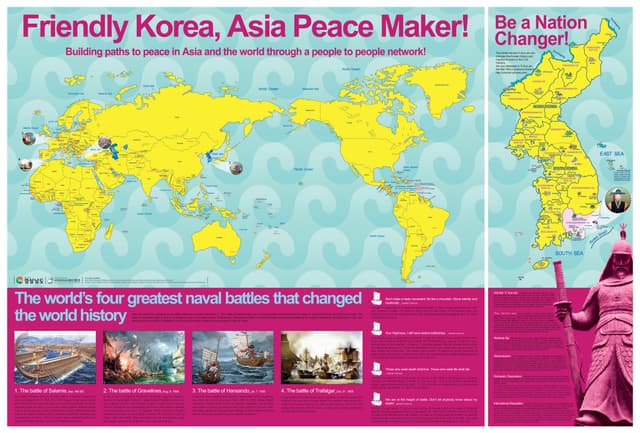
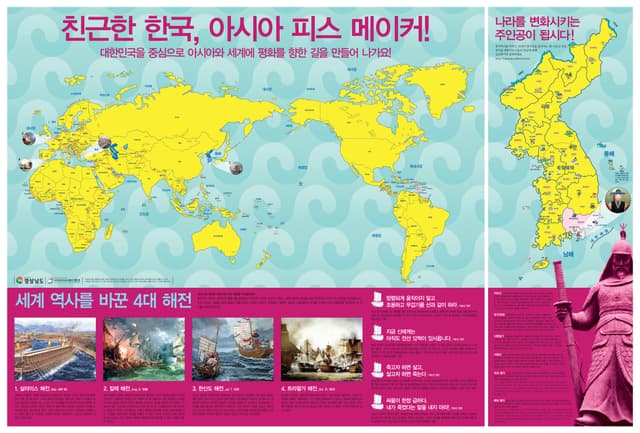
해양영웅 엽서세트는 바닷길을 개척하며 한국 역사를 만들어온 해양영웅 12명을 연대순으로 소개하는 홍보물이다. 백제와 중국·일본을 잇는 바닷길을 연 근초고왕을 비롯해, 바다를 무대로 도전한 인물들의 이야기를 담았다.
EnglishThis postcard set introduces 12 maritime heroes who shaped Korean history by pioneering sea routes, presented in chronological order. It features King Geunchogo, who opened the sea route linking Baekje with China and Japan, along with other figures who took on challenges at sea.
자료 원고 · English
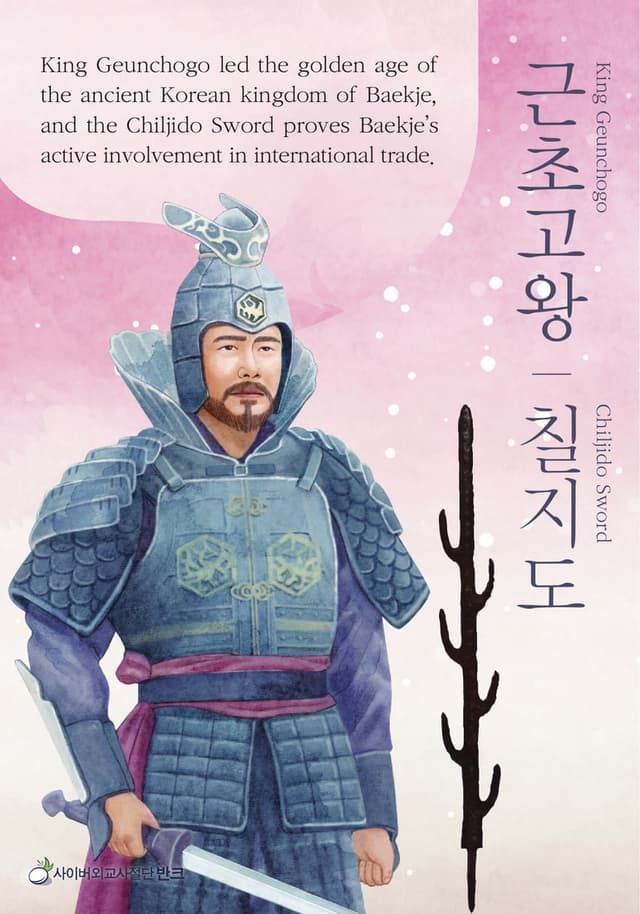
King Geunchogo
Baekje is the central oceanic civilization of Northeast Asia!
Pioneer a new sea route that connects the Korean Peninsula, China, and Japan!
King Geunchogo(r. 346~375) | 근초고왕
In ancient Korean history, there was a king who had a large influence on China and Japan. It was King Geunchogo, the thirteenth king of Baekje, who used the ocean to expand its economic and cultural influence across the region. Several Chinese and Japanese history books describe how Baekje influenced their kingdoms with its naval forces and advanced navigation during King Geunchogo’s reign. For example, the Book of Song, written in 488 by Chinese historian Shen Yue, wrote, “Baekje conquered and ruled China’s Liaoxi region and named it Jinping-jun Jinping-xian.”
There are also Japanese records that state that the Seven-Branched Sword, Japan’s national treasure, was a gift from Baekje and that the Japanese king was marveled by its exquisite craftmanship. This 75cm-long iron sword with seven branch-like prongs shows Baekje’s masterful metal craftsmanship. King Geunchogo achieved Baekje’s cultural and economic prosperity and expanded its influence to China’s Liaoxi and Shandong regions and to Japan by venturing across the ocean and building diplomatic relationships. King Geunchogo was an adventurous king, who established sea routes to connect the continent to the ocean and left lasting legacies across China and Japan.
King Gwanggaeto the Great
Achieve our dreams across the ocean in all the countries around the world!
King Gwanggaeto the Great(r. 391~412) | 광개토대왕
There was a Korean king who shared the same ambition and genius as Alexander the Great, who built the largest empire in the ancient world with shrewd military and diplomatic tactics. It was King Gwanggaeto the Great of Goguryeo. King Gwanggaeto, the nineteenth king of Goguryeo, expanded Korea’s territory to its largest extent during his 21 years of reign from his ascension to the throne at age 18 until his death at age 39. His adventurous ambition and accomplishments are inscribed on his epitaph. The epitaph reads, “The king’s grace reached the sky and his greatness spread across the world.” As he swept away outlaws, the people could safely focus on their livelihood. The kingdom became richer, and the people enjoyed good harvests.
King Gwanggaeto led a naval force of 40,000 soldiers to conquer Baekje. He understood the importance of the ocean and used it to his advantage. The Gwanggaeto Stele’s epitaph reads, “In the sixth year of King Gwanggaeto (396), the king himself led the naval force and attacked and captured Baekje’s capital.” By using Goguryeo’s geographical advantage that connects the continent to the ocean, King Gwanggaeto made Goguryeo the most powerful kingdom in Korea’s 5,000 years of history across all areas, including military, diplomacy, trade, and culture. The Goguryeo people perceived Goguryeo as the center of the world and their king as a son of heaven and built the largest Korean kingdom.
Isabu
Pioneer the marine territory in advance and broaden the dream of Silla!
Isabu | 이사부 장군
Isabu was a military general and politician of Silla who acquired Silla’s first maritime territory in 512 by subjugating the Usan Kingdom, today’s Ulleungdo in the East Sea. Isabu was a bona-fide military man, who rose to a general’s rank in his teens and fought on the battlefield until his late 70s. As the head of the military for 22 years, he contributed to Silla’s unification of the three kingdoms and its millennial prosperity, which made a permanent mark in world history. An old Korean history book series titled Samguk Sagi includes a heroic story about Isabu conquering the Usan Kingdom without a fight.
The Usan Kingdom ruled today’s Ulleungdo, Dokdo, and the East Sea that surrounds these islands. Isabu carried many wooden lion sculptures on deck to Usan. Upon arrival, he shouted, “Surrender now! If not, we will release these beasts and kill you all.” Frightened by the sight of the strange beasts, the Usan people lost their fighting spirit and surrendered. Thanks to Isabu’s wisdom, Silla effortlessly annexed the Usan Kingdom and strengthened its naval defense against Japan by taking control of the sea. Today’s Koreans call Isabu “the king of the East Sea” for his pioneering venture into the ocean and opening boundless new possibilities.
King Munmu the Great
Even if I perish, I will be the dragon of the East Sea to protect Silla!
King Munmu the Great(r. 661~681) | 문무대왕
An old Korean history book series titled Samgukyusa includes a story about a great king, who left famous last words: “After my death, do not bury my body in the ground. Cremate it and put my ashes in the East Sea. I will become a dragon in the East Sea and continue to protect our nation in my afterlife.” The king was King Munmu the Great with an eternal dedication to the kingdom. He was the thirtieth king (reign: 661 – 681) of the Korean millennial kingdom of Silla. He established Seonbu, the first maritime administration in Korea’s 5,000 years of history that managed naval and maritime affairs.
King Munmu the Great actively engaged in international trade to expand Silla’s regional influence and achieved the unification of three kingdoms by conquering Baekje and Goguryeo. Also, he played a key role in expelling Tang China in 676 and thwarting China’s ambition to subjugate Korea. He fulfilled his promise to protect the kingdom even after his death. In 731, Japan invaded the eastern coast of Silla with 300 vessels. Silla defeated Japan with its well-prepared naval forces that had been trained under the management of Seonbu. The king considered control of the ocean, the backbone of national security and economy. King Munmu the Great was a foresighted king who unified the three kingdoms and defended the Korean peninsula from foreign powers through strategic diplomacy and strong naval forces.
General Kim Si-deuk
Protect the identity of Koreans against the enemies invading by the sea route!
General Kim Si-deuk | 김시득 장군
There was a great military leader of Silla who led a major naval victory against Tang China, a powerful dynasty in ancient Chinese history. It was General Kim Si-deuk. He brought victory to Silla in the Battle of Gibeolpo. After defeating Goguryeo and Baekje through its alliance with Silla, China tried to subjugate Silla. In the face of a common threat, Silla joined hands with the dispersed people of Goguryeo and Baekje. The tide turned in favor of Silla with its victory in the battles in Maesoseong on the southern shore of the Hantangang River in 675 and in Gibeolpo at the mouth of the Geumgang River in 676. The Battle of Gibeolpo in particular was the greatest naval victory in ancient Korean history because Silla’s naval forces defeated the massive Tang naval forces.
Samguk Sagi or the History of the Three Kingdoms includes a story about this decisive victory led by General Kim Si-deuk: “General Kim Si-deuk lost the first battle against Tang General Xue Rengui’s forces, but he was victorious and caused over 4,000 casualties in the enemy forces in the subsequent 22 battles. With this victory, Silla took control of Korea’s western sea and ended the seven-year-long war. After this historic victory against Tang China, Silla built the first unified Korean kingdom by uniting the people of Goguryeo and Baekje under the Unified Silla. General Kim Si-deuk defended the Korean nation and its identity from an invading foreign enemy. He teaches us a lesson that we should make our own choices for our nation and protect our national identity against all odds.
Buddhist monk Hyecho
Explore the world by sea route and let the world know the dream of Koreans!
Buddhist monk Hyecho(704~787) | 혜초 스님
French scholar Paul Pelliot discovered a 1,200-year-old scroll in 1908 at the Mogao Caves in Dunhuang at the crossroads of China and Arabia. It turned out to be a travelogue titled “Wangocheonchukgukjeon” or Memoir of the Pilgrimage to the Five Kingdoms of India. It was written by Hyecho, a Buddhist monk of Silla, who travelled by ship to India in the eighth century. It is Korea’s earliest extant overseas travelogue. It has outstanding universal value as one of the four classic travelogues, along with the Travels of Marco Polo, the Travels of Friar Odoric, and the Travels of Ibn Battuta. How was the author of the scroll found in China proven to be Korean? It was because of a poem he wrote in the travelogue, expressing his nostalgia for his homeland: “Who can deliver my news to my home Gyerim (another name for Silla)?”
Hyecho is the first known Korean who traveled across the ocean to India, Arabia, and Central Asia. While he was an international traveler, he was also a Korean with a deep love and longing for his homeland. Hyecho left Silla to Tang China at age 16. He went to Xi’an, the capital of Tang, and to Guangzhou, which had a main international seaport. From Guangzhou, he traveled to India, Persia, and Central Asia. At the time, a voyage to India was a dangerous and life-risking journey. He overcame his fear of death and took the risk because he was determined to expand his knowledge by exploring different cultures and histories. Hyecho was the first Korean overseas travel writer and a global citizen who was ahead of his time.
Commander Jang Bogo
Create the largest maritime commercial state in Northeast Asia!
Commander Jang Bogo(?~841) | 장보고 대사
Korea annually celebrates Ocean Day on May 31. May 31 is the day when Jang Bogo of Silla established the Cheonghaejin garrison. Naval hero Jang Bogo safeguarded Silla’s international trade by building Cheonghaejin on today’s Wando in Jeollanamdo and sweeping pirates from the sea. He was regarded as the king of the ocean because he built a maritime trade network that connected Silla, Tang China, and Japan with Cheonghaejin as a trading hub and promoted trade with many other countries, including those in Southeast Asia and Arabia.
Many heroes appeared throughout Korean, Chinese, and Japanese history, but it is rare to find heroes who were documented in the history of all three countries. Jang Bogo is one of them. The New Book of Tang, an old Chinese history book, commended Jang Bogo for his courage, and famous Tang poet Du Fu described Jang as intelligent and the most successful man in the orient. Also, Japanese Buddhist priest Ennin admired Jang and thanked him for helping his passage to China. On China’s Shandong Peninsula, there is a Jang Bogo memorial and museum, built by the Chinese government. In Japan, there are temples that deify Jang Bogo. Edwin Reischauer, who served as the American ambassador to Japan and a professor at Harvard University, described Jang as “the trade prince of the maritime commercial empire” in his book, Ennin’s Travels in Tang China. Jang Bogo was a fearless trade king, who built Korea’s first maritime commercial empire.
King Wang Geon the Great
Pursue a great dream of building a unified country through the ocean!
King Wang Geon the Great(r. 918~943)| 왕건대왕
An old Korean history book series about Goryeo titled Goryeosa includes a story about the founder of Goryeo, who built a unified kingdom by controlling the sea. The story is about the Battle of Deokjinpo where Goryeo’s founder Wang Geon took control of a strategic seaport. The name Korea originated from Goryeo. In 912, Wang Geon’s naval forces were preparing for a big battle at Deokjinpo. Frightened by enemy forces, his subordinates lost their fighting spirit. Wang Geon said, “Do not fear. What wins victory is not numbers, but uniting the power of minds.” Then, he made a plan to set fire to enemy vessels by using the direction of the wind at sea, leading to a decisive victory against powerful enemy troops.
As the news of the victory spread quickly, people began to follow Wang Geon for his wisdom and excellent knowledge of the sea. He gathered his followers and created a human network to build the Goryeo kingdom. Eventually, Wang Geon unified all the Korean people for the first time in Korea’s 5,000 years of history. Wang Geon, once an unknown general, became the leader to unify the Korean nation because he had a great dream of the ocean since childhood and built his knowledge and skills to achieve that dream. Wang Geon was the founder of Goryeo who unified the Korean people by raising his power in the ocean.
Scientist Choe Museon
Install the naval gun on our vessel to protect the ocean and defend our country!
Scientist Choe Museon(1325~1395) | 최무선
Not many people know that Korea had a great victory in the world’s first naval artillery battle. In western history, the Battle of Lepanto between the allied Christian forces of the Holy League and the Ottoman Turks in 1571 is considered the first major naval battle with artillery. In Korean history, Goryeo led a major naval victory with artillery 191 years earlier than the Battle of Lepanto. This battle was the Battle of Jinpo. In 1380 during Goryeo, a Japanese fleet of 500 vessels with more than 10,000 soldiers invaded Korea. The Goryeo navy swept away the Japanese fleet by destroying most of the enemy vessels with cannons fired from 100 naval vessels. The Battle of Jinpo was the first naval artillery battle in the world.
According to Goryeosa or the History of Goryeo, smoke and flames covered the sky and enemy soldiers were engulfed in flames, and some jumped off the vessels and drowned. Behind Goryeo’s victory against Japan, which had five times more vessels than Goryeo, was Choe Museon, who had cannons installed on the vessels. As a scientist and inventor, Choe led the development of gunpowder and artillery, strengthening Goryeo and Joseon’s navy and contributing to defending Korea at sea. Choe Museon was a great scientist, who defended the nation with naval artillery.
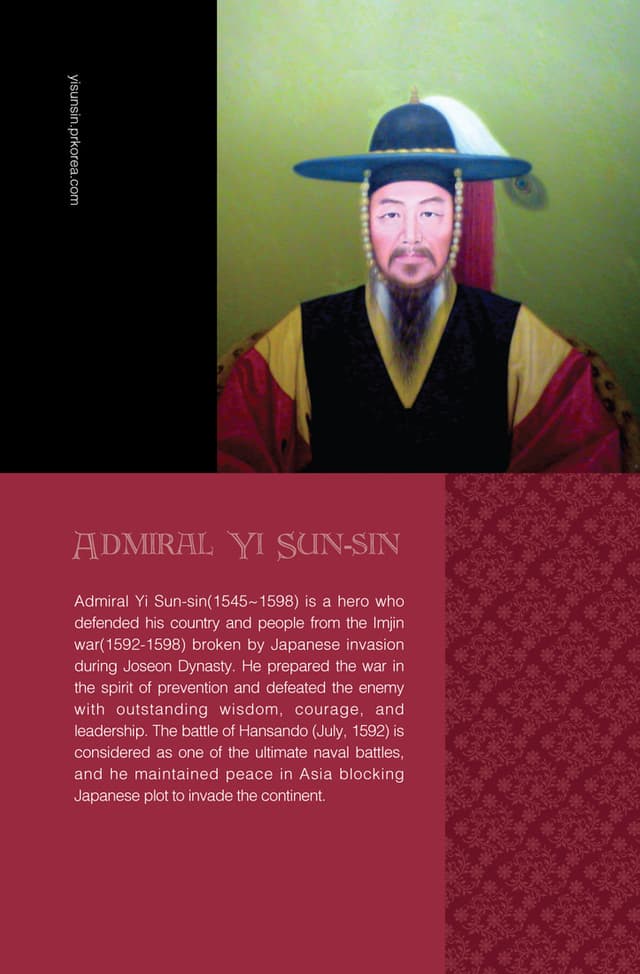
Admiral Yi Sun-sin
I still have 12 more ships lined up for battle!
Admiral Yi Sun-sin(1545~1598) | 이순신 장군
“I still have twelve ships!” Admiral Yi Sun-sin wrote this in his report to King Seonjo during the Japanese invasion of Korea in the late sixteenth century. His successor lost the majority of Joseon’s naval forces and vessels that Yi had diligently prepared. Then, Yi was reinstituted, but the king ordered to dissolve the navy and join the ground forces. However, Yi responded with determination to defend the nation with his twelve remaining ships by stressing the importance of defending the sea. Without the king and the government’s support, Yi and his followers went to battle with the twelve ships and had a decisive victory against the Japanese naval fleet of 330 ships.
The victory in this battle, known as the Battle of Myeongnyang (1597), is considered legendary in Korean and world naval history. Admiral Yi Sun-sin restored peace in Asia by winning all of his 23 battles during the Imjin War, the biggest war in northeast Asia at the time, in which Japan devastated Joseon’s territory and the lives of the people. His impressive victory streak resulted from his rigorous training of the navy, building of cutting-edge Geobukseon battleships, and foresighted strategies to defeat Japan. His inventive and highly effective naval battle strategies have been studied by naval historians around the world. Admiral Yi Sunshin is one of the most respected naval heroes, who defended his country and protected peace in Asia.
Fisherman, Civilian Diplomat An Yong-bok
Ulleungdo and Dokdo in the East Sea belongs to Joseon!
Fisherman, Civilian Diplomat An Yong-bok | 어부, 민간외교가 안용복
Dokdo in the East Sea consists of two islands, Dongdo and Seodo. On Seodo, there is a street called “An Yong-bok Street,” named after a fisherman in Joseon. An Yong-bok, the man whose name is chosen for Koreans’ most beloved island, appears in Joseon’s official historical record of the Annals of King Sukjong. Although he was a humble fisherman, Koreans call him admiral today to pay him the respect that he deserves. What made Koreans respect him so much that they gave him the honorary title of admiral and even gave his name to a street on their favorite island? It is because of his significant role in protecting Joseon’s territory, despite his low status.
While gathering seafood around Ulleungdo and Dokdo, An Yong-bok spotted Japanese fishermen trespassing and demanded that they stay off Joseon’s waters. Instead of complying, the trespassers kidnapped him and brought him to Japanese officials on Oki Island for punishment. Unfazed, An advocated for Joseon’s territorial rights to those islands and consequently obtained a diplomatic document stating that neither Ulleungdo nor Dokdo belonged to Japan. After seeing Japanese fishermen continuing to trespass, An visited Japan again and made an official complaint. Finally, in 1696, the Japanese government issued an administrative order that prohibited Japanese fishermen’s passage to these Korean islands. Fisherman An Yong-bok was a patriotic admiral in heart, who defended Ulleungdo and Dokdo.
Jeju Haenyeo Society
Retrieve the stolen country and the maritime economic sovereignty!
Freedom Fighters Jeju Haenyeo Society | 독립운동가 제주해녀회
In 2016, the Korean Ministry of Oceans and Fisheries announced 17 ocean heroes, who defended the nation during Korea’s 5,000 years of history. The majority were male, such as kings and well-known generals who defended the country in times of national crisis. A surprise was the inclusion of a women diver group called Jeju Haenyeohoe or Jeju Women Divers’ Society. This organization was selected for its role in defending the Korean people’s maritime rights in 1932 during the repressive Japanese occupation of Korea. Japanese corporations, sponsored by the Japanese government, threatened the Haenyeos’ livelihood by charging exorbitant commissions and membership fees. Fed up with Japan’s exploitation, five Haenyeo representatives, including Kim Ok-ryeon, Go Cha-dong, Kim Gye-seok, Bu Deok-ryang, and Bu Chun-hwa, started a protest against Japan, along with thousands of members of the official Jeju Women Divers’ Fishery Association. This protest developed into Jeju’s largest independence movement, participated in by more than 17,000 people. Haenyeos were ocean heroes, who led an independence movement to defend Korea’s maritime rights.
더 보기 ▾