홍보물
서울역사지도카드 (2013)
Seoul History Map Cards (2013)
한국어
서울역사지도카드는 대한민국 수도 서울의 역사와 문화유적을 소개하는 홍보물이다. 선사시대부터 이어진 서울은 백제와 조선의 수도로 각각 500여 년의 역사를 지녔으며, 암사동 선사주거지, 한성백제박물관, 경복궁 등 23곳의 역사문화유적지를 통해 서울의 역사와 문화를 알린다.
EnglishThe Seoul History Map Cards introduce the history and cultural heritage sites of Seoul, the capital of the Republic of Korea. Seoul's history goes back to prehistoric times, and it later served as the capital of both Baekje and Joseon, each for more than 500 years. These cards share Seoul's history and culture through 23 historical and cultural heritage sites, including the Amsa-dong Prehistoric Settlement Site, the Hanseong Baekje Museum, and Gyeongbokgung Palace.
자료 원고 · English
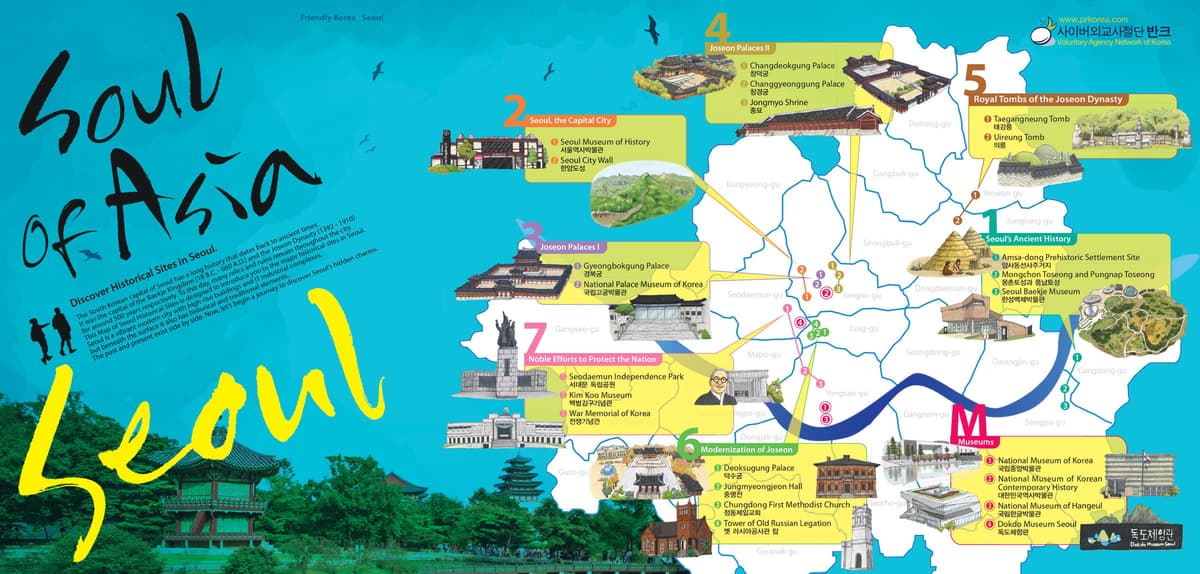
Soul of Asia Seoul
Discover Historical Sites in Seoul
The South Korean capital of Seoul has a long history that dates back to ancient times. It was the capital of the Baekje Kingdom (18 B.C. ? A.D. 660) and the Joseon Dynasty (1392 ? 1910) for around 500 years respectively. To this day, many relics and ruins remain throughout the city. This Map of Seoul Historical Sites is designed to introduce you to the major historical sites in Seoul. Seoul is a vibrant modern city with high-rise buildings and IT industrial complexes, but beneath the surface it also has historical and traditional elements. The past and present exist side by side. Now, let’s begin a journey to discover Seoul’s hidden charms.
1. Seoul’s Ancient History
① Amsa-dong Prehistoric Settlement Site 암사동선사주거지
Amsa-dong Prehistoric Settlement Site is a Neolithic settlement site around the Han River in Seoul. It was discovered after a big flood in 1925. There are two exhibition halls at the site where visitors can see the excavation site, unearthed artifacts, and general information about Neolithic remains in Korea.
② Mongchon Toseong and Pungnap Toseong 몽촌토성과 풍납토성
Mongchon Toseong and Pungnap Toseong are earthen fortresses from the Baekje era (18 B.C. ? A.D. 660). Baekje flourished through its active involvement in cultural exchange and trade with China and Japan. For around 500 years of its nearly 700 year history, Baekje had Seoul as its capital. Mongchon Toseong was excavated during preparations for the 1988 Olympic Games in Seoul, and it captured wide public attention. About a decade later, Pungnap Toseong was excavated 700 meters north of Mongchon Toseong. Tens of thousands of relics were discovered in these two areas.
③ Seoul Baekje Museum 한성백제박물관
Seoul was the capital of the ancient Korean kingdom of Baekje for nearly 500 years. For this reason, Seoul contains many relics and ruins from Baekje, including Mongchon Toseong, Pungnap Toseong, and the Seokchon-dong Ancient Tombs. The Seoul Baekje Museum exhibits the city’s ancient history and culture, particularly regarding Baekje. It opened in April 2012, and is located within Mongchon Toseong, a representative fortress of Baekje.
2. Seoul, the Capital City
① 서울역사박물관 Seoul Museum of History
The Seoul Museum of History is a city museum of Seoul, opened in 2002. Seoul is now a widely-known global city. It has been the capital of Korea for over 600 years since it became the capital of Joseon Dynasty (1392-1910) in 1392. The museum shows the history and culture of Seoul and the lifestyle changes of people in Seoul.
② 한양도성 Seoul City Wall
Seoul City Wall is a fortress that surrounds Hanyang (now Seoul), the capital of Joseon. Even today, over 600 years after its initial construction, the wall maintains its original shape because it was strategically built along the ridges of four mountains around the city. Thanks to extensive restoration efforts, visitors can see most parts of the 18,627m long wall.
3. Joseon Palaces Ⅰ
① Gyeongbokgung Palace 경복궁
Gyeongbokgung Palace was the main royal palace of the Joseon Dynasty, which was its first and biggest palace. It was destroyed in 1592 during the Imjin War, and later restored. However, it was again severely damaged during the Japanese Occupation (1910-1945), and only 7% of the palace complex survived. The Gyeongbokgung Palace restoration project has been ongoing for over 20 years, but there is still a long way to go to fully restore the original structure during its glory days when it consisted of over 500 buildings.
② National Palace Museum of Korea 국립고궁박물관
The National Palace Museum of Korea exhibits a collection of royal artifacts from the Joseon Dynasty, the last dynasty of the Korean people. Located within Gyeongbokgung Palace, it houses around 40 thousand relics that show royal ancestral rites, court music and paintings, court life, and others. Through these relics, visitors can gain a better understanding of the traditions of Joseon, which was a dynasty that lasted for 519 years.
4. Joseon Palaces Ⅱ
① Changdeokgung Palace 창덕궁
Changdeokgung Palace is the only royal palace from the Joseon Dynasty that was designated as a UNESCO World Heritage Site. It was built without harming nature, and is widely commended as being in perfect harmony and balance with its surrounding environment. Its rear garden shows the characteristic of Joseon’s palace architecture and garden culture that emphasized the harmonious coexistence of humans and nature.
② Changgyeonggung Palace 창경궁
Changgyeonggung Palace, adjacent to Changdeokgung, was built as a living space for the royal family. During the Joseon Dynasty, the two palaces were used as a combined space. Changdeokgung was usually used for political functions and Changgyeonggung for living. During the Japanese Occupation, many of the buildings at the palace were destroyed, and some parts were converted to serve as a zoo and a botanical garden. Subsequently, it was downgraded to a garden and renamed Changgyeongwon, meaning Changgyeong Garden.
③ Jongmyo Shrine 종묘
The Joseon Dynasty was founded on Confucianism, which emphasizes the importance of ancestral rites. Jongmyo is a Confucian royal ancestral shrine that houses the spirit tablets of the late kings and queens of Joseon. Following Confucian traditions, the main hall of Jongmyo was built with simple lines and minimal ornamentation. Its unique feature is the 101m long facade, which makes it the longest traditional wooden structure in Korea. An annual ancestral rite called Jongmyo Jerye has been performed at Jongmyo for over 600 years.
5. Royal Tombs of the Joseon Dynasty
① Taegangneung Tomb 태강릉
The Royal Tombs of the Joseon Dynasty are the tombs of the kings and queens of Joseon, which was Korea’s last kingdom that lasted for 519 years. The tombs were designated as a UNESCO World Heritage Site. A total of 40 tombs are scattered throughout the Seoul metropolitan area. Taegangneung refers to two of the tombs that house the remains of Queen Munjeong (1501-1565) and her son, King Myeongjong (1534-1567). Unlike most queens, Queen Munjeong exerted a strong political influence. Around Taegangneung, there is the Royal Tomb Museum of the Joseon Dynasty that provides information about the royal tombs.
② Uireung Tomb 의릉
Uireung is the royal tomb of Joseon’s 20th King, Gyeongjong (1688-1724), and his queen Seonui(1705-1730), which are located one above the other on a hill. During the Joseon Dynasty, the locations of royal tombs were carefully selected according to the traditional principles and rules of geomancy and geography. All the elements of royal tombs, including burial mounds, sculptures and other structures, are in general harmony with the surrounding landscape.Although many years have passed, the royal tombs still hold significance as sites where ancestral rites are performed.
6. Modernization of Joseon
① Deoksugung Palace 덕수궁
Deoksugung Palace is the smallest palace from the Joseon Dynasty. Facing a threat on his life from Japan, Emperor Gojong (1852-1919) fled to the Russian Legation in 1896. A year later, in 1897, he moved to Deoksugung, making it central to the modern history of Korea. Many foreign legations were nearby, and Deoksugung adopted western architectural elements, such as stone structures. As a result, Deoksugung has features that are distinct from other palaces.
② Jungmyeongjeon Hall 중명전
Jungmyeongjeon was built in 1901 as a royal library. It was initially within Deoksugung Palace, but became separated from the palace by a stone wall during the Japanese Occupation. It is one of the first structures with western-style architecture in the palace, and it is also the site where the Eulsa Treaty (1905) was signed and Korea’s diplomatic rights were taken away. Later, Emperor Gojong sent a special envoy to The Hague to expose the illegitimacy of the treaty.
③ Chungdong First Methodist Church 정동 제일교회
Chungdong First Methodist Church was Korea’s first Protestant church, which was established in 1897 by American missionary, Henry Appenzeller (1858-1902). From its early phase, the church served as the center of Korea’s enlightenment movement, and made significant contributions to advancing democracy, adopting new cultures, and promoting a national consciousness. All members of the church participated in the 1919 March 1st Movement, and continued to be actively engaged in independence movements throughout the Japanese Occupation Period.
④ Tower of Old Russian Legation 옛 러시아공사관 탑
With imperialistic ambition, Japan murdered Empress Myeongseong (1851-1895). Emperor Gojong and the crown prince, who later became Emperor Sunjong (1874-1926), fled to and stayed at the Old Russian Legation for 375 days. The tower of the legation still remains in Jung-dong, Seoul.
7. Noble Efforts to Protect the Nation
① Seodaemun Independence Park 서대문 독립공원
Seodaemun Independence Park is built around Seodaemun Prison. It covers an area of 109,193.8m². In 1908, while accelerating its effort to annex Korea, Japan established Seodaemun Prison to lock up Korean independence fighters. Until Korea regained its independence in 1945, the prison was a place of suffering where many Koreans were imprisoned and tortured. However, it is now serving as a place of education that reminds people of their responsibility to protect independence, freedom, and peace.
② Kim Koo Museum 백범김구기념관
Kim Koo Museum shows the life of respected independence fighter Kim Koo (1876-1949) and the modern Korean history. He devoted his life to regaining the independence of Korea, and became the Premier of the Korean Provisional Government in 1944. Hyochang Park, the location of the museum, contains the tombs of independence fighters.
③ War Memorial of Korea 전쟁기념관
The War Memorial of Korea is a war history museum, located in Yongsan-gu, Seoul. It exhibits many historical documents and other records of wars that occurred in Korea. The purpose of the museum is to prevent another war and to promote the peaceful unification of Korea by teaching people about war. Over 9,000 historical pieces are displayed at indoor and outdoor exhibition areas.
M. Museums
① National Museum of Korea 국립중앙박물관
The National Museum of Korea is a main museum in Korea, and was ranked the ninth most visited museum in the world in 2011 by the Art Newspaper. It covers an area of 295,550.69 m², and houses over 300 thousand pieces of art and relics. Around 15 thousand pieces are always on display in its six permanent exhibition halls. It also holds many special exhibitions with art loaned from foreign museums and with different themes. For children’s education, it operates a children’s museum within the museum.
② National Museum of Korean Contemporary History 대한민국역사박물관
The National Museum of Korean Contemporary History, opened in 2012, is Korea’s first national contemporary history museum. After opening its ports in the 19th century, Korea experienced many political upheavals, including the founding of the Korean Empire, the Japanese occupation of Korea, independence in 1945, the Korean War, territorial division, and the establishment of governments. This museum shows visitors how Korea achieved its remarkable development within a short period of time, and what direction it is heading.
③ National Museum of Hangeul 국립한글박물관
Hangeul is the Korean alphabet invented in 1443 by King Sejong (1397-1450). The invention of Hangeul is considered the greatest cultural accomplishment of the Korean people. The museum shows how Hangeul was invented and evolved, as well as how Koreans have used it.
④ Dokdo Museum 독도체험관
Dokdo is the easternmost territory of Korea. Despite its small size, Dokdo is the most important and special island in the minds of Koreans. Koreans call Dokdo a home in their heart, which was reflected in the establishment of the Dokdo museum. The museum allows visitors to experience Dokdo in the capital city of Seoul by providing information about Dokdo, including its nature and history.
더 보기 ▾