홍보물
한국역사유적카드 (2018)
Korean Historical Heritage Cards (2018)
한국어
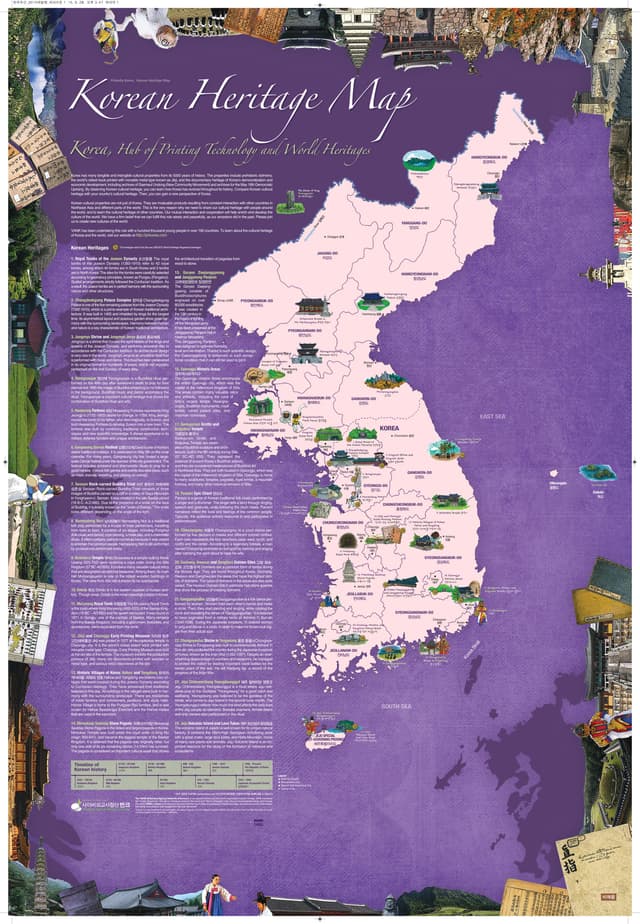
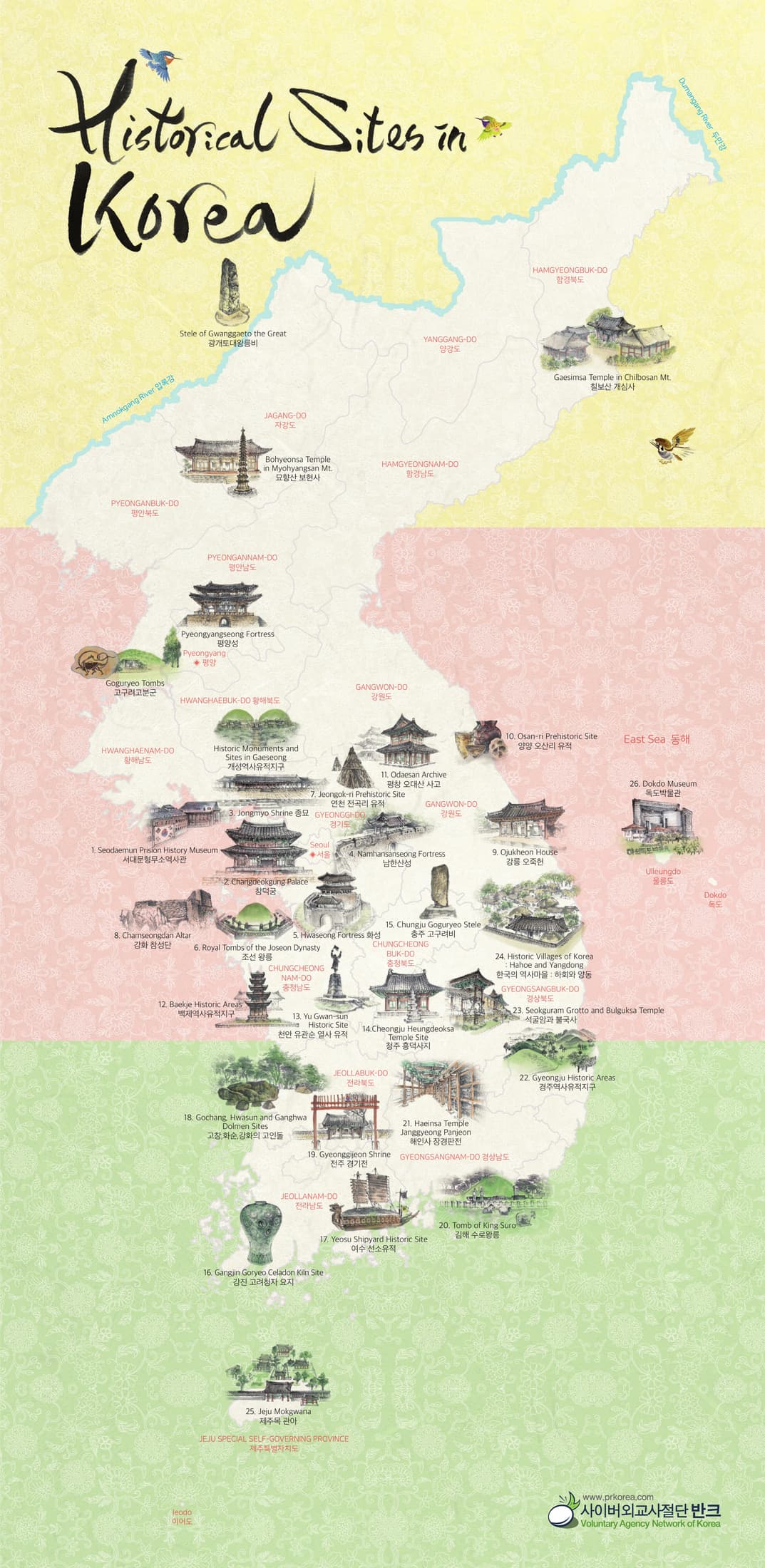
한국역사유적카드는 한국의 오천 년 역사와 문화를 보여주는 유적 32곳(북한 6곳, 남한 26곳)을 소개하는 자료다. 앞면에는 한반도 지도 위에는 32곳의 유적 그림을, 뒷면에는 남한 26곳의 유적을 영문 소개를 담았다.
EnglishKorean Historical Heritage Cards introduce 32 historical sites (6 in North Korea and 26 in South Korea) that show 5,000 years of Korean history and culture. The front shows illustrations of the 32 sites on a map of the Korean Peninsula, and the back has English descriptions of the 26 sites in South Korea.
자료 원고 · English
■ Historical Sites in Korea
1. Seodaemun Prison History Museum 서대문형무소 역사관
Located in Seodaemun District in Seoul, the Seodaemun Prison History Museum is a place where the history of Korean independence movement is presented. During the Japanese Occupation Period (1910-1945), many Korean freedom fighters fought for independence from Imperial Japan and ended up imprisoned. This museum is now used to remind visitors of the importance of freedom and peace.
2. Changdeokgung Palace 창덕궁
Changdeokgung is a palace from the Joseon Dynasty (1392-1910). It embodies the characteristics of Korean palace architecture that places a building in harmony with its natural surrounding and follows conventional Confucian architectural styles. Its buildings were placed organically without altering the natural landscape. To the north of the palace, a spacious rear garden, Huwon in Korean, sits on a hill.
3. Jongmyo Shrine 종묘
Jongmyo is a Confucian royal shrine in Seoul that houses the spirit tablets of the kings and queens of the Joseon Dynasty. Its buildings were constructed strictly with Confucian architectural styles. The arrangement of buildings and spaces is unique. The Jongmyo ancestral ritual is still annually performed, and its rite, music, and dance are preserved as intangible heritage.
4. Namhansanseong Fortress 남한산성
Namhansanseong is a mountain fortress in a suburb of Joseon’s capital of Seoul. It was built to function as a capital in case of emergency. An army of Buddhist monks built and defended the fortress. Namhansanseong represents the culmination of East Asia’s military architectural engineering in the 17thcentury.
5. Hwaseong Fortress 화성
Hwaseong Fortress is an urban fortress in the city of Suwon in Gyeonggido Province. Built during the Joseon Dynasty, Hwaseong shows a unique architectural style that combines Korean and western military architecture. All available architectural knowledge was used to build the fortress. The entire construction process was documented in Hwaseong Seongyeok Uigwe, published in 1801.
6. Royal Tombs of the Joseon Dynasty 조선 왕릉
The Royal Tombs of the Joseon Dynasty consist of 40 tombs of Joseon’s deceased kings and queens. The tombs were created in and around Seoul over five centuries from 1408 to 1966. Their locations were carefully chosen based on strict royal court rules and Confucian traditions. The burial mounds and associated structures are placed in harmony with nature.
7. Jeongokri Prehistoric Site 연천 전곡리 유적
The Jeongokri Prehistoric Site was found after the discovery of an early Stone-Age hand axe in 1978. Since then, many stone tools were unearthed. Hand axes had been found only in Africa and Europe. The hand axe in Jeongokri was the first found in Asia, rewriting the history of the Old Stone Age.
8. Chamseongdan Altar 강화 참성단
Chamseongdan is an altar on the Manisan Mountain peak in the town of Ganghwa. It is said to be built by Dangun, the founder of the first Korean kingdom of Gojoseon(2333-108 BC), to pray to heaven. The ritual was performed by many kings of several Korean kingdoms. The National Foundation Day ceremony on October 3 and the National Sports Festival torch lighting ceremony are annually held at Chamseongdan.
9. Ojukheon House 강릉 오죽헌
Ojukheon is a house where Shin Saimdang (1504-1551) and her son Yulgok Yi I (1536-1584) lived during the Joseon Dynasty. Shin was an outstanding writer and artist and raised Yi I to be a prominent Confucian scholar. Ojukheon is one of Korea’s oldest surviving residential buildings, showing the characteristics of homes of the noble class at the time.
10. Osanri Prehistoric Site 양양 오산리 유적
The Osanri Prehistoric Site is the oldest New Stone Age relic in Korea. It is located in the town of Yangyang in Gangwondo Province on the Korean east coast. Many pieces of clay and stone pottery and a clay face sculpture were unearthed. Pottery made of stone from Baekdusan Mountain were also found, suggesting exchange with northern regions in Korea.
11. Odaesan Archive 평창 오대산 사고
Located on Odaesan Mountain in Pyeongchang of Gangwondo Province, the Odaesan Archive keeps Joseon Wangjo Sillok (Annals of the Joseon Dynasty). The annals are the world’s longest continual records of a single dynasty that cover 472 years. They were meticulously documented, edited, and stored at multiple locations for security.
12. Baekje Historic Areas 백제역사유적지구
The Baekje Historic Areas consist of eight areas that remain in Gongju, Buyeo, and Iksan. Baekje (18 BC – AD 660) is one of the Korean ancient kingdoms. It actively communicated with neighboring kingdoms in Korea, China and Japan, and developed a unique culture and technology. The historic areas contain palace sites, Buddhist temple sites, royal tombs, stone pagodas, and fortresses.
13. Yu Gwan-sun Historic Site 천안 유관순 열사 유적
The Yu Gwan-sun Historic Site in Cheonan in Chungcheongnamdo is built to commemorate Yu Gwan-sun (1902-1920). Yu, then a 16-year-old high school student, participated in the March 1st Independence Movement in her hometown of Cheonan. The movement was a nonviolent protest to demand national independence from Japan. Over two million people across the country participated in this movement. Yu was arrested by Japanese military police and imprisoned at Seodaemun Prison. She was tortured to death at the age 17.
14. Cheongju Heungdeoksa Temple Site 청주 흥덕사지
Cheongju Heungdeoksa Temple is where Jikji Simche Yojeol (Jikji for short) was printed in 1377. Jikji is the oldest extant book printed with movable metal type. Movable metal type shows a technological breakthrough in printing history. Built on the Heungdeoksa Temple site, the Early Printing Museum in Cheongju displays the printing process of Jikji, wood blocks, and other books printed with movable metal type.
15. Chungju Goguryeo Monument 충주 고구려비
Chungju Goguryeo Stele in Chungcheongbukdo Province is an upright stone slab erected during Goguryeo (37 BC - AD 668). It is also known as Jungwon Goguryeo Stele. It is the only surviving Goguryeo stele that is found in Korea. It has historical significance as evidence of the relationship between Goguryeo, Baekje, and Silla.
16. Gangjin Goryeo Celadon Kiln Site 강진 고려청자 요지
Gangjin Goryeo Celadon Kiln Site in Jeollanamdo Province is a pottery kiln (oven) site from Goryeo (918-1392). Goryeo was the second country that made celadons after China. Gangjin was a major area for producing celadons. Around 180 kilns from Goryeo remain in nine villages of this town. The artistic value of celadons made in this town is internationally recognized.
17. Yeosu Shipyard Historic Site 여수 선소유적
Yeosu Shipyard in Jeollanamdo Province was where ships were built from Goryeo to Joseon. The famous turtle ship, Geobukseon in Korean, was built here by Admiral Yi Sun-sin (1545-1598). The shipyard was not only a place for shipbuilding, but also a place for naval defense. Barracks, training grounds, and blacksmiths’ workshops remain at this site.
18. Gochang, Hwasun, and Ganghwa Dolmen Sites 고창, 화순, 강화의 고인돌 유적
The Gochang, Hwasun, and Ganghwa Dolmen Sites consist of ancient tombs made with large stones. Hundreds of dolmens are concentrated in each region, which is rare around the world. There is also a quarry that reveals how the dolmens were created.
19. Gyeonggijeon Shrine 전주 경기전
The Gyeonggijeon Shrine in Jeonju in Jeollabukdo Province houses the portrait of Taejo Yi Seonggye (1335-1408), the founder of Joseon. The Joseon Dynasty regarded this portrait highly and renewed the building constantly. The current building reflects the architectural styles of mid-Joseon. Ornaments on its pillars are marvelous.
20. Tomb of King Suro 김해 수로왕릉
The Tomb of King Suro in Gimhae in Gyeongsangnamdo Province is a burial mound of King Suro, the founder of Gaya(42-562) and the forefather of the Kim family in Gimhae. Gaya was a confederacy of several kingdoms in the Nakdong River downstream basin. It had abundant iron and produced elaborate ironware. Stone statues and various structures in the tomb show the artistic styles of late Gaya.
221. Haeinsa Temple Janggyeong Panjeon 해인사 장경판전
The Janggyeong Panjeon in Haeinsa Temple is the depository built in the 15th century to store wooden Buddhist texts. Its main purpose was to store Palman Daejanggyeong (Tripitaka Koreana woodblocks). Due to the scientific construction of the depository, the woodblocks have been preserved in impeccable condition for nearly 600 years.
22. Gyeongju Historic Areas 경주역사유적지구
The Gyeongju Historic Areas consist of five areas in the city of Gyeongju. Many relics remain in Gyeongju because Gyeongju was the capital of Silla (57 BC – AD 935), an ancient Korean kingdom that lasted for a millennium. The areas contain Buddhist temples, pagodas, royal tombs, fortresses, and sculptures that reveal Silla’s outstanding culture and art.
23. Seokguram Grotto and Bulguksa Temple 석굴암과 불국사
Seokguram and Bulguksa are ancient Buddhist relics from the Silla Dynasty. Seokguram is an artificial granite grotto containing a statue of the Buddha. Bulguksa is a Buddhist temple on Tohamsan Mountain. They were both constructed in the late 8th century under the leadership of the prime minister at the time. Seokguram and Bulguksa are considered to be masterpieces of East Asian Buddhist art.
24. Historic Villages of Korea: Hahoe and Yangdong 한국의 역사마을: 하회와 양동
Hahoe and Yangdong are the most representative historic clan villages in Korea. After their initial establishment in the early Joseon Dynasty, they have been well-preserved. The arrangement and style of the houses reflect Confucian culture. The villages contain the residences of head families, houses of the nobles and commoners, Confucian academies and study halls, and pavilions.
25. Jeju Mokgwana 제주목 관아
The Historic Jeju Government Office, Jeju Mokgwana in Korean, is where administrative offices during Joseon were located. It is a symbolic site that contains the history of administration, politics, and culture in Jeju. Around the office, there are also building sites and relics from the Tamna period before Jeju was absorbed by the central government.
26. Dokdo Museum 독도박물관
The Dokdo Museum in Ulleung-gun in Gyeongsangbukdo Province displays various materials about Dokdo. Dokdo is the most meaningful island to Koreans. Ulleungdo and Dokdo islands in the East Sea boast beautiful views and a rich ecosystem where a diverse species of animals, plants, birds, and fish live.
더 보기 ▾