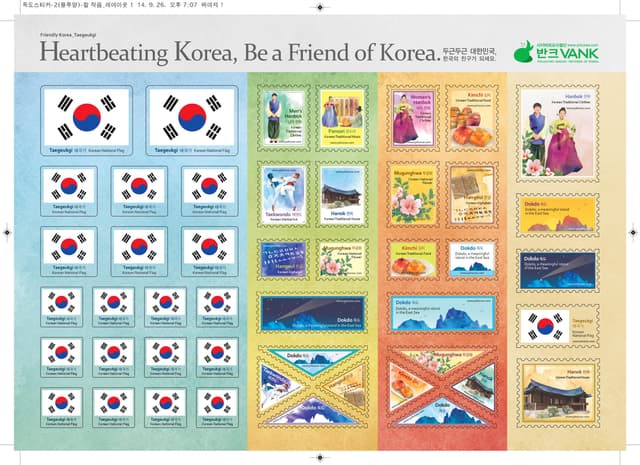
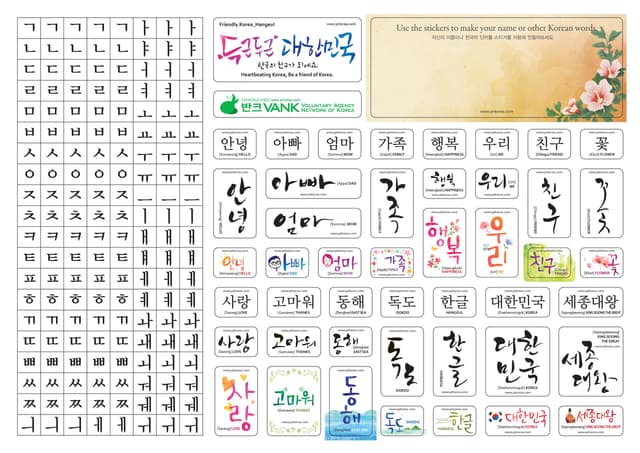
한국어한글엽서 세트는 한국 고유의 문자 한글로 한국의 언어와 문화를 소개하는 홍보물이다. 대한민국 소개를 비롯해 한복·한식·한옥·한지·판소리·태권도 등 한국문화와, 사랑·축하·감사·응원의 마음을 담은 한국어 표현으로 구성했다. 1443년 세종대왕이 창제하고 훈민정음으로 그 원리를 밝힌 한글의 창제 배경도 함께 소개한다.
EnglishThe Hangeul Postcard Set introduces the Korean language and culture through Hangeul, Korea's unique writing system. It covers an introduction to Korea along with aspects of Korean culture such as hanbok (traditional Korean clothing), hansik (Korean food), hanok (traditional Korean house), hanji (traditional Korean paper), Pansori, and Taekwondo, as well as Korean expressions of love, celebration, gratitude, and support. It also introduces the background of Hangeul's creation, which was invented by King Sejong the Great in 1443 and explained in Hunminjeongeum.
자료 원고 · English우리는 한글엽서를 통해 한국문화와 한국인의 마음을 세계인들과 나누며 친구가 되고 싶습니다. 한국문화의 주인공인 한국인들과 친구가 되세요~! → Friendly Korea Community chingu.prkorea.com
Hangeul postcards introduce Korean culture and language with Hangeul, the alphabet of Korea. One set of postcards consists of ‘Hangeul’, ‘Hanbok’, ‘Hansik’, ‘Hanok’, ‘Hanji’, ‘Pansori’, ‘Taekwondo’ Korean culture, introduction about Korea, and Korean meaning ‘saranghaeyo (I love you)’, ‘chukahaeyo (Congratulations)’, ‘gamsahaeyo (Thank you)’, and ’ariari (Go Go)‘.
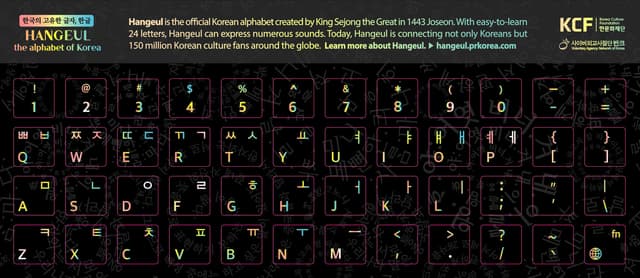
Hangeul is the official Korean alphabet created by King Sejong the Great in 1443 Joseon. Upon the invention of Hangeul, King Sejong published Hunminjeongeum, the Hangeul guidebook, which established the creator, time, and principles of Hangeul’s invention. Before the creation of Hangeul, Koreans used Chinese characters. Unfortunately, these characters were not suitable for the Korean language and were too difficult to be used widely by the general public. Recognizing the problem, King Sejong created Hangeul, the alphabet developed specifically for the Korean language.
The consonants of Hangeul refer to the shape of the speech mechanism and vowels signify the philosophy of heaven, earth, and man. Hangeul contains a total of 24 alphabets, with 14 consonants and 10 vowels that can be broken down into 5 basic consonants and 3 basic vowels. By adding strokes or combining 8 basic alphabets, Hangeul can express numerous sounds.
Hangeul is the Korean alphabet that links the hearts of not only Koreans in Korean Peninsula and abroad, but also 150 million Korean culture fans all around the globe. Hangeul now moves forward from the communication of Koreans to the connection of the whole world. Learn more about Hangeul. → hangeul.prkorea.com
We want to share the culture and heart of Korea with the world through Hangeul postcards. Let’s be friends with Koreans, the center of Korean culture! → Friendly Korea Community chingu.prkorea.com
-대한민국 [daehanminguk]
‘Daehanminguk’ (Republic of Korea) is written by Hangeul, the official alphabet of Korea. Korea has 5,000 years old history and brilliant culture. Hangeul was created by King Sejong the Great in 1443 Joseon. With easy-to-learn 24 letters, Hangeul can express numerous sounds. Today, Hangeul is connecting not only Koreans but 150 million Korean culture fans around the globe. Learn more about Hangeul. ▶hangeul.prkorea.com
-똑똑한 한글 [ttokttokan hangeul]
‘Ttokttokan Hangeul’ (Clever Hangeul) is written in Hangeul, the official alphabet of Korea. Hangeul was created by King Sejong the Great in 1443 Joseon. With easy-to-learn 24 letters, Hangeul can express numerous sounds. Today, Hangeul is connecting not only Koreans but 150 million Korean culture fans around the globe. Learn more about Hangeul. ▶hangeul.prkorea.com
-고운 한복 [goun hanbok]
‘Goun Hanbok’ (Beautiful Hanbok) is written in Hangeul, the official alphabet of Korea. Hanbok is Korean traditional clothing that embraces both the aesthetic and cultural identity of Koreans. Hangeul was created by King Sejong the Great in 1443 Joseon. With easy-to-learn 24 letters, Hangeul can express numerous sounds. Today, Hangeul is connecting not only Koreans but 150 million Korean culture fans around the globe. Learn more about Hangeul. ▶hangeul.prkorea.com
-맛있는 한식 [masinneun hansik]
‘Masinneun Hansik’ (Delicious Hansik) is written in Hangeul, the official alphabet of Korea. Hansik is Korean food that is a healthy cuisine with diverse ingredients and plentiful nutrients. Hangeul was created by King Sejong the Great in 1443 Joꠓseon. With easy-to-learn 24 letters, Hangeul can express numerous sounds. Today, Hangeul is connecting not only Koreans but 150 million Korean culture fans around the globe. Learn more about Hangeul. ▶hangeul.prkorea.com
-멋있는 한옥 [meosinneun hanok]
‘Meosinneun Hanok’ (Wonderful Hanok) is written in Hangeul, the official alphabet of Korea. Hanok is a traditional Korean house with environmental-friendly wooden architecture, ondol (Korean heating system), and a wood floor. Hangeul was created by King Sejong the Great in 1443 Joseon. With easy-to-learn 24 letters, Hangeul can express numerous sounds. Today, Hangeul is connecting not only Koreans but 150 million Korean culture fans around the globe. Learn more about Hangeul.▶hangeul.prkorea.com
-오래가는 한지 [oraeganeun hanji]
‘Oraeganeun Hanji’ (Durable Hanji) is written in Hangeul, the official alphabet of Korea. Hanji is a traditional Korean paper made from paper trees and lasts for 1000 years while maintaining its excellent quality. Hangeul was created by King Sejong the Great in 1443 Joseon. With easy-to-learn 24 letters, Hangeul can express numerous sounds. Today, Hangeul is connecting not only Koreans but 150 million Korean culture fans around the globe. Learn more about Hangeul.▶hangeul.prkorea.com
-씩씩한 태권도 [ssikssikan taekwondo]
‘Ssikssikan Taekwondo’ (Energetic Taekwondo) is written in Hangeul, the official alphabet of Korea. Taekwondo is the Korean traditional martial art that trains and strengthens the body and mind with hand and foot without the usage of a weapon. Hangeul was created by King Sejong the Great in 1443 Joseon. With easy-to learn 24 letters, Hangeul can express numerous sounds. Today, Hangeul is connecting not only Koreans but 150 million Korean culture fans around the globe. Learn more about Hangeul. ▶hangeul.prkorea.com
-즐거운 판소리 [jeulgeoun pansori]
Jeulgeoun Pansori’ (Fun Pansori) is written in Hangeul, the official alphabet of Korea. Pansori is a Korean traditional music performance that tells a story through a vocalist and a drummer. The vocalist delivers the story by singing, speech, and gestures while following the beat of the drummer. Hangeul was created by King Sejong the Great in 1443 Joseon. With easy-to-learn 24 letters, Hangeul can express numerous sounds. Today, Hangeul is connecting not only Koreans but 150 million Korean culture fans around the globe. Learn more about Hangeul. ▶hangeul.prkorea.com
-사랑해요 [saranghaeyo]
We send the message of ‘saranghaeyo’ (I love you) in Hangeul, the official alphabet of Korea. Hangeul was created by King Sejong the Great in 1443 Joseon. With easy-to-learn 24 letters, Hangeul can express numerous sounds. Today, Hangeul is connecting not only Koreans but 150 million Korean culture fans around the globe.
Learn more about Hangeul. ▶hangeul.prkorea.com
-축하해요 [chukahaeyo]
We send the message of ‘chukahaeyo’ (Congratulations) in Hangeul, the official alphabet of Korea. Hangeul was created by King Sejong the Great in 1443 Joseon. With easy-to-learn 24 letters, Hangeul can express numerous sounds. Today, Hanꠓgeul is connecting not only Koreans but 150 million Korean culture fans around the globe. Learn more about Hangeul. ▶hangeul.prkorea.com
-감사해요 [gamsahaeyo]
We send the message of ‘gamsahaeyo’ (Thank you) in Hangeul, the official alphabet of Korea. Hangeul was created by King Sejong the Great in 1443 Joseon. With easy-to-learn 24 letters, Hangeul can express numerous sounds. Today, Hangeul is connecting not only Koreans but 150 million Korean culture fans around the globe. Learn more about Hangeul. ▶hangeul.prkorea.com
-아리아리 [ariari]
We send the message of ‘ariari’ (Go Go) in Hangeul, the official alphabet of Korea. Ariari is a pure Korean expression of cheer. Hangeul was created by King Sejong the Great in 1443 Joseon. With easy-to-learn 24 letters, Hangeul can express numerous sounds. Today, Hangeul is connecting not only Koreans but 150 million Korean culture fans around the globe. Learn more about Hangeul. ▶hangeul.prkorea.com
더 보기 ▾  1
1 2
2 3
3 4
4 5
5 6
6 7
7 8
8 9
9 10
10 11
11 12
12