홍보물
무형문화유산지도 (2022)
Intangible Cultural Heritage Map (2022)
한국어
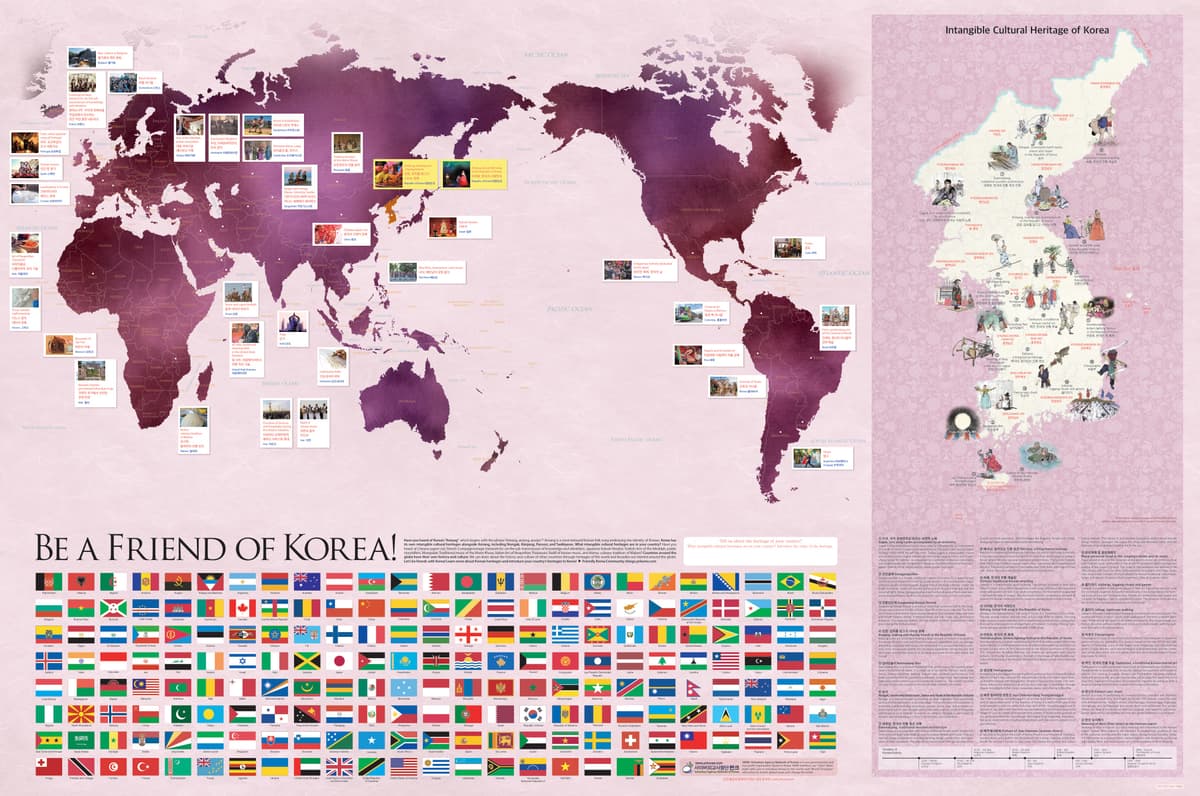
무형문화유산지도는 한국의 유네스코 무형문화유산 21개를 세계의 무형문화유산과 35개와 함께 소개하는 홍보물이다. '아리랑, 아리랑, 아라리요'로 시작하는 민요 아리랑을 비롯해 농악, 김장, 판소리, 택견 등 한국의 무형유산을 세계 각국의 무형유산과 함께 소개한다.
EnglishThis promotional material introduces Korea's 21 UNESCO intangible cultural heritages alongside 35 intangible heritages from around the world. It features Korea's intangible heritages, including Arirang, a folk song starting with the words "Arirang, Arirang, Arariyo," as well as Nongak, Kimjang, Pansori, and Taekkyeon, presented together with intangible heritages from other countries.
자료 원고 · English
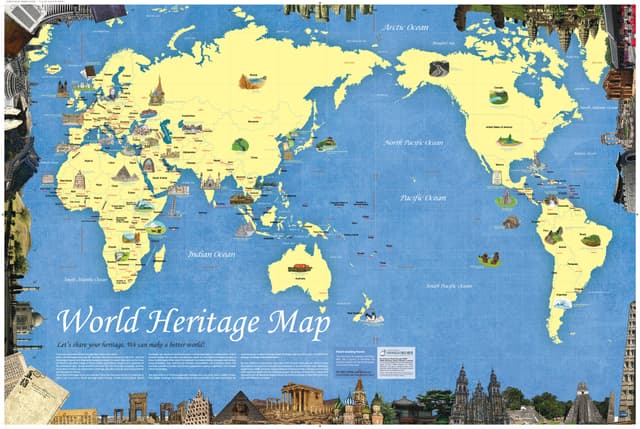
Have you heard of Korea’s “Arirang” which begins with the phrase “Arirang, arirang, arariyo”? Arirang is a most beloved Korean folk song embracing the identity of Korean. Korea has its own intangible cultural heritages alongside Arirang, including Nongak, Kimjang, Pansori, and Taekkyeon. What intangible cultural heritages are in your country? Have you heard of Chinese paper-cut, French Compagnonnage (network for on-the-job transmission of knowledge and identities), Japanese Kabuki theatre, Turkish Arts of the Meddah, public storytellers, Mongolian Traditional music of the Morin Khuur, Italian Art of Neapolitan ‘Pizzaiuolo’, Radif of Iranian music, and Nsima, culinary tradition of Malawi? Countries around the globe have their own history and culture. We can learn about the history and culture of other countries through heritages of the world and broaden our interest around the globe.
Let’s be friends with Korea! Learn more about Korean heritages and introduce your country’s heritages to Korea! ▶ Friendly Korea Community chingu.prkorea.com
Gagok, lyric song cycles accompanied by an orchestra
Gagok is Korean traditional vocal music sung by following the accompaniment of a small orchestra. It was mostly performed by the upper class during Joseon Dynasty (1392~1910) for self-discipline. Today, Gagok is more widely known around the country. Gagok includes 26 namchang, songs for men, and 15 yeochang, songs for women, accompanied by traditional orchestral instruments such as geomungo (six-string zither), daegeum (bamboo transverse flute), gayageum (twelve-string zither) and piri (small double-reed pipe).
② 강강술래 Ganggangsullae
Ganggangsullae is a Korean traditional custom of praying for a good harvest and fertile land. It was performed by young women in the southwestern region of Korea, usually during Chuseok, August 15th of the lunar calendar. Under the bright full moon, dozens of women gather in a circle, join hands and sing and dance all night. Today, Ganggangsullae is performed all around the Korean peninsula and elementary students also learn the custom as a school curriculum.
③ 강릉단오제 Gangneung Danoje Festival
Gangneung Danoje Festival is an annual rural ritual ceremony held in the Gangneung region around the day of Dano, May 5th of the lunar calendar. The festival includes a shamanistic ritual paying tribute to the mountain deity and male and female tutelary deities, traditional music and folk songs, play, and various activities. The Nanjang market, Korea’s largest outdoor marketplace, takes place during the festival period.
Kimjang, making and sharing kimchi in the Republic of Korea
Kimjang is the act of Koreans making a large amount of Kimchi to prepare for the winter. Kimchi is a Korean food of preserved vegetables, such as cabbage, and radish, seasoned with spices and fermented. It is an essential dish in a Korean meal. Housewives gather the necessary ingredients during the year and set a date around late autumn to Kimjang and share Kimchi with family and friends.
⑤ 남사당놀이 Namsadang Nori
Namsadang Nori is a Korean traditional folk performance by traveling entertainers comprised of males. It is made up of six events, farmers’ band, mask dance, Joseon tightrope walking, puppet play, acrobatic performance, and bowl spin performed by a professional theater troupe today. Namsadang Nori takes place in the outdoor yard surrounded by audiences. The content provides not only fun but also a satire on the life of weak members of society.
Nongak, community band music, dance and rituals in the Republic of Korea
Nongak is a popular Korean performing art that originated from community spirit and entertainment in a farming village. The performance incorporates an ensemble mainly including percussion, parade, dance, play, and acrobatic art.
Each region has its own Nongak performers and program, which is frequently performed at local festivals or events. In addition, Nongak is performed by Koreans abroad including in China, United States, and Uzbekistan.
Daemokjang, traditional wooden architecture
Daemokjang is a woodworker with skills in traditional Korean wood architecture. They construct large-scale buildings such as a palace, temple, and house. They also take full charge of operations including planning, design, construction, and supervision of other carpenters. The skills can be passed down through decades of education and field experience. World heritages like Bulguksa Temple and Changdeokgung Palace are also constructed by Daemokjang.
⑧ 매사냥, 살아있는 인류 유산 Falconry, a living human heritage
Falconry is a traditional hunting style that trains falcons to catch prey in the wild. It has been practiced around the world for more than 4000 years including in Korea, where falconry was practiced since ancient times. The Goryeo Dynasty (918~1392) even installed a government office overseeing falcon breeding and falconry. Falconers train falcons from babies and mark them with tags on their
tails. Today, falconry is inherited by professional practitioners.
Ssireum, traditional Korean wrestling
Ssireum is a characteristic sport in Korea. Two people compete to grab each other’s ‘Satba’, a long fabric twined into a belt strap, and knock the opponent down with power and skill. In an adult competition, the final winner is awarded a bull and the title of ‘Jangsa’. Big and small Ssireum competitions are held all around the Korean peninsula and in countries abroad where Koreans reside.
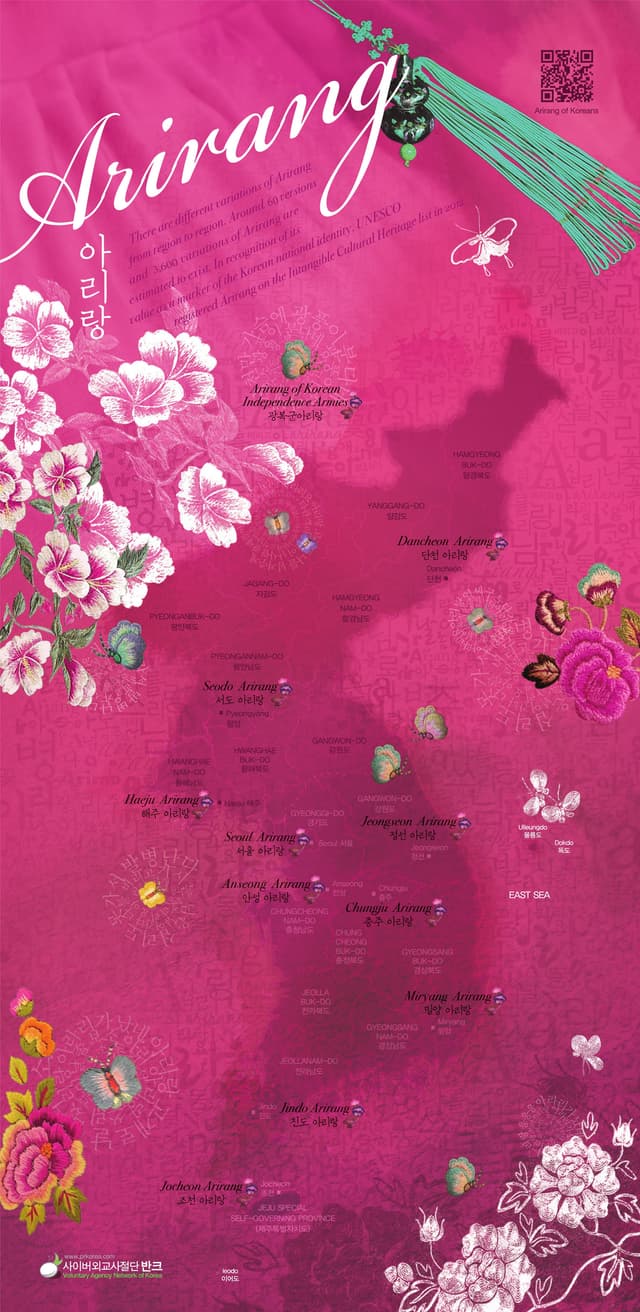
Arirang, lyrical folk song in the Republic of Korea
Arirang is the representative folk song of Korea. It is comprised of the refrain, ‘Arirang, arirang, arariyo’, and two lines of lyrics that differ by region. The song sings various universal themes with a simple melody and literary composition that can be improvised into arrangements or imitated. Currently, ‘Arirang’ variations are approximately 60 types with 3,600 songs.
Yeondeunghoe, lantern lighting festival in the Republic of Korea
Yeondeunghoe is a festival celebrating the birth of Buddha on April 8th of the lunar calendar. It is held all around Korea. Buddhism has made a great impact on Korean society since its first introduction to the Korean peninsula in the year 372. Around the Buddha’s Birthday, the streets are decorated with colorful lanterns. On the day of celebration, the bath of the image of baby Buddha signifies the beginning of the festival, followed by a lantern parade and traditional games.
⑫ 영산재 Yeongsanjae
Yeongsanjae is the biggest Korean Buddhist ceremony that re-enacts Buddha’s delivery of the Lotus Sutra on the Vulture Peak in India. It is held in every Korean Buddhist temple with Bongwonsa Temple in Seoul as the center. The ceremony delivers the philosophical and spiritual message of Buddhism through means including Buddhist music, ceremony, dance, and offering to Buddha.
⑬ 제주 칠머리당 영등굿 Jeju Chilmeoridang Yeongdeunggut
Jeju Chilmeoridang Yeongdeunggut is an annual ritual held throughout the island of Jeju located south of the Republic of Korea. It is held in February of the lunar calendar to wish for safety and a big catch of fish. Yeongdeunggut runs in all parts of Jeju Island with the most representative one at Chilmeoridang in the village of Gun-rip. Village shamans perform a series of rituals to the goddess of the winds (Grandmother Yeondeung), the Dragon King Yongwang, and mountain gods, and residents including female divers and ship owners prepare food and offerings.
⑭ 제주해녀문화 Culture of Jeju Haenyeo (Women Divers)
In Jeju Island, located in the south of Korea, there is a community of ‘Haenyeo’, women divers who gather marine products for a living. Haenyeo holds their breath for around 1 minute to dive down 10m below the surface and collect marine animals. The culture of Jeju Haenyeo includes an environment-friendly diving method, Jamsugut, the prayer for safety and abundant catch, and the Haenyeo song sung when heading out to the sea.
Royal ancestral ritual in the Jongmyo shrine and its music
Royal ancestral ritual in the Jongmyo shrine and its music are confucian ritual and ritualistic music performed at the shrine for ancestral tablets of kings and queens of the Joseon Dynasty. The order of the ceremony was defined in the 15th century and most elements have remained unchanged until today. Jongmyo ritual music consists of music played by Korean traditional instruments, songs, and dances. Jongmyo ritual is held every May at Jongmyo shrine.
⑯ 줄다리기 Juldarigi, tugging rituals and games
Juldarigi is a traditional folk game played to wish for a good harvest and bring the community together. It is performed not only in Korea but also in rice-farming areas of East and Southeast Asia. People are divided into two teams and compete by tugging a rope in opposite directions. The purpose of the game is not victory but a prosperous and secure community.
⑰ 줄타기 Jultagi, tightrope walking
Jultagi is a Korean traditional performing art presented in the outside yard. The acrobat performs acrobatic stunts while walking back and forth a slender tightrope. While acting 40 types of acrobatic movements, the Korea Jultagi performer also jokes with an earthbound clown and communicates with the audience throughout the performance.
⑱ 처용무 Cheoyongmu
Cheyongmu is a type of court dance performed at royal banquets to dispel evil spirits and pray for tranquility. The dance is based on the Silla (57 BC~AD 935) legend of Cheoyong, a son of the dragon king Yongwang, who banished evil spirits. 5 male dancers, each representing 4 cardinal directions and the center, wear white, blue, black, red, and yellow costumes and uniquely shaped Cheoyong masks to dance.
⑲ 택견, 한국의 전통 무술 Taekkyeon, a traditional Korean martial art
Taekkyeon is a traditional Korean material art. Its movements are rhythmic and flexible similar to dancing, but can quickly subdue the opponent with powerful attacks. The training is largely divided into Poombalbki (stepping method), hand skill, and foot skill, and also teaches how not to injure the opponent. For a long time, Taekkyeon integrated the community together by acting as both a physical training method and a custom of farming communities.
⑳ 판소리 Pansori epic chant
Pansori is a type of performing art characterized by a vocalist and drummer delivering a musical story. It emerged during the 17th century Joseon Dynasty with different stories. Today, 5 stories, Chunhyangga, Simcheongga, Sugungga, Heungbuga, and Jeokbyeokga are passed down and performed. The vocalist follows the beat of the drummer with sori (singing), aniri (speech), and neoreumsae (gesture) for storytelling and may also guide audiences to participate.
Weaving of Mosi (fine ramie) in the Hansan region
Weaving of Mosi in Hansan is a fabric weaving skill transmitted in the Hansan region. Korean Mosi began to be exported to neighboring countries in the 4~7th centuries and became the major export during Goryeo Dynasty. Today, it is still popular as a summer fabric. Hansan region is well-known for producing
Talchum, mask dance drama in the Republic of Korea
더 보기 ▾