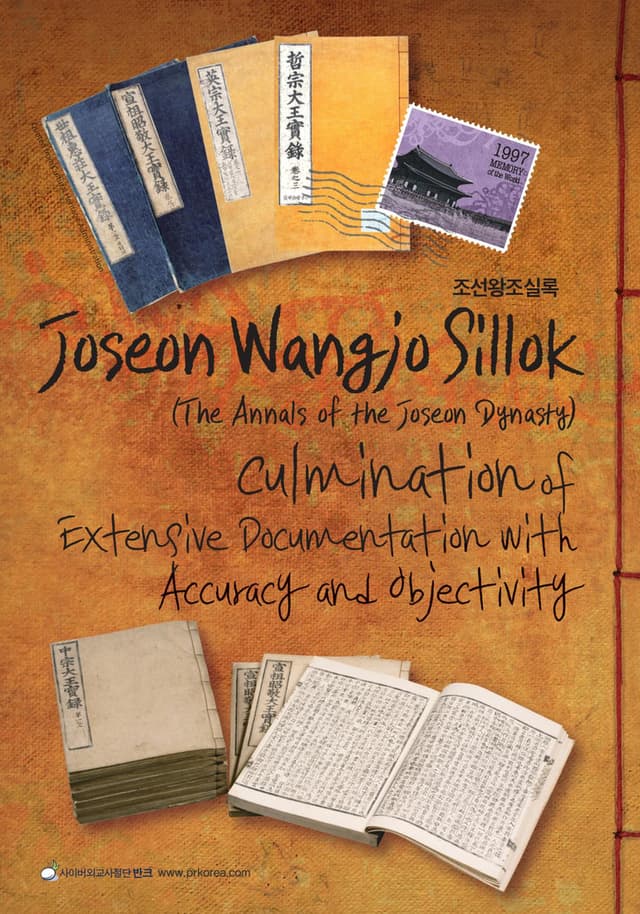
홍보물
 1
1 2
2직지와 세계기록유산 세계지도 (2024)
Jikji and the World Map of Memory of the World Heritage (2024)
한국어
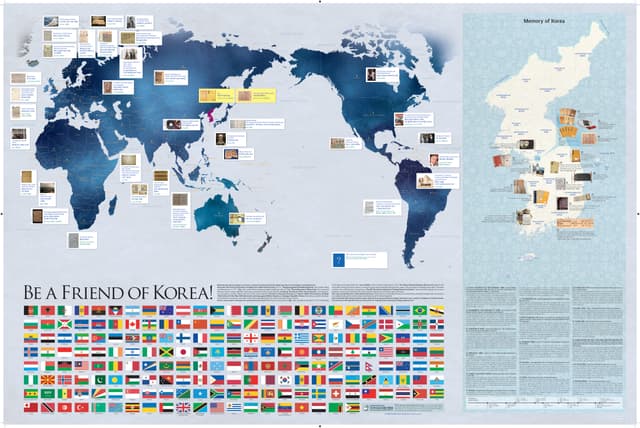
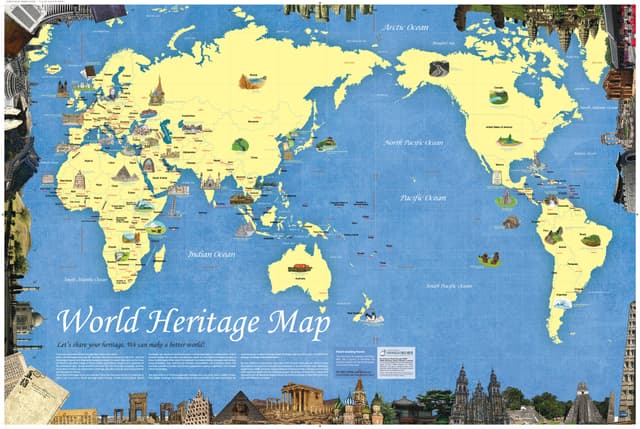
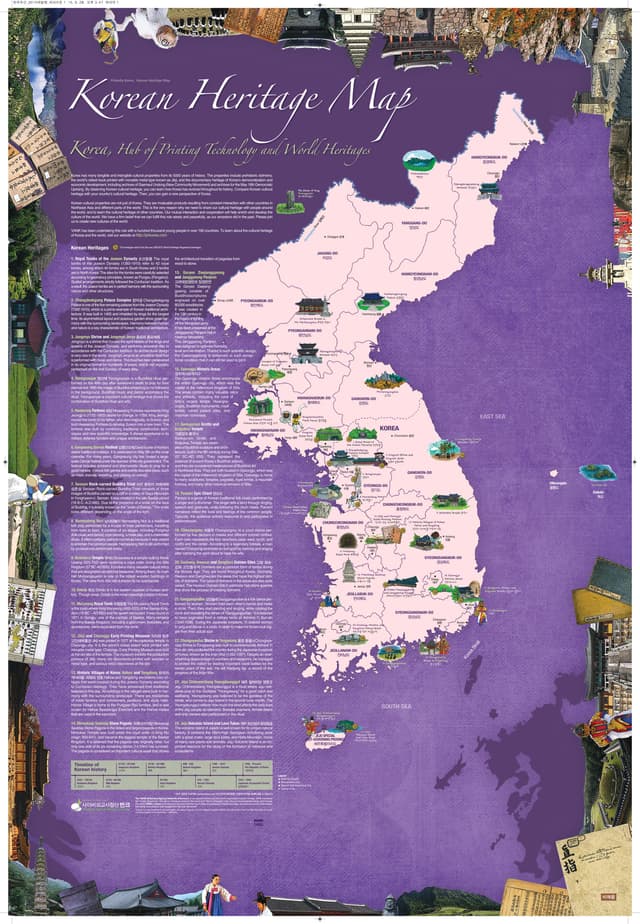
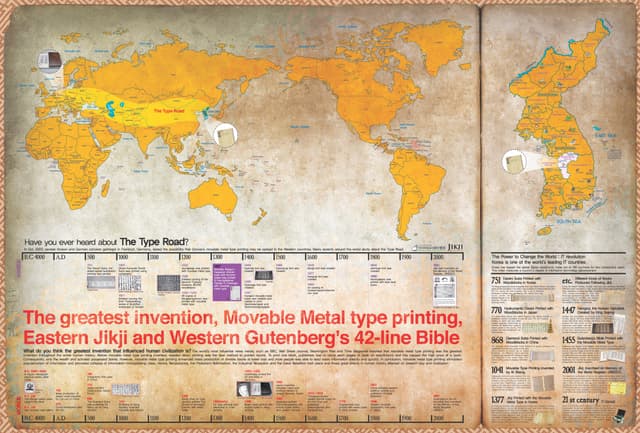
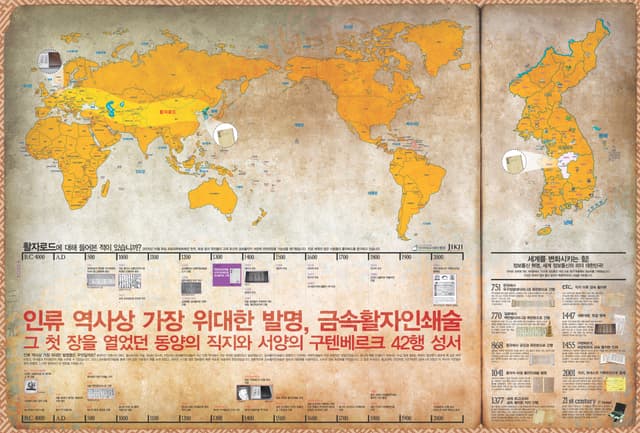
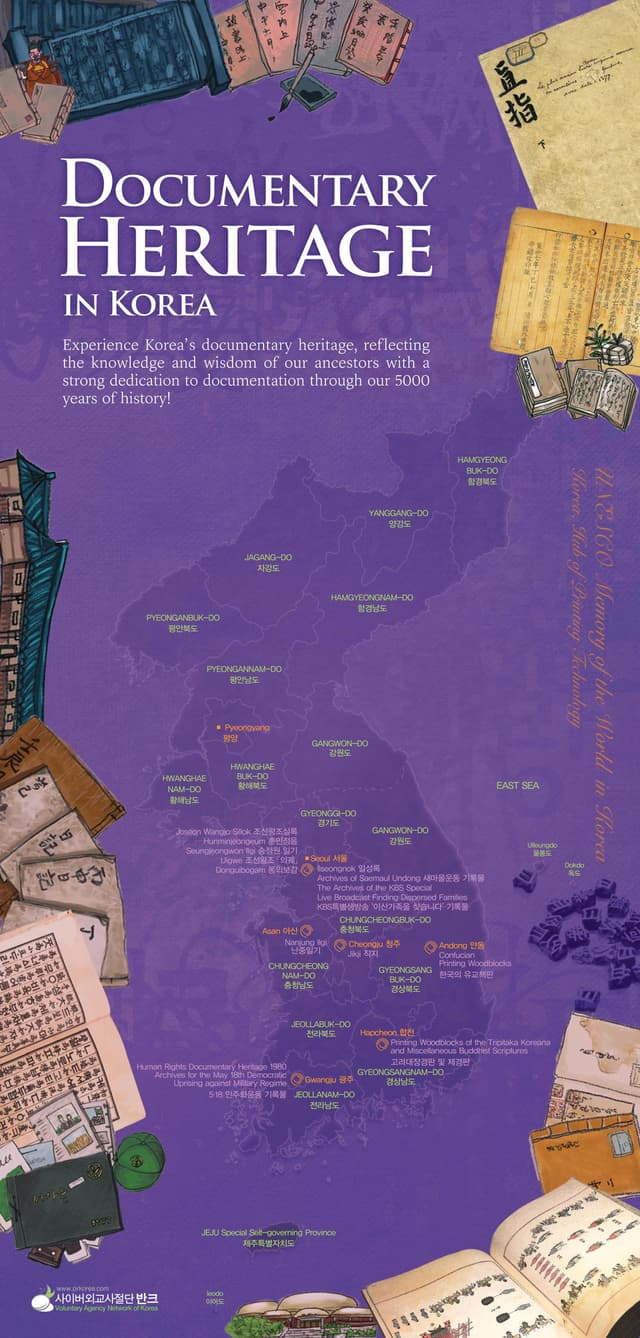
직지와 세계기록유산 세계지도는 세계에서 가장 오래된 금속활자본 직지와 훈민정음 등 한국 유산을 알리는 앞뒤 2장으로 구성된 홍보물이다. 앞면은 세계지도에 세계기록유산 25개를 영문으로, 뒷면은 한국의 문화·자연·무형·기록유산 58개를 한글과 영문으로 함께 소개한다.
EnglishThis promotional material, made up of a front and a back sheet, introduces Korean heritage, including Jikji, the world's oldest book printed with movable metal type, and the Hunminjeongeum Manuscript (Hunmin Chongum). The front side shows a world map marking 25 Memory of the World items in English, while the back side introduces 58 Korean cultural, natural, intangible, and documentary heritages in both Korean and English.
자료 원고 · English
The World’s Documentary Heritages
What documentary heritages do you want to pass down to the future generation?
In 1377, 『Jikji』, the world’s oldest movable metal type print, was printed at Heungdeoksa Temple, Cheongju in Korea. Like 『Jikji』, the world has many recorded heritages that have preserved our knowledge and wisdom throughout the centuries. Some preserve the history of documentation and printing like 『Jikji』, some preserve ancient languages and cultures like 「The Bleek Collection」, some preserve the advance of science like 『De revolutionibus libri sex』, and some preserve the progress of freedom and human rights like 「Original Declaration of the Rights of Man and of the Citizen」.
The world's documentary heritages remain in the forms of paintings, scriptures, printings, audio, video, and digital data. The method of recording changed with the growth of civilization, but humanity’s will to pass down knowledge and wisdom to future generations still continues. What documentary heritages are in your country? What documentary heritages do you want to pass down to the future generation?
Learn about various world documentary heritages. Write down documentary heritages you want to pass along to the future and tell about them to the teens and youth of Korea. We can be friends by the world’s documentary heritages! → Be a friend of Korea, Friendly Korea Community chingu.prkorea.com
1. Baegun Hwasang Chorok Buljo Jikji Simche Yojeol (Vol.2), also known as 『Jikji』, is the world’s oldest movable metal type print. It was printed at Heungdeoksa Temple, Cheongju, in 1377. Baegun Hwasang(1298-1374), the Buddhist monk from Goryeo, wrote 『Jikji』 by editing Buddha and great monks’ teachings. His writing was then published by his disciples with movable metal types. Originally, 『Jikji』 was published in two volumes, but only the second volume is found and currently kept at the National Library of France. 『Jikji』 is a vital heritage representing the start of movable metal type printing, a revolutionary technology of human history.
2. Hunminjeongum Manuscript is a manual of the Korean alphabet, 'Hangeul' published in 1446. The name of the manuscript was also the original name of the Korean alphabet. Hangeul was created for the public by King Sejong the Great (1397-1450), the fourth King of the Joseon Dynasty. 『Hunminjeongum Manuscript』 includes two parts: ‘Yeui’ and ‘Haerye’. ‘Yeui’ describes the purpose and goal of Hangeul, as well as the sound and instructions of the alphabet in the words of King Sejong. ‘Haerye’ was written by scholars, explaining principles and usage of the alphabet in detail with examples. This manual is a rare and important document on the creation of the alphabet, recording its purpose, principles, and usage.
3. Ben Cao Gang Mu (Compendium of Materia Medica) is the most comprehensive and complete medical book in Chinese history. Li Shi Zhen (1518-1593), a medical expert from the Ming Dynasty, finished the first draft in 1578 after 27 years of work. The book has recorded analyses and descriptions of every plant, animal, mineral, and other materials believed to possess medical properties. It organized and documented all medical knowledge of East Asia before the 16th century, revising and correcting many misunderstandings on the essence of medicines and sources of illness.
4. Borobudur Conservation Archives is a set of documents about the conservation of the Borobudur Temple, the world’s biggest Buddhist temple located on Java Island of Indonesia. This conservation project, carried out from the 1960s to 1980s, was one of the largest international campaigns of the 20th century, serving as the beginning of the creation of the World Heritage Convention. This campaign was also the first to use modern technologies for conservation procedures, with later world heritage conservation projects following the same process.
5. Rigveda is the oldest scripture among the four 『Vedas』, the Hindu scriptures that are among humanity’s first literary documents. Rigveda is closely related to the Aryan culture that influenced many ancient Asian regions. The heritage consists of the 30 most valuable manuscripts from the Bhandarkar Oriental Research Institute located in Pune, India. These manuscripts also act as traditional resources to interpret and understand ancient 『Rigveda』 literature.
6. The Deed For Endowment: Rab’ I-Rashidi (Rab I-Rashidi Endowment) 13th Century manuscript is a document about the submission of Rab' i-Rashidi as the waqf, the Islamic act of endowment. Rab’ i-Rashidi is an academic complex established by the politician, doctor, and historian Rashid al-Din (1247-1318) in Tabriz, Iran. The deed is 382 pages long, with the first 290 pages written by Rashid al-Din himself, and the rest by the Governor of Tabriz and two scribes. The heritage records the waqf, the endowment act representing Islamic society’s pillar. Also, it illustrates Central Asia’s the dynamic politics and economic during the time of writing.
7. Archives of the Dutch East India Company are documents regarding the Dutch East India Company, founded in 1602 by the Netherlands to initiate the Eastern trade. The Dutch East India Company most actively operated in areas spanning from South Africa to Japan until the early 17th century. Around 25 millions pages of recorded documents still remain in the archives of Jakarta, Colombo, Chennai, Cape Town, and Hague. Though their trading operation was a process of imperial exploitation, the archives contain valuable information about countries lacking historical resources from that time.
8. Rothschild Miscellany is a Hebrew manuscript created in Northern Italy during the Renaissance. The manuscript is 946 pages long and contains not only religious content but also history, politics, poetry, and fables. The book has 37 pieces of various literature and splendid illustrations painted from gold, silver, and other precious pigments. It is a unique documentary heritage that holds valuable information about the life of Italian Renaissance Jewry.
9. The Memory of the Suez Canal is a collection of documents about the ‘Suez Canal’, one of the most significant canals in the world. The Suez Canal is an essential heritage of human history: connecting the East and West and greatly influencing the history of the Middle East after its opening on November 17th, 1869. The collection includes many international documents from Egypt, France, and other foreign organizations, as well as rare books, photographs, and paintings related to the Suez Canal.
10. The Bleek Collection is a collection of documents and paintings by four German researchers, including Dr. Wilhelm Heinrich Immanuel Bleek(1827-1875) and his sister-in-law, Lucy Lloyd(1834-1914), about languages and folklore of Bushman. These documents are valuable for presenting the language, life, religion, mythology, folklore, and stories of the late Stone Age people. Many scholars, including researchers outside linguistics, use this collection as a resource.
11. The Collection of Arabic Manuscripts and Books documents the society and culture of Zanzibar and East Africa. The collection is currently housed at the National Archives of Zanzibar in Tanzania and includes around 800 manuscripts and prints, some dating back to the 17th~18th century. The manuscript also serves as an art piece displaying calligraphy, the arrangement to margins, and artistic ornamentation alongside its subjects on Islam, Arabic literature, rhetoric, and the history of ideas in Zanzibar and Eastern Africa.
12. William Ponty School Collection of Papers is a collection of manuscripts written by 3rd-grade students of William Ponty School during the 1933 summer vacation. William Ponty School was founded on November 24th, 1903, as a teacher training trainee college for French West Africa teachers. The collection encompasses 28 subjects about socio-cultural aspects of Black Africa. Many notable Africans, including Mamadou DIA, the President of the Senegal Council, participated in the project.
13. The Human Being Interests Linked to the Religions and the Body is a book written by Abdullah dan Fodio(1766-1829) about Islamic law and medicine. The book contains 26 folios and 52 pages with an average of 21 lines on each page. Its content is mainly divided into two parts; The former discusses human rights from conception to death according to Islamic law, and the latter describes medicines. The heritage demonstrates a very modern idea of human rights and highlights health professionals’ ethics.
14. Magna Carta, issued in 1215 is one of the most notable documents in English history. It represents the freedom of England, law, and democracy, and its influence affects the whole world. In June 1215, King John gathered with nobles to resolve the political crisis. After establishing 「Magna Carta」, he sent many copies around the countries, with four copies currently remaining. 「Magna Carta」 is the first written document to limit the royal authority and reestablish the power of custom to inhibit unjust and arbitrary behavior of the king.
15. The 42-line Gutenberg Bible, printed on vellum, is the first book to be printed by movable metal types in Europe. The Bible was printed around 1455 by Johannes Gutenberg (1397-1468) in Germany. 「42-line Gutenberg Bible」, printed on vellum, currently has four surviving copies, with one residing at the Goettingen State and University Library. The library also houses the 『Goettingen Model Book』, the source of bible illustration, and the 「Notarial Instrument of Ulrich Helmasperger」, the evidence of Gutenberg’s invention. These documents are significant in their representation of the early
European history of movable metal type printing.
16. Diaries of Anne Frank is written by Anne Frank(1929-1945), a teenager who recorded two years of living in hiding with her family and other four Jewish residents during World War II. The heritage consists of a check-patterned diary, two notebooks, 360 drafts of diary papers, and other documents recorded by Anne. Diaries of Anne Frank is one of the ten most-read books in the world and is still used in present classes around the world as historical evidence of genocide and racial discrimination.
17. Original Declaration of the Rights of Man and of the Citizen (1789, 1791) was written by the National Constituent Assembly to establish human civil rights during the 1789 French Revolution. The original handwritten document is currently preserved as heritage. Lafayette initially drafted the declaration, and later completed it with revisions by Thomas Jefferson. The document includes content on the topics of freedom, equality, and freedom of religion, press, and society. The heritage became the foundation of the French Constitution of 1791, and further influenced constitution and politics
worldwide, including the 1948 Universal Declaration of Human Rights by the United Nations.
18. The Historical Collections (1899-1950) of the Vienna Phonogrammarchiv consists of around 4,000 recordings of international ethnic languages and ethnic folk music. The ‘Vienna Phonogrammarchiv’ is the world’s first sound archive, founded in 1899, with over 50,000 recordings (around 7,000 hours of material) in its collection. The collection includes early recordings of orally transmitted cultures before the influence of Western civilization and documents with their original sources currently extinct or greatly changed. Many recordings within the collections are the oldest of their kind, and some are unique, serving as a primary resource for many fields of study.
19. Nicolaus Copernicus’ masterpiece “De revolutionibus libri sex” is an autography by Nicolaus Copernicus(1473-1543), a Renaissance astronomer. The document is a draft written around 1520 about the heliocentric theory. The draft is housed at the Jagiellonian Library in Cracow, where Copernicus once studied. His revolutionary heliocentric theory criticized flaws of the geocentric theory, the universal idea of that time. His work greatly improved the study of natural science and became the foundation for many scientific fields.
20. Slavonic Publications in the Cyrillic script of the 15th century is a collection of Slavonic publications written in the Cyrillic alphabet from the 15th to early 16th century. It consists of 63 books, most of which are kept in the Russian State Library as the cultural heritage of Slavonic nations. Other copies reside in Ukraine, Byelorussia, Bulgaria, Serbia, Montenegro, Romania, France, The United Kingdom, The United States of America, Croatia, Slovenia, The Czech Republic, and Greece. Most of these publications are very rare, some unique, and all greatly influence Slavic nations’ development.
21. The Discovery of Insulin and its Worldwide Impact is a collection of documents related to the discovery of insulin. The heritage encompasses research data of the Nobel prize winners Dr. Frederick Banting(1891-1941) and Dr. John Macleod(1876-1935), including letters from their patients. Following the discovery of insulin, millions of lives of diabetic patients are saved and significantly improved. As the number of diabetic patients increases worldwide, the discovery of insulin continues to be a significant event to humanity.
22. The Wizard of Oz (Victor Fleming 1939), produced by Metro-Goldwyn-Mayer is a film that was directed by Victor Fleming in 1939. The heritage includes the original movie film and soundtrack housed at George Eastman House located in Rochester, New York. The movie is an adaptation of the classic fairy tale 『The Wonderful Wizard of Oz』, and appeals audiences of all ages worldwide. The Wizard of Oz is also one of the most watched movies in film history.
23. The Collection of Mexican Codices records the Mesoamerican culture of Mexico from the 16th to early 20th century, as well as the post-Spanish Conquest colonial era. The collection consists of one pre-Hispanic codex, 92 colonial original documents, and 68 manuscripts. The Codices are the only available literary sources on native cultures before the Spanish conquest and the early relationship between natives and conquistadors. They are also the only surviving records of a reading and writing system unique to the cultures of Mesoamerica.
24. Documentary Heritage of Enslaved Peoples of the Caribbean is a collection of documents describing the life and social structure of enslaved people of the Caribbean from the 17th to 19th century. In 1661, the Barbados Slave Code was passed by the English colony of Barbados, and became the foundation for other slave laws around the world. After the 17th century, the British Empire developed a colonial economy in the Caribbean stemming from the enslavement in Barbados. The heritage in question consists of related legal documents, plantation ledgers, slave trade documents, estate and shipping inventories, publications, and printings.
25. The Emperor’s collection: foreign and Brazilian photography in the XIX century dro II(1825-1891) consists of 21,742 photographs collected by Brazilian Emperor Pedro II(1825-1891). The collection was later donated to the National Library of Brazil and is currently kept as the ‘Collection of photographs of Teresa Cristina Mar�a’. It is the biggest photography collection in South America, consisting of customs, technology, and industrial development of the 19th century. Additionally, the collection includes pieces important to the history of photography taken by early-generation photographers in a variety of subjects.
더 보기 ▾