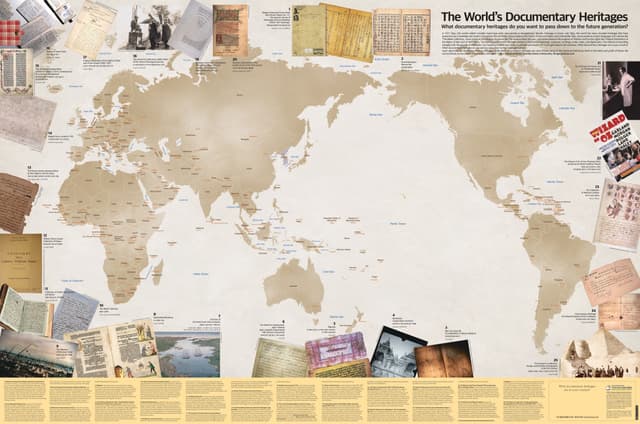
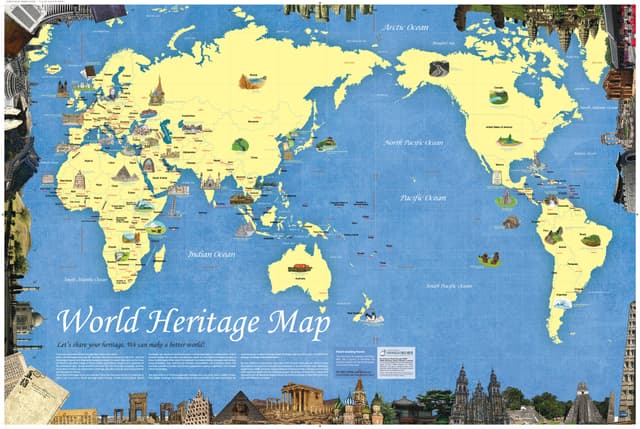
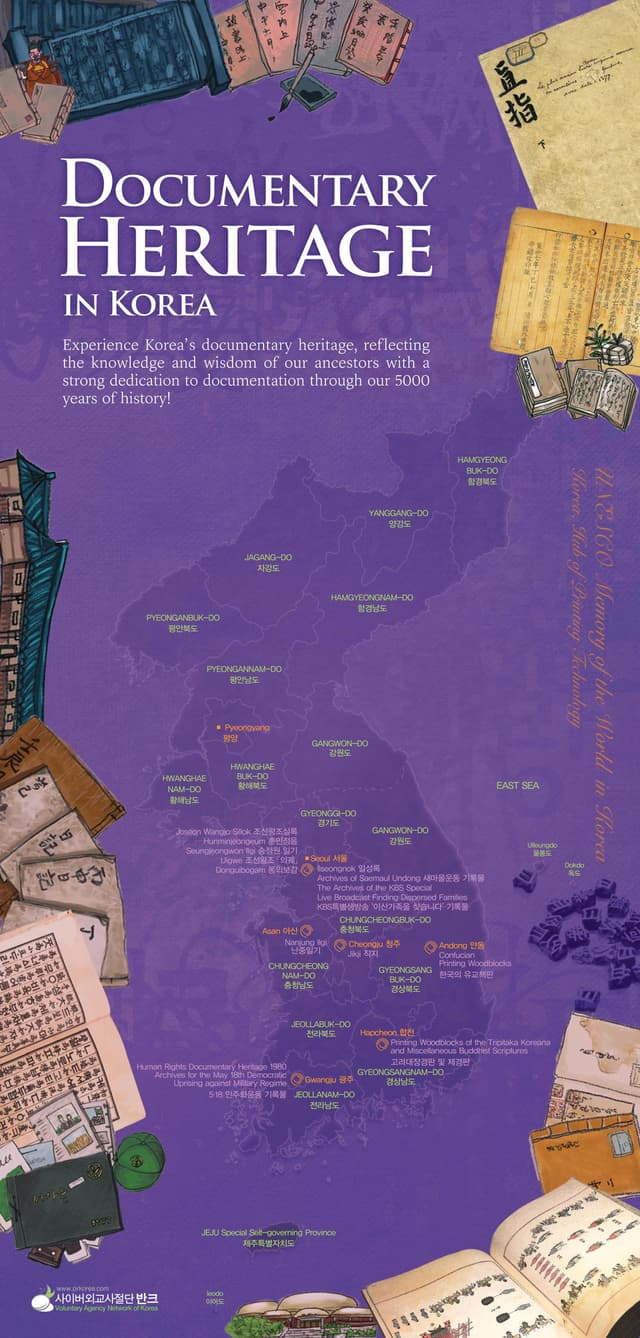
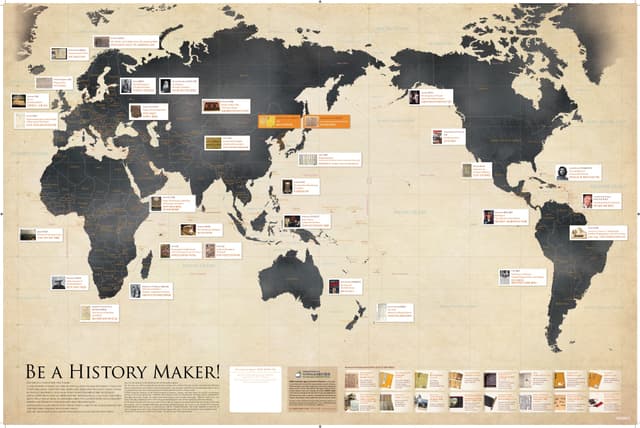
한국어세계기록유산지도는 한국의 기록유산 17개와 세계 각국의 기록유산 35개를 함께 소개하는 세계지도이다. 751년경 인쇄된 『무구정광대다라니경』, 1377년 간행된 세계에서 가장 오래된 금속활자본 『직지』, 1446년 반포된 한글의 해설서 『훈민정음(해례본)』, 『조선왕조실록』을 비롯한 여러 기록을 소개한다. 세계의 기록유산으로는 미국 빅터 플레밍 감독의 오즈의 마법사, 멕시코 고문서 컬렉션, 19세기 브라질 황제의 소장품, 중국 전통음악 녹음 기록, 태국 랑 캄행 왕의 비문, 이집트 수에즈 운하 관련, 남아프리카공화국 블레크 컬렉션, 프랑스 권리선언, 폴란드 쇼팽 걸작선 등을 세계지도와 함께 소개한다.
EnglishThe Memory of the World Map is a world map that introduces 17 items of Korea's documentary heritage together with 35 documentary heritage items from countries around the world. It presents records such as the Mugujeonggwang daedaranigyeong (The Great Dharani Sutra of Immaculate and Pure Light), printed around 751; Jikji, the world's oldest book printed with movable metal type, published in 1377; the Hunminjeongeum Manuscript (Hunmin Chongum), the explanatory text of Hangeul promulgated in 1446; and the Joseon Wangjo Sillok (Annals of the Joseon Dynasty). Documentary heritage from around the world is shown on the map as well, including The Wizard of Oz directed by Victor Fleming of the United States, the Collection of Mexican Codices, the collection of a 19th-century Brazilian emperor, the Chinese Traditional Music Sound Archive, the King Ram Khamhaeng Inscription of Thailand, the Memory of the Suez Canal of Egypt, the Bleek Collection of South Africa, the Declaration of the Rights of Man and of the Citizen of France, and the Masterpieces of Fryderyk Chopin of Poland.
자료 원고 · EnglishBe a Friend of Korea!
What documentary heritages are in your country?
Countries around the globe have their own heritages recording history.
Korea also has many documentary heritages that made Korean history.
In 751, 『Mugujeonggwang Daedaranigyeong』, the world’s oldest woodblock print. In 1377, 『Jikji』, the world’s oldest existing movable metal type print. In 1446, 『Hunminjeongeum Manuscript』, the manual of Hangeul, Korea’s unique alphabet. Many documentations of the Joseon Dynasty including 『The Annals of the Joseon Dynasty』, recording politics, economics, society, culture, and arts of the Joseon Dynasty. ‘Archives of Saemaul Undong’ and ‘Human Rights Documentary Heritage 1980 Archives for the May 18th Democratic Uprising against Military Regime, in Gwangju, Republic of Korea’ recording economic development and democratization of modern Korea. These valuable Memories of Korea bear the Korean history.
Korean documentary heritages are connected to the world.
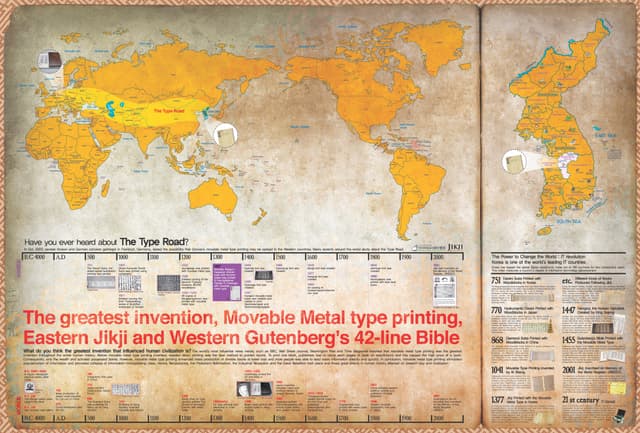
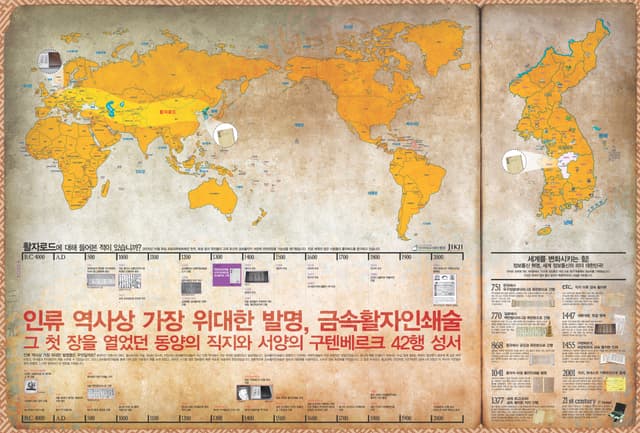
When Korea in Asia printed 『Jikji』 with movable metal types in 1377, Gutenberg of Germany in Europe printed the 『42-Line Bible』 with movable metal types in 1455. ‘The Nation Debt Redemption Movement’ began in the early 20th century by Korean citizens to redeem foreign debt and fight extortion from Japan. This movement motivated many other colonized countries also suffering from foreign loans. ‘The KBS Special Live Broadcast "Finding Dispersed Families"’ presented the tragedy of war and a divided country and emphasized the world with the importance of human rights and peace.
This map records Memories of the World and Korea.
Study diverse and valuable Korean and world history through heritages.
We can broaden our understanding of the world and protect Memories of the World together.
Let’s be friends with Korea and learn more about Korean documentary heritages.
Introduce your country’s heritages to Korean friends.
Our memories will make the history of the world.
→Friendly Korea Community chingu.prkorea.com
-Human Rights Documentary Heritage 1980 Archives for the May 18th Democratic Uprising against Military Regime, in Gwangju, Republic of Korea
Human Rights Documentary Heritage 1980 Archives are documentations related to the democratic uprising against the military regime that occurred between May 18th, 1980, and May 27th in Gwangju, Republic of Korea. The documentations include papers, photographs, and videos about the resistance of citizens, the punishment of the accused, and compensation. The May 18th Democratic Uprising was a pivotal event in Korean democracy that influenced many East Asian countries and set an international example of compensation for human rights violations.
-The Archives of the KBS Special Live Broadcast "Finding Dispersed Families"
The Archives of the KBS Special Live Broadcast "Finding Dispersed Families" are related documentations of The KBS Special Live Broadcast "Finding Dispersed Families" aired live for 138 days from 10:15 pm on June 30th, 1983 to 4 am on November 14th. The archives consist of 463 tapes of the original recordings and other 20,522 materials including applications written by separated families. The archives spread the tragedy of the Korean war and a divided country to the international society and eased the tension on the Korean peninsula.
-Printing Woodblocks of the Tripitaka Koreana and Miscellaneous Buddhist Scriptures
The printing woodblocks of the Goryeo Daejanggyeong (Goryeo dynasty Tripitaka) are wooden printing blocks carved during the 13th century, under commission by the Goryeo Dynasty of Korea. There is a total of 81,258 blocks preserved at the Haeinsa Temple. The temple also holds 5,987 miscellaneous woodblocks separately created to supplement the Goryeo Daejanggyeong, some of which are the only extant copy in the world. The printing woodblocks of the Goryeo Daejanggyeong and miscellaneous woodblocks have a high level of accuracy that long served as a standard of East Asian Buddhism research. Due to their significant durability, woodblocks are possible to print even to this day.
-The Archives of the National Debt Redemption Movement
The Archives of the National Debt Redemption Movement is a documentation of the National Debt Redemption Movement that began from 1907 to 1910 to repay a national debt. In midst of the Korean invasion by Imperialistic Japan, Korea faced a threat to its sovereignty under coercive external debt owed to Japan. In response to this, Korean citizens began a public fundraising campaign in which men, women, entertainers, beggars, and even thieves participated. The campaign was halted by Japan but was known outside Korea and affected many other colonized countries also suffering from foreign loans.
-Nanjung Ilgi : War Diary of Admiral Yi Sun-sin
Nanjung Ilgi is the handwritten journal of Admiral Yi Sun-sin (1545~1598) during the Imjin War (1592~1598) triggered by the invasion of Japan. It is composed of 7 volumes with a total of 205 pages. Admiral Yi Sun-sin contributed greatly to the victory of Joseon by leading every naval battle he commanded to victory. The journal includes the situational record of war alongside personal thoughts and one’s own poem.
-Donguibogam, Principles and Practice of Eastern Medicine
Donguibogam is an encyclopedic bible of medical knowledge and treatment techniques of Joseon and East Asia compiled by Heo Jun (1539~1615), a medic of Joseon, under royal command in 1613. It is composed of 25 volumes and contains significant insight into preventive medicine and public health which was only formally introduced in the 19th century. The content includes well-compounded Eastern medical knowledge, accentuation on public health, and types of medicine herbs easily-accessible by the common people.
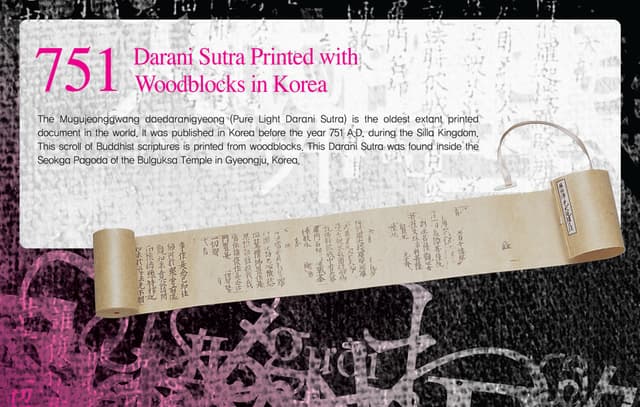
-Mugujeonggwang Daedaranigyeong (The Great Dharani Sutra)
Mugujeonggwang Daedaranigyeong is the oldest woodblock print in the world, published in the year 751 in the Silla Kingdom, the ancient Korean country. It is a Hanji (Korean traditional paper) scroll, about 8cm in width and about 620cm long in total, with Buddhist scriptures printed on it. Hanji is the traditional paper of Korea with high durability, flexibility, and resistance to germs. Korea has a lot of preserved documentary heritages including Mugujeonggwang Daedaranigyeong, demonstrating the significant endurance of Hanji.
-Baegun hwasang chorok buljo jikji simche yojeol (vol. Ⅱ), the second volume of "Anthology of Great Buddhist Priests' Zen Teachings"
Also known as Jikji, this volume is the oldest existing movable metal types print from the 1377 Korean Goryeo era. It is printed at Heungdeoksa Temple of Cheongju City and contains the main idea of Zen Buddhism. Originally, Jikji consisted of a total of two volumes, but only the second volume is found and currently kept at the National Library of France. Korea was ahead of its time in printing technology. Around the year 751, Korea printed the world’s oldest woodblock print, Mugujeonggwang Daedaranigyeong, and began movable metal type printing in Goryeo which continued to the Joseon era to publish multiple movable metal type printed books.
-Archives of Saemaul Undong (New Community Movement)
Archives of Saemaul Undong are documentations of the New Community Movement conducted from 1970 to 1979 in Korea to reduce poverty. Archives include documentary materials produced by the Office of the President, central and local administrative agencies, and individual villages, letters, instructional manuals, photographs, and videos. During the movement, Korean farm household income rapidly increased and became the root of Korean economic growth. Today, Korea is sharing stories of Saemaul Undong with other countries fighting poverty.
-Seungjeongwon Ilgi, the Diaries of the Royal Secretariat
Seungjeongwon Ilgi is an extensive record of government affairs of the Joseon Dynasty. Seungjeongwon is the royal secretariat office of the king that documented the daily life of every king. Prior records before 1623 are all lost but 3,245 volumes dating from March 1623 to August 1910 remain. It chronicles an open-door policy between the late 19th century and early 20th century and the documentation and preservation of the royal dynasty.
-Ilseongnok Records of Daily Reflections
Ilseongnok is a government affairs diary written by the kings of Joseon to be referred to for other governmental purposes. A total of 2,329 books from 1760 to 1910 are preserved. It began with the diary of King Jeongjo (Reign: 1776~1800), the 22nd king of Joseon, from his youth, as the eldest son of the crown prince. From 1783, the recording process was done by officials from Gyujanggak Library, the royal library of Joseon, and reviewed by the king. The diaries have a unique purpose and method of recording, containing detailed documentation of Eastern and Western political and cultural exchange between the 18th and 20th centuries.
-Royal Seal and Investiture Book Collection of the Joseon Dynasty
Royal Seal and Investiture Book Collection of the Joseon Dynasty are seals created for royal ceremonies, such as the crowning of a prince, accession of the throne, or inauguration of official titles, the investiture books, and royal edicts. Materials included gold, silver, and jade for the royal seal and jade and bamboo for books. The culture of utilizing royal seals and investiture books continued for the whole Joseon Dynasty, which enabled documentation of different phrases, contents, sentence structures, writing styles, materials, and decorations of each era.
-Uigwe, the Royal Protocols of the Joseon Dynasty
Uigwe is the document holding protocols of royal ceremonies of the Joseon Dynasty with text and illustrations for the later generations. It contains not only major ceremonies such as weddings, funerals, or feasts but also architecture and the construction of a royal tomb. Currently, around 4,000 books from 1601 to 1928 are preserved. Uigwe has vibrant illustrations painted by officially recognized painters.
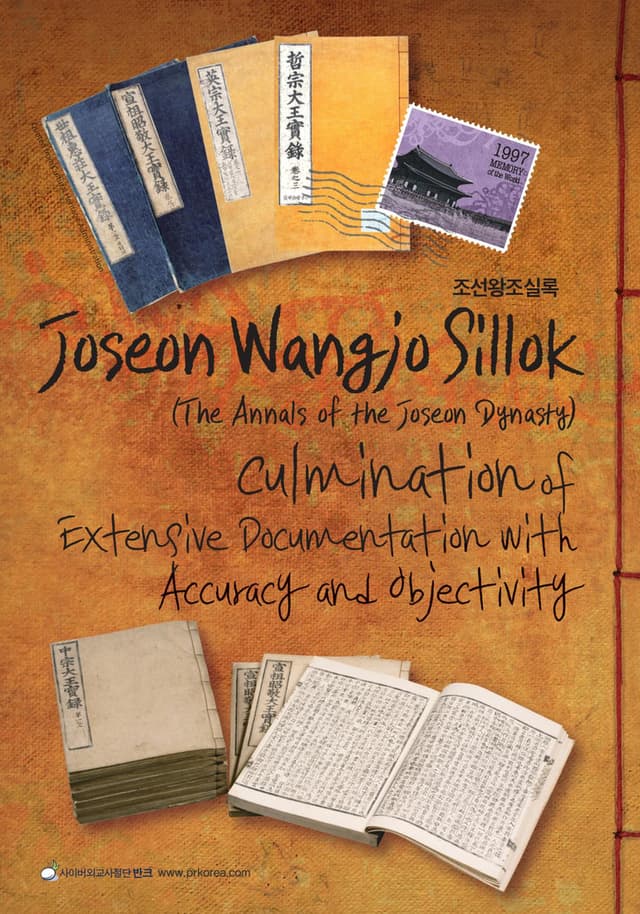
-The Annals of the Joseon Dynasty
The Annals of the Joseon Dynasty is a record that holds around 470 years of the history of the Joseon Dynasty. It is one of the most detailed historical documents in the world with a total of 2,077 volumes existing. ‘Sagwan’, historiographers who record the first draft of the record, participate in every national conference and thoroughly documented the proceedings. These drafts were later published in the Annal after the king’s death. Every recording and publishing process was strictly protected and not even the king was permitted to read the records for the sake of fairness
-Documents on Joseon Tongsinsa/Chosen Tsushinshi: The History of Peace Building and Cultural Exchanges between Korea and Japan from the 17th to 19th Century
Documents on Joseon Tongsinsa are recordings relating to diplomatic delegations sent from Korea to Japan during the 17th to 19th century. Documents are composed of diplomatic materials, travel logs, cultural exchange, and more. After the invasion of Japan in the late 16th century, diplomatic relations between the two countries had been discontinued. To rejuvenate and build a peaceful relationship, Korea sent diplomatic delegates to Japan 12 times with Japan’s invitation. These cross-cultural exchanges resulted in political stability in the East Asia region including the two countries.
-Confucian Printing Woodblocks in Korea
Confucian Printing Woodblocks in Korea are 64,226 pages of woodblocks used for printing Confucian books during the Joseon Dynasty. It consists of various areas such as literature, politics, economics, philosophy, and interpersonal relations with all devoted to the realization of ethical community. Production process and cost were decided in the community and shared the expenses. The heritage was passed down to later scholars not only as a device to print books but as a symbol of knowledge from ancient sages.
-Hunminjeongeum Manuscript
Hunminjeongeum Manuscript is a manual of Korea’s own alphabet, ‘Hangeul’, invented and published by King Sejong the Great (1397~1450) in 1446 Joseon. The book introduces King Sejong’s purpose for Hangeul's creation for the common people and the scientific principles of Hangeul modeled after Korean speech mechanisms. Through easily learnable Hangeul, Koreans were able to fully write the Korean language which greatly contributed to the advancement of Korean culture.
Be a Friend of Korea!
→Friendly Korea Community chingu.prkorea.com
더 보기 ▾