자료 원고 · English◎ History of Korea
-Gojoseon Kingdom
The Gojoseon Kingdom was the first Korean nation founded during the Bronze Age under the principle of Hongik Ingan(humanitarianism), meaning ‘To broadly benefit humanity’.
-Silla Kingdom
Silla, a kingdom that continued for about a thousand years, developed its society around Buddhism and the Hwarangdo. Queen Seondeok of Silla laid the foundation for the unification of the Three Kingdoms.
-Goguryeo Kingdom
The Goguryeo Kingdom grew into a powerful nation in Northeast Asia based on its strong military power. King Gwanggaeto the Great led a golden age of territorial expansion.
-Baekje Kingdom
The Baekje Kingdom made a significant impact on ancient East Asian culture through refined art and maritime exchange. It also introduced Buddhism and cultural practices to Japan.
-Gaya Confederacy
The Gaya Confederacy was a confederated kingdom that emerged in the southern part of the Korean Peninsula. It developed an iron culture through abundant iron resources and prospered as a hub of international trade.
-Balhae Kingdom
The Balhae Kingdom succeeded Goguryeo and grew into a powerful nation in Northeast Asia. It developed a unique culture with active diplomatic practices.
-Goryeo Dynasty
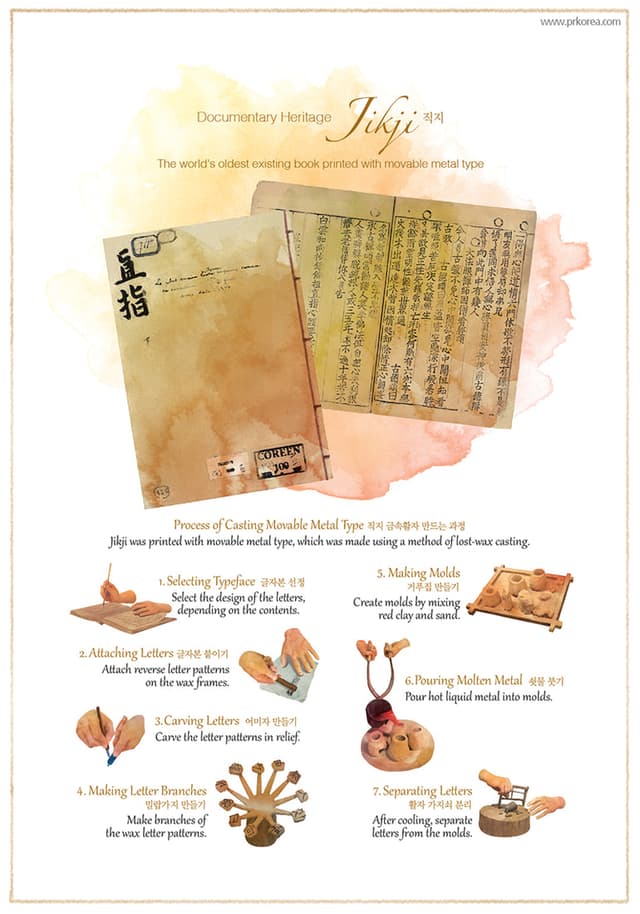
The Goryeo Dynasty flourished in Buddhist culture and published ‘Jikji’, the world’s oldest book printed with movable metal type. Through active international exchanges, it introduced the name ‘Korea’ to the world.
-Joseon Dynasty
The Joseon Dynasty was governed based on Neo-Confucianism. King Sejong the Great created ‘Hangeul’ and implemented policies for the well-being of the people, ushering in the golden age of Joseon.
-Anti-Japanese Resistance Period
The Japanese Occupation Period (also known as the Anti-Japanese Resistance Period) was a time when Korea lost its sovereignty to Japan. Despite brutal oppression, Koreans continually resisted through various independence movements to escape colonialism.
-Republic of Korea
In just half a century, the Republic of Korea achieved both economic growth and democratization. Today, it communicates with the world through Hallyu(Korean Wave) and aspires to contribute to global peace through reunification.
◎ Korea’s Independence Movement
In 1910, Korea was forcibly annexed by Japan. For the next 35 years, Koreans continued to resist harsh oppression with independence movements.
-Righteous Army Movement (Uibyeong Undong)
The Righteous Army Movement was a long-standing tradition of armed resistance in Korean history, where citizens voluntarily fought against foreign invasion. During the Japanese occupation, these movements laid the foundation of Korea’s independence movements.
-March First Independence Movement
In 1919, around two million Koreans participated in a nonviolent independence movement against Japanese imperialism. This movement triggered the establishment of the Korean Provisional Government and became a symbolic example of anti-colonial resistance movements in Asia.
-Battles of Bongodong and Cheongsanri
In 1920, Korean independence forces defeated the Japanese army in the Battles of Bongodong and Cheongsanri. These two battles, now regarded as two main armed independence movements of Korea, shocked Japanese society and widely demonstrated Koreans' will for independence.
-Provisional Government of the Republic of Korea
Established in Shanghai, China on April 11, 1919, the Provisional Government of the Republic of Korea led diplomatic campaigns, armed resistance, and national unity. It became the foundation of today's Korea.
◎ Korea’s Documentary Heritage
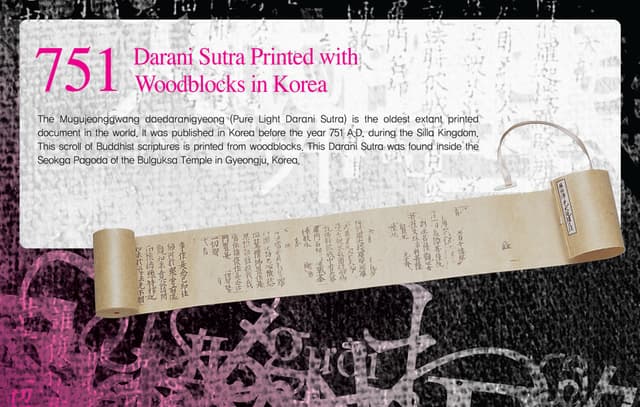
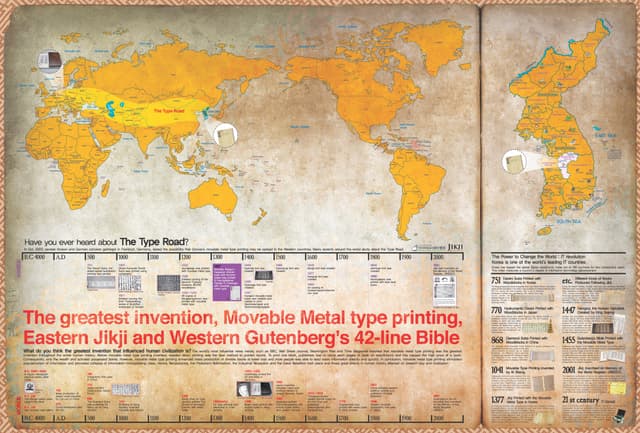
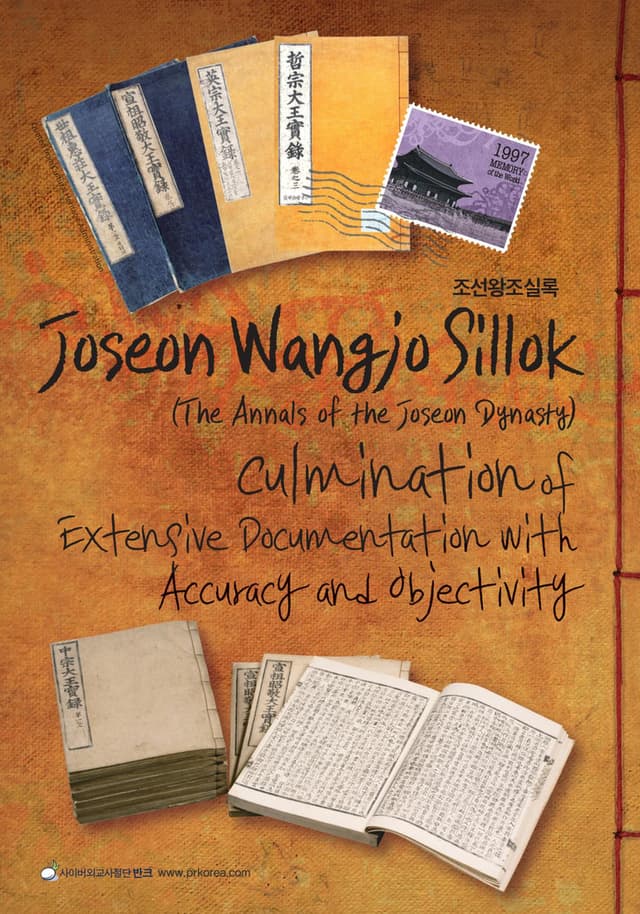
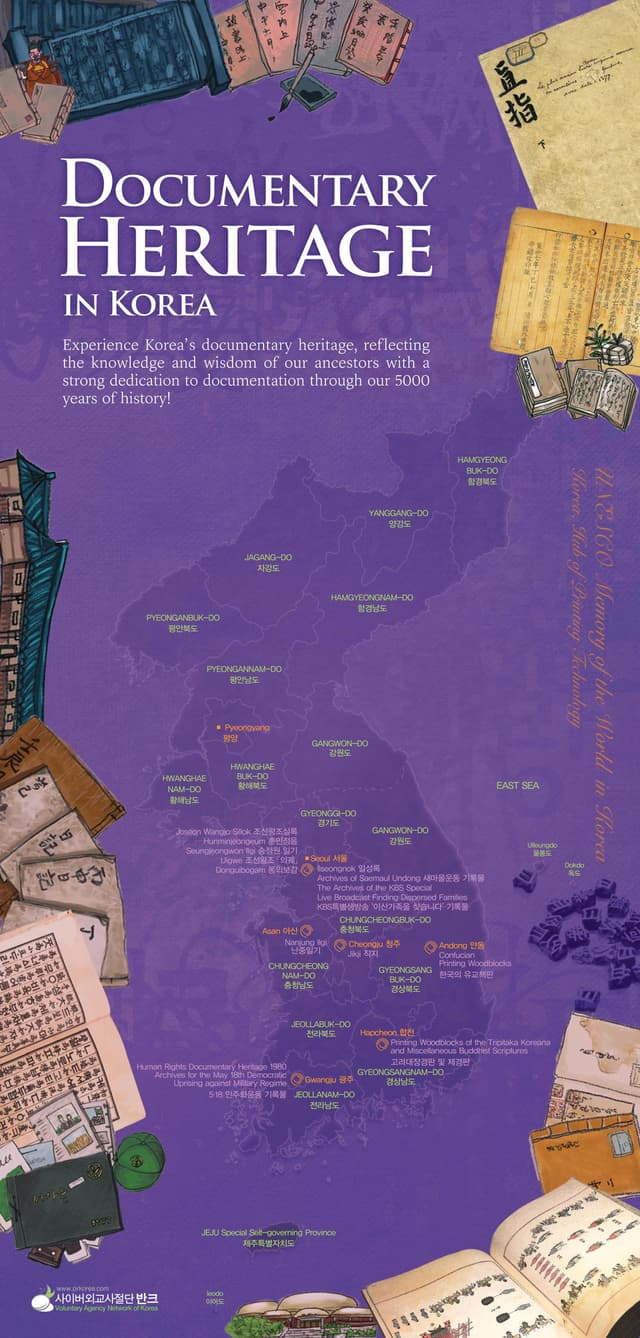
The Republic of Korea is a global leader in documentary heritage. In the early 8th century, Korea printed 『The Great Dharani Sutra of Immaculate and Pure Light』, the first woodblock print in the world. In 1377, 『Jikji』, the world’s oldest book printed with movable metal type, was published 78 years before Gutenberg’s Bible. In 1446, King Sejong published 『Hunminjeongeum Manuscript』, which described the principles and usage of ‘Hangeul’, the Korean alphabet designed for the common people. The book marks the birth of this unique alphabet. There are other meaningful documentary heritages in Korea. 『The Annals of the Joseon Dynasty』 objectively records 500 years of Joseon’s politics, society, and culture. 『The May 18 Democratic Uprising Records』 document a citizen-led pro-democracy movement. The Archives of the 『KBS Special Live Broadcast "Finding Dispersed Families"』 vividly shows the tragedy of national division and the Cold War. These documentary heritages greatly reflect Korea's history, culture, knowledge, and identity.
Let’s learn about Korea more deeply through its invaluable documentary heritages!
https://jikji.prkorea.com/
-Mugujeonggwang Daedaranigyeong (The Great Dharani Sutra), Early 8th c.
-Printing Woodblocks of the Tripitaka Koreana and Miscellaneous Buddhist Scriptures, 13th
-Baegun hwasang chorok buljo jikji simche yojeol (vol.II), the second volume of "Anthology of Great Buddhist Priests' Zen Teachings", 1377
-The Annals of the Joseon Dynasty, 1392~1863
-Royal Seal and Investiture Book Collection of the Joseon Dynasty, 1392~1966
-Hunminjeongeum Manuscript, 1446
-Confucian Printing Woodblocks in Korea, 1460~1956
-Nanjung Ilgi: War Diary of Admiral Yi Sun-sin, 1592~1598
-Uigwe: The Royal Protocols of the Joseon Dynasty, 1601~1909
-Documents on Joseon Tongsinsa : The History of Peace Building and Cultural Exchanges between Korea and Japan from the 17th to 19th Century, 1607~1811
-Donguibogam: Principles and Practice of Eastern Medicine, 1613
-Seungjeongwon Ilgi, the Diaries of the Royal Secretariat, 1623~1910
-Ilseongnok: Records of Daily Reflections, 1760~1910
-Archives of the Donghak Peasant Revolution. 1894~1895
-Archives of the National Debt Redemption Movement, 1907~1908
-Revealing Truth: Jeju 4·3 Archives, 1947~1954
-Archives of the April 19 Revolution, 1960
-Archives of Saemaul Undong (New Community Movement), 1970~1979
-Korea Reforestation Archives: A reforestation model achieved through public-private governance, 1973~1980s
-Human Rights Documentary Heritage 1980 Archives for the May 18th Democratic Uprising against Military Regime, in Gwangju, Republic of Korea, 1980
-Archives of the KBS Special Live Broadcast “Finding Dispersed Families”, 1983
◎ Let’s Travel! Korea’s Heritage Sites
Korea is home to many precious heritage sites preserved through Korea’s long history.
These include ‘Gochang, Hwasun, and Ganghwa Dolmen Sites’ where the 40% of world’s dolmens are located, ‘Seokguram Grotto and Bulguksa Temple’ in Gyeongju which represents masterpieces of ancient Buddhist architecture, and ‘Haeinsa Temple Janggyeong Panjeon’ in Hapcheon which preserves the 13th-century Tripitaka Koreana woodblocks in perfect condition. In Seoul, the former capital of the 500-year Joseon Dynasty and the current capital of Korea, one can find ‘Changdeokgung Palace Complex’, harmoniously designed with nature, and ‘Jongmyo Shrine’, where Confucian rituals are still performed today.
In the south of the Korean Peninsula, there is ‘Jeju Volcanic Island’, known for its unique volcanic landscape. Along the western and southern coasts, ‘Getbol(Korean Tidal Flats)’ provide habitats for diverse marine life.
From prehistoric megalithic culture to the cultures from 5,000 years of dynasties, and natural heritage sites harmonizing nature and ecology, let’s travel Korea’s heritage sites and meet the richer, more vibrant side of Korea!!
※Heritage Sites Located in Various Regions
-‘Gochang, Hwasun, and Ganghwa Dolmen Sites’ are located in 3 regions: Gochang, Hwasun, and Ganghwa.
-‘Getbol, Korean Tidal Flats’ are located in four regions: Shinan, Boseong-Suncheon, Gochang, and Seocheon.
-‘Seowon, Korean Neo-Confucian Academies’ consist of 9 academies: Sosu-seowon, Namgye-seowon, Oksan-seowon, Dosan-seowon, Piram-seowon, Dodong-seowon, Byeongsan-seowon, Museong-seowon, and Donam-seowon.
-‘Sansa, Buddhist Mountain Monasteries in Korea’ consist of 7 temples: Tongdosa, Buseoksa, Bongjeongsa, Beopjusa, Magoksa, Seonamsa, and Daeheungsa.
-‘Baekje Historic Areas’ include 8 sites in three regions: Gongju, Buyeo, and Iksan.
-‘Gaya Tumuli’ consists of 7 burial mounds located in Gyeongbuk-do, Gyeongnam-do, and Jeonbuk-do.
-‘Royal Tombs of the Joseon Dynasty’ are located in 40 sites across Seoul, Gyeonggi-do, and Gangwon-do.
◎ Hansik, The Taste Of Korea
Hansik is traditional Korean food typically consisting of rice, soup, and various side dishes. Using seasonal ingredients, and fermented foods, it harmonizes various flavors into one healthy cuisione.
-Kimchi, The Daily Dish
Kimchi, a fermented dish of vegetables seasoned with spices, is the most representative Korean food. It never misses its spot on the Korean meal table and its types vary by region and season.
-Miyeokguk, The Birthday Soup
Miyeokguk, or seaweed soup, is a soup of seaweed boiled with beef or seafood. It is traditionally eaten by Koreans on birthdays, symbolizing gratitude for life and a wish for good health and longevity.
-Tteokbokki, A Snack with Friends
Tteokbokki, made with chewy rice cakes in spicy gochujang sauce, is a popular street food, especially loved by students.
-Traditional Holiday Dishes : Tteokguk and Songpyeon
Seollal(Korean New Year) and Chuseok are two representative traditional holidays of Korea.
*Seollal: January 1st of the lunar calendar / Chuseok: August 15th of the lunar calendar
-Tteokguk is a Korean food eaten on Seollal. It is a soup boiled with white rice cakes and eaten on the morning of New Year with family to signify becoming a year older.
-Songpyeon is a half-moon-shaped rice cake filled with ingredients like beans, chestnuts, and sesame seeds, eaten on Chuseok to celebrate the fall harvest and wish for blessings.
◎ Korean Jang (Fermented Sauces): Ganjang, Doenjang, and Gochujang
Ganjang, Doenjang, and Gochujang form the foundation of Hansik’s flavor with their deep and harmonious flavor from fermentation.
-Ganjang(soy sauce) is used for salty taste. To make ganjang, meju, made from boiled beans, is fermented in brine for over 40 days. The extracted liquid becomes soy sauce.
-Doenjang(soybean paste) has a savory taste. After over 40 days of fermentation in brine, the meju is mashed and aged for months to make doenjang.
-Gochujang(red chili paste) provides the uniquely spicy taste in Hansik. It is made by fermenting red pepper powder with glutinous rice, meju powder, barley malt, and salt for several months.
◎ Hanbok, The Cloth Of Korea
Hanbok is Korea’s traditional clothing with over 1,600 years of history. Its balance of curving lines and colors reflects Korean philosophy and symbolism. Hanbok evolved in various forms depending on the season, social status, and occasion. Today, it is mainly worn on special occasions.
◎ Hangeul, The Korean Alphabet
Hangeul is Korea’s unique and scientific writing system, created by King Sejong the Great in 1443. It is the only alphabet in the world with its creation documented, including its principles and purpose. Its logical structure makes it easy to learn and efficient for digital use.
※Get your Korean name! Ilhum(korean.im)
더 보기 ▾