홍보물
 1
1 2
2 3
3 4
4 5
5 6
6 7
7 8
8 9
9 10
10이순신 엽서세트 (2008)
Admiral Yi Sun-sin Postcard Set (2008)
한국어
이순신 장군 엽서세트는 한국의 영웅 이순신 장군을 소개하는 홍보물이다. 이순신 장군, 임진왜란, 난중일기, 거북선, 한산도 해전을 소개하는 엽서 5장, 어록 엽서 4장, 국내외 평가를 담은 엽서 2장 등 총 11장으로 구성했다.
EnglishThe Admiral Yi Sun-sin Postcard Set is a promotional item introducing Admiral Yi Sun-sin, one of Korea's great heroes. It includes 11 postcards in total: 5 postcards introducing Admiral Yi Sun-sin, the Imjin War, Nanjung Ilgi, Geobukseon, and the Battle of Hansando; 4 postcards featuring his famous quotes; and 2 postcards showing how he has been recognized both in Korea and abroad.
자료 원고 · English
Admiral Yi Sun-sin
Admiral Yi Sun-sin(1545~1598) is a hero who defended his country and people from the Imjin War(1592-1598) broken by Japanese invasion during Joseon Dynasty. He prepared the war in the spirit of prevention and defeated the enemy with outstanding wisdom, courage, and leadership. The Battle of Hansando (July, 1592) is considered as one of the ultimate naval battles, and he maintained peace in Asia blocking Japanese plot to invade the continent.
The Imjin War
Imjin War broke out when Battle-trained Japanese under control of Toyotomi Hideyoshi invaded Korean medieval state, Joseon dynasty from 1592 to 1598. This war is known as Bunroku Geichono yaku(文祿·慶長の役) in Japan and R ′ench ′en W -olu‵an(壬辰倭亂) in China. Though the war situation was disadvantageous to Joseon at first, Joseon fleet under Admiral Yi Sun-sin defeated Japanese navy continuously and also the resistance of Uibyeong-a lot of civil army and Buddhist monk army voluntarily were formed and attacked Japanese troops-and combined army of Ming and Joseon made Japanese retreat and gave end to the war.
Nanjung Ilgi
Nanjung Ilgi is a war diary written directly by Admiral Yi Sun-sin during the Imjin War period from 1592 to 1598. It is highly valued because Admiral Yi recorded the barracks life of his naval headquarters, naval tactics and situations in many naval battles, and various features of the lives of people in Joseon Dynasty. He also straightforwardly wrote down his emotions and thoughts, making the diary the best resource to learn about him as a person.
Geobukseon
The Geobukseon as an assault battleship was designed by reforming the Panokseon battleship, Korea’s primary battleship, in anticipation of Japanese invasion under the command of Admiral Yi Sun-sin. Its name comes from its appearance, which was similar as floating turtle; Geobuk means a turtle in Korean. It carried guns and stuck iron spikes on the shell (top). Sailors inside of this ship could see the enemy, but enemy could not see its inside. In the battles, Admiral Yi ordered an assault commander to lead the ship into the enemy fleet and bombard the fleet with cannons.
International Reputation
Admiral Yi Sun-sin was respected and complimented not only by Joseon, but also admirals of Ming and even those of Japan. He is a hidden global leader who defended his country from Japanese invasion and maintained peace in Asia.
“Admiral Yi Sun-sin has not only the ability to govern the whole world, but also the merits of having straightened out a country.” (Chen Lin, General of the Ming Chinese Navy), “You may compare me with Lord Nelson, but not with Admiral Yi Sun-sin. Next to him, I am only a petty officer” (Togo Heihachiro, Admiral of the Imperial Japanese Navy in his victory celebration), “It is always difficult for Englishmen to admit that Nelson ever had an equal in his profession, but if any man is entitled to be so regarded, it should be this great naval commander” (Ballard, George Alexander, 1862-1948)
Domestic Reputation
Admiral Yi Sun-sin is the greatest hero in Korean people’s mind. He has inspired and encouraged Korean leaders beyond generation and position, and his constant will and courage has been loved by men and women in 21st century, Korea.
“I turned my back on you, but you didn’t turn your back on me. Although I finally awarded you as the first-rank meritorious subject, this reward is not enough for your contributions.” (King Seonjo, 1552-1608), “The foundation stone for my ancestors to recover our country was only the power of Chungmugong (Yi’s posthumous title), that was it.” (King Jeongjo, 1752-1800), “There is nobody, even among the renowned generals of the past who have been celebrated as the few great heroes to appear in a century, that can excel Yi”-Yi Sik (1584-1647, renowned scholar under King Injo)
The Battle of Hansando
It took place on July 8, 1592 and was one of the biggest and decisive naval battles during Imjin War period. Japanese army won every battle in early period of the Imjin War, but the war situation changed by Admiral Yi Sun-sin and his fleet. Especially, the Battle of Hansando was turning point. After this battle, Japanese had to change their strategy of their invasion of Korea and the whole war situation was dramatically reversed.
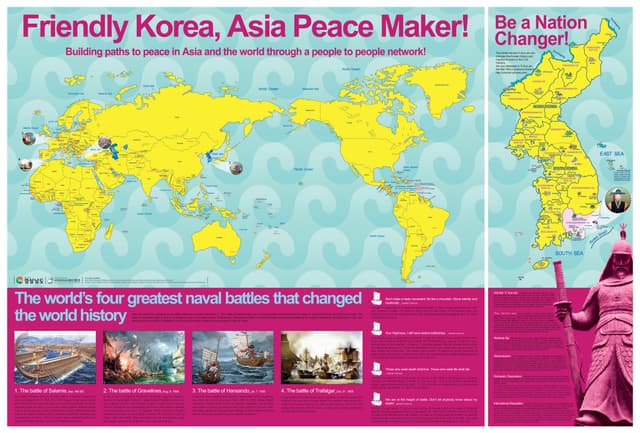
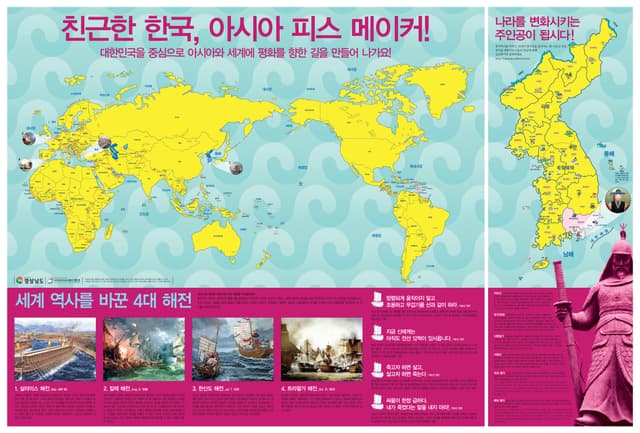
The world’s four greatest naval battles
Battle of Salamis took place between the Greek city-states and Persia in 480BC. Battle of Gravelines broke out when Spanish attempted to invade England. Battle of Trafalgar took place during the Napoleonic war period between England and France in 1805. All of these battles have their great importance in world history because these battles not only changed warfare but also the world history. The Battle of Hansando has also great importance because it also changed not only warfare of the Imjin War but also the East Asian situation. Therefore it is adequately considered as one of the world’s four greatest naval battles.
“Your Highness, I still have twelve battleships.”- Admiral Yi Sun-sin-
“지금 신에게는 아직도 전선 12척이 있사옵니다”
King Seonjo sent a royal edict to Admiral Yi after the Korean Navy under General Won Gyun was nearly annihilated at the battle of Chilcheonllyang, saying “Close the navy. Concentrate on land warfare”. However, Yi strongly insisted that the Korean Navy should be maintained because he knew the importance of the navy better than anyone else. He later added one more ship. The Korean Navy under Yi’s leadership faced hundreds of enemy ships with a force of only thirteen ships, yet triumphed at the battle of Myeongnyang
(Yi Chungmugong Haengnok ; Biography of Admiral Yi Sun-sin).
“Don’t make a hasty movement. Be like a mountain. Move silently and cautiously.”- Admiral Yi Sun-sin-
“망령되게 움직이지 말고 조용하고 무겁기를 산과 같이 하라”
Admiral Yi’s statement to his generals before the battle of Okpo, stressing that they be calm and cautious in battle: The battle of Okpo was the first victory of the Korean Navy and Korean Army since the outbreak of the Imjin War (Okpopawaebyeongjang, May 10, 1592; Yi’s report to the King).
“Those who seek death shall live. Those who seek life shall die.”- Admiral Yi Sun-sin-
“죽고자 하면 살고, 살고자 하면 죽는다”
Admiral Yi’s statement to his generals on the eve of the battle of Myeongnyang, stressing that they be mentally strong in battle: On the next day, Yi and his generals desperately fought against overwhelming odds, 13-133 (number of battleships), and triumphed (Nanjung Ilgi, September 15, 1597; Yi’s war diary).
“We are at the height of battle. Don’t let anybody know about my death!”- Admiral Yi Sun-sin-
“싸움이 한창 급하다. 내가 죽었다는 말을 내지 마라!”
Admiral Yi’s last words: Admiral Yi Sun-sin was shot by an enemy bullet in the battle of Noryang against retreating Japanese forces on November 19, 1598. Even in the last moment of his life he was concerned about the war situation. In order to not discourage his soldiers, he said the famous phrase to his oldest son Hoe and his nephew Wan who were at his side. The battle concluded with a Korean victory (Yi Chungmugong Haengnok; Biography of Admiral Yi Sun-sin).
더 보기 ▾