홍보물
독립운동 세계지도1 (2017)
World Map of the Independence Movement 1 (2017)
한국어
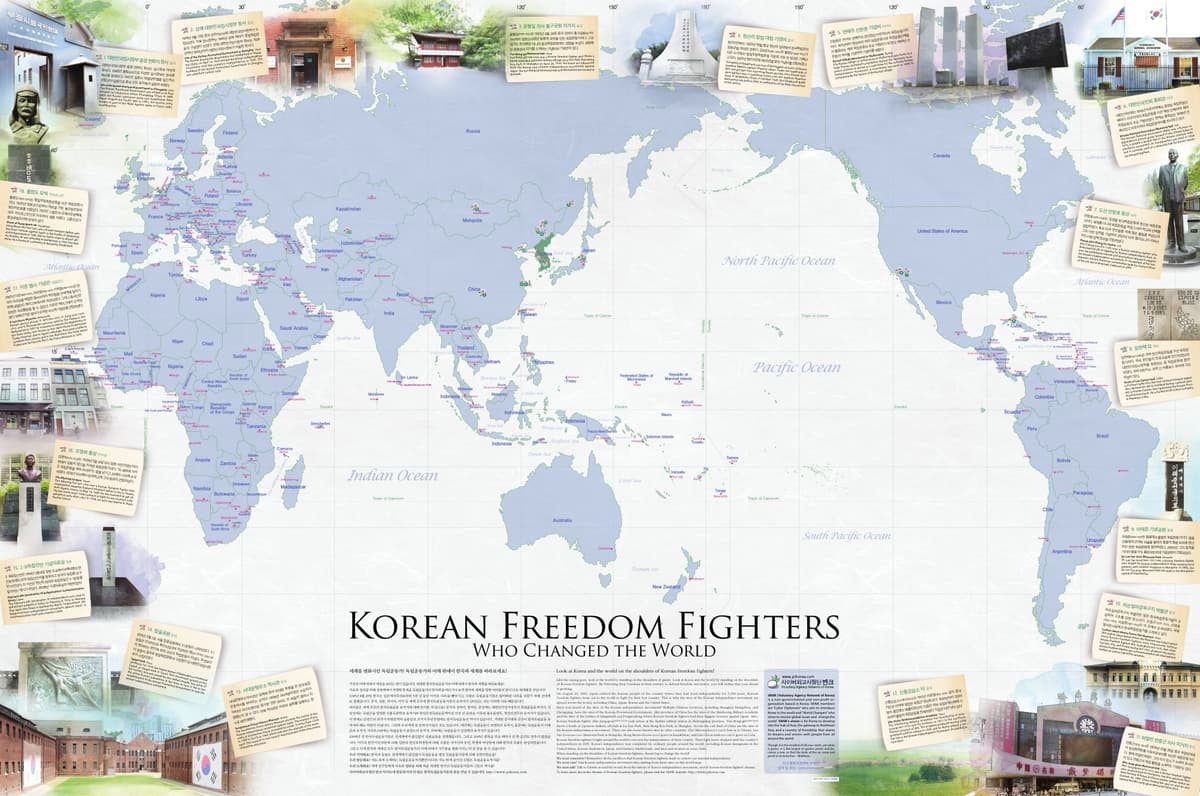
독립운동 세계지도1은 세계 곳곳에 남아있는 한국 독립운동 유적지를 소개하는 홍보물이다. 1910년 국권을 빼앗긴 뒤 중국 상하이·항저우·충칭의 대한민국임시정부 유적지, 지린성의 신흥무관학교 등 독립운동가들이 세계로 나가 남긴 발자취를 따라간다.
EnglishWorld Map of the Independence Movement 1 is a promotional material introducing sites around the world related to Korea's independence movement. After Korea lost its sovereignty in 1910, independence activists went abroad and left their mark in many places. This material follows their footsteps, including the Provisional Government of the Republic of Korea sites in Shanghai, Hangzhou, and Chongqing, China, and the Sinheung Military Academy in Jilin Province.
자료 원고 · 한국어
독립운동 세계지도 원고
세계를 변화시킨 독립운동가! 독립운동가의 어깨 위에서 한국과 세계를 바라보세요!
거인의 어깨 위에서 세상을 보라는 말이 있습니다. 위대한 한국독립운동가의 어깨 위에서 한국과 세계를 바라보세요! 자유와 정의를 위해 전세계 곳곳에서 치열한 싸움을 했던 독립운동가의 발자취를 따라가다 보면 한국과 세계를 향한 여러분의 꿈이 더 크고 위대해질 것입니다!
1910년 8월 29일 한국은 일본제국주의로부터 오 천년 동안 이어온 나라를 빼앗겼습니다. 수많은 독립운동가들이 잃어버린 나라를 되찾기 위해 전세계로 향했습니다. 중국, 일본, 러시아, 미국 등 세계 곳곳에 한국독립운동가들의 유적지가 남아있는 것은 이러한 이유 때문입니다.
여러분은 세계 곳곳에 있는 한국독립운동유적지에 대해 들어본 적이 있나요? 중국의 상하이, 항저우, 충칭에는 대한민국임시정부의 독립운동유적지가 있습니다. 중국 지린성에는 독립군을 양성했던 신흥무관학교의 독립운동유적지와 항일무장독립운동역사상 가장 큰 승리로 기록된 봉오동전투와 청산리전투의 독립운동유적지가 있습니다. 이 밖에도 안중근의 의거지인 하얼빈역과 윤봉길의 의거지인 루쉰공원에도 한국독립운동의 역사가 있습니다. 거대한 중국대륙 곳곳이 한국독립운동유적지라 해도 과언이 아닙니다. 그런데 우리에게 잘 알려지지 않은 독립운동유적지도 있습니다. 대만에 있는 독립운동가 조명하의 유적지, 몽골에 있는 독립운동가 이태준의 유적지, 카자흐스탄에 있는 독립운동가 홍범도의 유적지, 쿠바에 있는 독립운동가 임천택의 유적지가 바로 그것들입니다.
100여년전 한국독립운동가들은 전세계 곳곳에서 끊임없이 독립운동을 전개했습니다. 이로 인해 한국독립운동은 1945년 광복을 맞을 때까지 단 한 순간도 멈추지 않았습니다. 미국의 한인이민자들에 의해, 일본의 한인유학생들에 의해, 수많은 지식인과 농민, 학생과 여성들에 의해 한국의 독립은 완성되었습니다.
우리는 기억해야 합니다! 전세계 곳곳에서 끊임없이 독립운동을 펼쳤던 독립운동가에 의해 한국의 독립이 완성되었다는 것을 기억해야 합니다. 우리는 방문해야 합니다! 지도 속에 소개하는 독립운동유적지뿐만 아니라 전세계 곳곳의 독립운동유적지를 방문하고 관심을 가져야 합니다. 그리고 우리는 세계인에게 당당히 소개해야 합니다! 위대한 한국독립운동가들과 한국독립운동역사를 소개해야 합니다.
한국과 세계인 모두 한국독립운동가의 어깨 위에서 지구촌을 변화시키는 더 큰 꿈을 꿀 수 있을 것입니다.
사이버외교사절단 반크 사이트에 방문하시면 더 많은 한국독립운동가의 꿈을 만날 수 있습니다. http://www.prkorea.com
1. 대한민국임시정부중경연화지 청사 | 중국
대한민국임시정부 중경 연화지 청사는 임시정부의 마지막 청사이다. 1940년 충칭(중경)으로 이전한 임시정부는 한국광복군을 창설하였다 이후 한국광복군은 1941년 일본이 태평양전쟁을 일으키자 연합군의 일원으로 중국, 인도 등지에서 일본과 싸웠다.
2. 상해대한민국임시정부 청사 | 중국
1919년 4월 13일 중국 상하이(상해)에 대한민국임시정부가 수립되었다. 이후 임시정부는 1945년 광복 때까지 항일독립운동의 구심점이 되었다. 상해대한민국임시정부 청사는 1926년부터 1932년까지 대한민국임시정부가 사용한 청사이다.
3. 윤봉길 홍커우공원 의거지 | 중국
윤봉길(1908~1932)은 1932년 4월 29일 중국 상하이 홍커우공원(현 루쉰공원)에서 일본군사령관 등에게 포탄을 던진 독립운동가이다. 그의 의거는 한국뿐만 아니라 중국독립운동에도 영향을 주었다. 공원에는 윤봉길의 의거를 소개하는 기념비와 기념관이 있다.
4. 청산리항일대첩기념비 | 중국
청산리전투는 1920년 10월 중국 청산리 일대에서 한국독립군이 일본군을 대파한 전투이다. 김좌진(1889~1930)과 홍범도(1868~1943)가 이끈 이 전투는 항일무장독립운동 가운데 가장 큰 성과로 기록되고있다. 2001년 청산리전투80주년을 맞아 기념비를 건립하였다.
5. 연해주 신한촌 기념비 | 러시아
신한촌은 러시아 연해주의 한인집단거주지이자 독립운동기지이다. 1911년부터 형성되어 여러 독립운동가와 독립운동단체들이 활동하는 해외 독립운동의 주요 거점지가 되었다. 1999년 신한촌의 역사를 기념하여 기념비를 세웠다.
6. 대한인국민회 총회관 | 미국
대한인국민회는 1910년 미주지역에서 결성된 독립운동단체이다. 미주지역의 독립운동을 이끈 핵심 단체이며, 해외 독립운동의 주요 거점지였다. 현재의 총회관은 1938년 건축되었고 미주지역의 독립운동역사를 전시하고 있다.
7. 도산 안창호 동상 | 미국
안창호(1878~1938)는 일생을 한국독립운동에 헌신한 독립운동가이다. 세계를 다니며 독립운동을 하였고 여러 학교와 단체를 설립하였다. 특히 미국 한인들을 위해 많은 활동을 하였는데 그의 이런 업적을 기념하여 2001년 미국 캘리포니아 리버사이드시청 앞에 동상을 건립하였다.
8. 임천택 묘 | 쿠바
임천택(1903~1985)은 쿠바 한인독립운동을 이끈 독립운동가이다. 쿠바 한인들의 민족교육에 헌신하였으며 대한민국임시정부를 후원하는 등 독립운동에 참여하였다. 쿠바 마탄사스 외곽 산 카를로스 묘지에 무덤이 있다.
9. 이태준 기념관 | 몽골
이태준(1883~1921)은 몽골에서 활동한 독립운동가이다. 몽골인들에게 근대적 의술을 펼치며 몽골의 질병 퇴치에 헌신하는 한편 독립운동에 참여하였다. 2000년 그의 업적을 기리어 몽골 수도 울란바토르에 기념공원이 건립되었다.
10. 여순일아감옥구지박물관 | 중국
중국의 여순일아감옥구지박물관은 여러 한국독립운동가들이 수감되어 고초를 당한 장소이다. 안중근(1879~1910)과 신채호(1880~1936), 이회영(1867~1932)이 이 곳에서 순국하였다. 국제열사전시실에서 한국독립운동가를 소개하고 있다.
11. 하얼빈 안중근 의거지 | 중국
안중근(1879~1910)은 1909년 10월 26일 중국 하얼빈역에서 한국침략원흉 이토히로부미를 처단한 독립운동가이다. 현재 하얼빈역에는 그의 의거 장소가 자세히 표시되어 있고 안중근의 독립 활동을 소개하는 기념관도 있다.
12. 신흥강습소 터 | 중국
신흥강습소(신흥무관학교)는 1911년 이회영(1867~1932) 등이 중국 지린성 지역에 설립한 독립군 양성학교이다. 1920년까지 2천여명의 졸업생이 배출되었으며, 이들은 여러 독립운동단체에 소속되어 활발히 독립운동을 전개하였다. 지금은 터만 남아 있다.
13. 서대문형무소역사관 | 한국
서대문형무소역사관은 일제에 맞서 위대한 투쟁을 한 한국독립운동역사를 보여주는 곳이다. 1908년 2424명 이었던 수감자가 1943년 23,532명으로 증가한 것만 보아도 이 싸움이 얼마나 치열했는지 알 수 있다. 이제 역사관은 자유와 평화를 일깨우는 장소로 재탄생했다.
14. 탑골공원 | 한국
1919년 3월 1일 서울 탑골공원에서 3•1운동이 시작되었다. 3•1운동은 전국적으로 확산되었으며 약200만명(당시 한국인 2천만명)이 참여하는 한민족 최대 규모의 독립운동이 되었다. 이 운동의 결과로 항일독립운동의 구심점이 된 대한민국임시정부가 수립되었다.
15. 2•8독립선언 기념자료실 | 일본
2•8독립선언은 1919년 2월 8일 일본 도쿄에서 6백여명의 한인유학생이 모여 독립선언서를 발표하고 한국의 독립을 요구한 사건이다. 이 사건은 한민족 최대의 독립운동인 3•1운동을 일으키는 계기가 되었다. 2008년 기념자료실이 마련되었다.
16. 조명하 흉상 | 타이완
조명하(1905~1928)는 1928년 5월 14일 당시 일본 식민지였던 타이완에서 일왕의 장인을 저격한 독립운동가이다. “저 세상에 가서도 독립운동을 계속 하리라”는 말을 남기고 24세의 나이에 순국하였다. 1978년 타이베이 한국학교에 동상이 건립되었다.
17. 이준열사기념관 | 네덜란드
1907년 이준(1859~1907), 이상설(1870~1917), 이위종(1887~미상)은 을사늑약의 부당함을 세계에 알리기 위해 네덜란드 헤이그에 특사로 파견되었다. 그러나 특사단은 정당한 외교활동을 할 수 없었고 이준은 헤이그에서 순국하였다. 당시 특사단이 묵었던 장소에 이준열사기념관이 있다.
18. 홍범도 묘역 | 카자흐스탄
홍범도(1868~1943)는 항일무장독립운동을 이끌었던 독립운동가이다. 1920년 일본군으로부터 대승을 거둔 봉오동전투와 청산리전투를 이끌었다. 1937년 스탈린의 강제이주정책에 따라 카자흐스탄으로 이주하여 생을 마쳤다. 크즐오르다 중앙공동묘지에 묘역이 있다.
더 보기 ▾자료 원고 · English
KOREAN FREEDOM FIGHTERS WHO CHANGED THE WORLD
Look at Korea and the world on the shoulders of Korean independence fighters!
Like the saying goes, look at the world by standing on the shoulders of giants. Look at Korea and the world by standing on the shoulders of Korean freedom fighters. By following their footsteps in their journey to defend freedom and justice, you will realize that your dream is growing.
On August 29, 1910, Japan robbed the Korean people of the country where they had lived independently for 5,000 years. Korean freedom fighters went out to the world to fight for their lost country. This is why the sites of the Korean independence movement are spread across the world, including China, Japan, Russia and the United States.
Have you heard of the sites of the Korean independence movement? Multiple Chinese locations, including Shanghai, Hangzhou, and Chongqing, have the sites of the Korean Provisional Government. Jilin province of China has the sites of the Shinheung Military Academy and the sites of the battles of Qingshanli and Fengwudong where Korean freedom fighters had their biggest victories against Japan. Also, Korean freedom fighter Ahn Jung-geun took action at the Harbin railway station in Heilongjiang province. Yun Bong-gil threw a bomb at Japanese military officials at Lu Xun Park, then Hong Kou Park, in Shanghai. Across the vast land of China are the sites of the Korean independence movement. There are also lesser known sites in other countries. Jo Myeong-ha’s bust is in Taiwan, Lee Tae-joon Memorial Park in Mongolia, Hong Beomdo’s grave in Kazakhstan, and Im Cheon-taek’s grave in Cuba.
Korean freedom fighters fought around the world to recover the independence of their country. Their fight never stopped until the country’s independence in 1945. Korea’s independence was completed by ordinary people around the world, including Korean immigrants in the United States, Korean students in Japan, and farmers, intellectuals, and men and women in every field.
We must remember! Remember all the sacrifices that Korean freedom fighters made to recover their national independence. Visit sites where they fought! Start with these sites on this world map of Korean independence movement sites. Pay special attention to sites that have been neglected. Share what you learn from this map with friends around the world! Talk to friends about the history of the Korean independence movement and the dreams of Korean freedom fighters. Standing on the shoulders of Korean freedom fighters, dream big to change the world!
To learn more about the dreams of Korean freedom fighters, please visit the VANK website:
http://www.prkorea.com
1. Site of the Korean Provisional Government in Chongqing | China
The Korean Provisional Government was settled in its final location on Lianhuachi Street, Chongqing, China, in 1940. Here, the Korean Liberation Army was established. After Japan waged the Pacific War in 1941, the Korean army fought as part of the Allies against Japan in China, India, and Myanmar.
2. Site of the Korean Provisional Government in Shanghai | China
The building of the Korean Provisional Government in Shanghai was used from 1926 to 1932. The Korean provisional government was established in Shanghai, China, on April 13, 1919 and led the Korean independence movement until the country’s independence in 1945.
3. Yun Bong-gil Memorial Hall | China
Yun Bong-gil (1908-1932) was a Korean freedom fighter who threw a bomb and killed Japanese military officials at Lu Xun Park, then Hong Kou Park, in Shanghai on April 29, 1932. His brave act influenced both the Korean and Chinese independence movements against Japan. The Yun Bong-gil Memorial Hall and Monument are located at the park.
4. Qingshanli Battle Monument | China
The Battle of Qingshanli was one of the biggest victories of Korean freedom fighters against Imperial Japan. Under the leadership of Kim Jwajin (1889-1930) and Hong Beomdo (1868-1943), Korean freedom fighters won a sweeping victory over the Imperial Japanese Army in Qingshanli, China, in October 1920. The Qingshanli Battle Monument was built in 2001 in celebration of the 80th anniversary of the victory.
5. Korean Village Monument in Vladivostok | Russia
The Korean Village or Sinhanchon in Vladivostok was home to a large Korean immigrant population during the Japanese occupation of Korea. It served as a main base for the overseas Korean independence movement. A monument was built in 1999 to commemorate the history of the Korean village.
6. Korean National Association Memorial Hall | USA
The Korean National Association (KNA) was a Korean independence activist group formed in the United States in 1910. It played a pivotal role in the Korean overseas independence movement. Its headquarters was built in 1938 and is currently used as a memorial hall for Korean American freedom fighters.
7. Dosan Ahn Chang-ho Statue | USA
Ahn Chang-ho (1878 – 1938) was a Korean freedom fighter who dedicated his life to fighting for Korean independence from Japan. He established schools and associations abroad to support the Korean independence movement. In recognition of his contribution, Korean American communities built his statue in front of the city hall in Riverside, California, in 2001.
8. Grave of Im Cheon-taek | Cuba
Im Cheon-taek (1903-1985) was a Korean freedom fighter who devoted his life to instilling Korean national identity in Korean Cubans and supporting the Korean Provisional Government. He is buried at San Carlos Cemetery in Matanzas, Cuba.
9. Dr. Lee Tae-Joon Memorial Park | Mongolia
Dr. Lee Tae-Joon (1883–1921) was a Korean freedom fighter who fought for Korean independence while treating local patients with modern medicine in Mongolia. In 2000, the Dr. Lee Tea-Joon Memorial Park was built in the Mongolian capital of Ulaanbaatar.
10. Lushun Japan-Russia Prison Site Museum | China
The Lushun Japan-Russia Prison Site Museum was a place where many Korean freedom fighters were imprisoned. Famous Korean freedom fighters Ahn Jung-geun (1879-1910), Shin Chae-ho (1880-1936), and Lee Hoe-young (1867-1932) all died in this prison. Korean freedom fighters are commemorated in the International Soldiers in Lushun hall at this museum.
11. Ahn Jung-geun Memorial Hall | China
Ahn Jung-geun (1879 – 1910) was a Korean freedom fighter who assassinated Ito Hirobumi, the first Japanese Resident-General of Korea, at China’s Harbin railway station on October 26, 1909. China marked the spot he shot Ito and opened the Ahn Jung-geun Memorial Hall in 2014.
12. Site of the Shinheung Military Academy | China
The Shinheung Military Academy was founded by Lee Hoe-young (1867-1932) and his brothers in 1911 in the northeast Chinese province of Jilin. The academy produced around 2,000 graduates until its closing in 1920, and its alumni played a crucial role in the Korean independence movement. Its building is now gone.
13. Seodaemun Prison History Museum | Korea
The Seodaemun Prison History Museum presents the history of the Korean independence movement against Japan. The number of prisoners at Seodaemun Prison increased by nearly 10 times from 2,424 in 1908 to 23,532 in 1943, which indicates the intensity of the movement. This prison is now used as a museum to remind people of the importance of national independence.
14. Tapgol Park | Korea
On March 1st, 1919, the largest Korean independence movement began at Tapgol Park in Seoul. This movement spread across the country and was joined by two million people, one tenth of the entire Korean population at the time. In turn, it led to the establishment of the Korean Provisional Government to lead the Korean independence movement.
15. February 8th Declaration of Independence Commemoration Room | Japan
The February 8th Declaration of Independence was read to 600 Korean students in Tokyo on February 8, 1919, to demand that Japan free Korea. It sparked the March 1st Movement, the biggest Korean independence movement against Japan. A commemoration room was created in the Japanese capital of Tokyo in 2008.
16. Jo Myeong-ha Bust | Taiwan
Jo Myeong-ha (1905–1928) was a Korean freedom fighter who assassinated Japanese Emperor Hirohito’s father-in-law in Taiwan, then Japan’s colony, on May 14, 1928. He was executed at age 24. His last words were “I will continue to fight for my country’s independence even after I die.” In 1978, his bust was placed at Taipei Korean School.
17. Yi Jun Peace Museum | the Netherlands
Korean special envoys Yi Jun (1859-1907), Lee Sangseol (1870-1917), and Yi Wi-jong (1887-unknown) went to The Hague in the Netherlands in 1907 on a mission to expose the illegitimacy of the Eulsa Treaty, also known as the Japan-Korea Protectorate Treaty. However, due to Japan’s sabotage, they were unable to complete their mission and Yi Jun died there. The hotel where Yi died was turned into the Yi Jun Peace Museum in 1995.
18. Grave of Hong Beomdo | Kazakhstan
Hong Beomdo (1868-1943) was a Korean freedom fighter who led major victories against Japan in the battles of Qingshanli and Fengwudong in 1920. Due to Stalin’s order to deport ethnic Koreans, he was relocated to Kazakhstan in 1937 and died there. He is buried at a cemetery in Kyzylorda, Kazakhstan.
더 보기 ▾