홍보물
 1
1 2
2 3
3 4
4 5
5 6
6 7
7 8
8 9
9 10
10 11
11 12
12한국섬 엽서 (2020)
Postcards of Korean Islands (2020)
한국어
한국섬 엽서는 무인도 2,767개, 유인도 470개 등 총 3,237개에 이르는 한국의 섬 중 의미 있는 12개를 소개하는 엽서다. 인천국제공항이 자리한 영종도, 민속문화가 풍부한 진도, 이순신 장군의 역사가 담긴 한산도, 한국의 가장 동쪽 영토 독도까지 다양한 섬의 역사와 문화를 담았다.
EnglishKorea has about 3,237 islands in total, including 2,767 uninhabited islands and 470 inhabited ones. This postcard set introduces 12 meaningful islands among them, each with its own history and culture. They include Yeongjongdo, home to Incheon International Airport; Jindo, known for its rich folk culture; Hansando, tied to the history of Admiral Yi Sun-sin; and Dokdo, Korea's easternmost territory.
자료 원고 · English
Friendly Korea Community(chingu.prkorea.com)에서 한국인 친구를 사귀고 서로 교류해보세요. 여러분의 지식이 더 넓고 더 풍성하게 성장할 것입니다.
→Friendly Korea Community http://chingu.prkorea.com
How many islands does Korea have? Surrounded by the ocean on three sides, Korea has a total of 3,237 islands and islets that include 470 inhabited islands and 2,767 uninhabited ones.
These postcards will introduce you to 12 representative islands of Korea. What kinds of history and culture exists on these islands? Yeongjongdo is the gateway to Korea where the Incheon International Airport is located. Jindo has a rich heritage of Korean folk culture. Hansando has the legacy of Korea’s most beloved hero, Admiral Yi Sun-sin. Dokdo at the easternmost point of Korea is the most meaningful island to Koreans. These postcards will give you a glimpse of Korea’s beautiful islands with their unique history and culture.
In the past, islands have often been undervalued due to their lack of accessibility. In the 21st century, however, with convenient transportation, they are gaining new recognition. The natural resources, marine ecosystems, and distinctive culture and history of each island are valuable assets to humanity.
What islands do you know about? What history and culture do they have? Make Korean friends through the Friendly Korea Community (chingu.prkorea.com) and develop sincere friendships! New knowledge will help you grow and enrich your life.
→ Visit Friendly Korea Community at http://chingu.prkorea.com
-The Island of Korea, Dokdo 한국의 섬, 독도
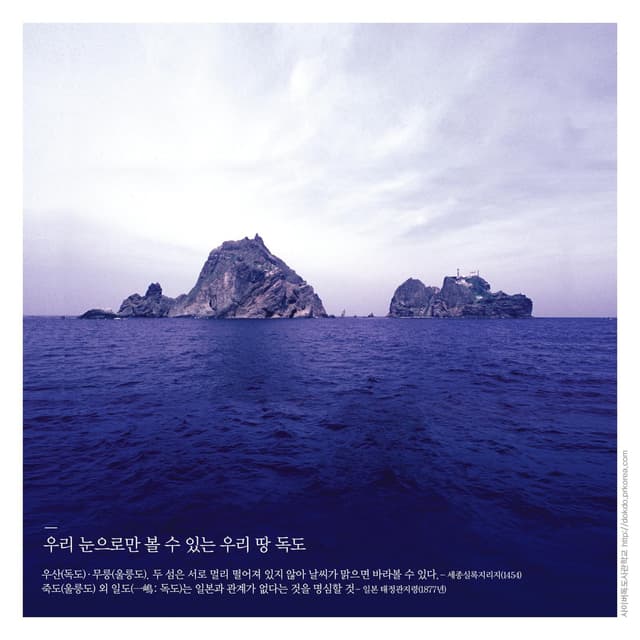
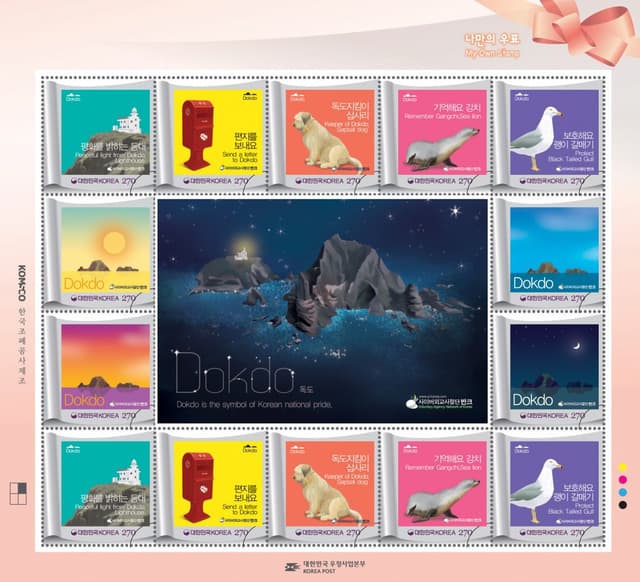
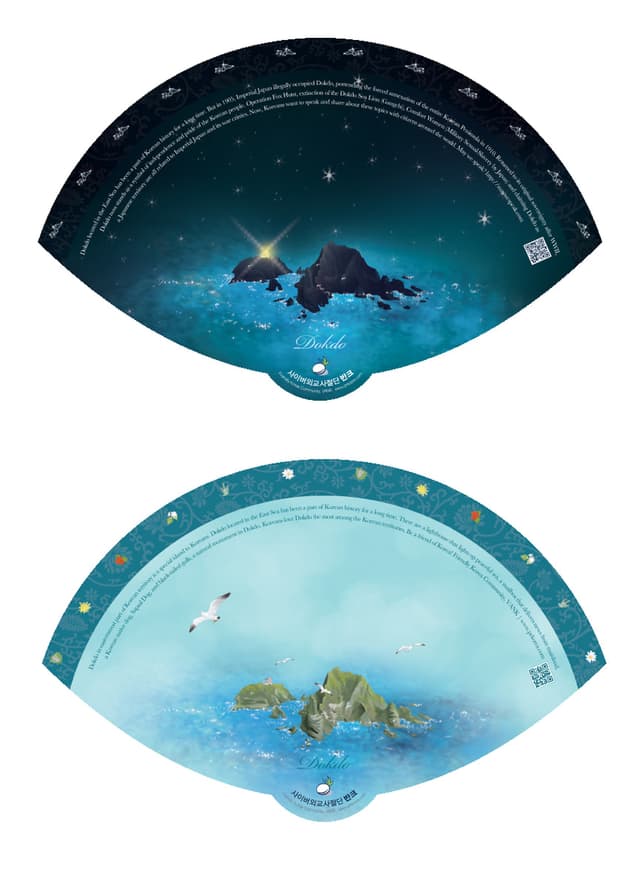
Dokdo is the easternmost island of Korea. With a total area of 187,554m2, it consists of two main islands, Dongdo (East Island) and Seodo (West Island), and 89 surrounding islets. Despite its small size, Dokdo is inhabited by around 40 residents, including guards and lightkeepers.
The entirety of Dokdo was designated as a Korean natural monument in 1982. Dokdo is recognized for its high ecological value. It is home to 60 plant species, 160 bird species, 130 insect species, and diverse marine life. Located on a bird migratory route, Dokdo serves as a resting place for many migratory birds, including black-tailed gulls, streaked shearwaters, and Swinhoe’s storm petrels. Also, the Dokdo seamounts, formed by volcanic activity, have important geological value, showing the evolution of undersea mountains.
Since Ulleungdo became part of Silla in 512, its affiliated island of Dokdo has been considered a territory of Korea. The geography section of the Annals of King Sejong (1454), official documents of the early Joseon, noted that Dokdo was visible from Ulleungdo on a clear day due to their proximity. In the early 20th century, Dokdo became the first victim of Japan’s imperialistic expansion to Korea. With the end of the Japanese occupation of Korea in 1945, it was returned to Korea.
Dokdo is the most meaningful island to the Korean people. It symbolizes Korea’s full independence and sovereignty.
-The Island of Korea, Ganghwado 한국의 섬, 강화도
Ganghwado is an island on the western mouth of the Han River, which flows through the heart of Seoul, the capital of the Republic of Korea. With a total area of 302.58 ㎢, it is the fourth largest island in Korea.
Due to the location at the mouth of the Han River and its proximity to Goryeo’s (918 - 1392) capital Gaeseong and Joseon’s (1392 - 1910) capital Hanyang (today’s Seoul), it bore witness to many historical events. Faced with Mongolian invasion, Goryeo moved its capital temporarily to Ganghwado where it made the Goryeo Daejanggyeong, part of UNESCO’s Memory of the World Register. During Joseon, Ganghwado served as a military stronghold where many military facilities were built.
Ganghwado also boasts many Bronze-Age relics and artifacts. Most significant are the Goindols or dolmens. Part of the ancient Megalithic culture, dolmens are found across the world, but they are largely concentrated in Northeast Asia, including Korea, China, and Japan. Korea has the largest concentration of various types of dolmens in the world. Roughly 120 dolmens, including the cluster in Bugeun-ri, are found on Ganghwado. The Bugeun-ri Goindol is a table-type dolmen that is made of two 2.6-meter high upright stones supporting a massive 7.1-meter long and 5.6-meter wide capstone. Along with Gochang and Hwasun dolmen sites, the Ganghwa dolmen sites were designated as a UNESCO World Heritage Site in 2000.
From prehistoric times, Goguryeo (37 BC-AD668), Baekje (18 BC-AD 660), Silla(57 BC-AD 935), Goryeo(918-1392), Joseon(1392-1910), to the present, Ganghwado has been an important part of Korea’s 5,000 years of history.
-The Island of Korea, Yeongjongdo 한국의 섬, 영종도
Yeongjongdo is an island off the west coast of Incheon. With a total area of 104.28km², it is the seventh largest island in Korea. Present-day Yeongjongdo was made in a two-year project from 1992 to 1994 that connected Yeongjongdo with Yongyudo, Sammokdo, and Sinbuldo through seawall construction and land reclamation.
Yeongjongdo is the first gateway to Korea because it is home to the Incheon International Airport, which opened in March 2001. In 2019, the Incheon International Airport served more than 70 million international passengers, making it the world’s fifth largest international passenger airport. It is also recognized for the best service, topping the Airport Council International’s prestigious Airport Service Quality (ASQ) ranking for twelve consecutive years.
The Incheon International Airport has a wide range of facilities for rest, dining, and shopping as well as areas for Korean cultural performances and exhibitions. Yeongjongdo is working on diverse projects in aviation, aviation logistics, tourism, and transportation to continue enhancing its infrastructure for the airport.
Yeongjongdo, the host of the Incheon International Airport, is an island that connects Korea and the world with 24/7 operations.
-The Island of Korea, Anmyeondo 한국의 섬, 안면도
Anmyeondo is an island off Korea’s west coast. With a total area of 113.46km², it is the sixth largest island in Korea.
Anmyeondo was originally a cape. Historically, the west coast of Korea served as a sea route to deliver grain, which was collected as tax from the provinces of Chungcheongdo, Jeollado, and Gyeongsangdo. Due to strong wind and waves, ship sinking accidents were frequent. In 1638, the government of Joseon built a canal to create a safe sea route by cutting out the land between Changgi-ri in Anmyeon-eup and Sinon-ri in Nam-myeon. After its transition from a cape to an island, it gained its name Anmyeondo Island. Anmyeondo was re-connected with the mainland with the construction of the Anmyeon Bridge in 1970.
Anmyeondo is part of the Taean Coastal National Park. Along its coastline, there are more than a dozen scenic beaches, including Bangpo, Ggotji, and Sambong beaches. Beaches on Anmyeondo are known for wide sandy beaches, gentle slopes, and clear water, attracting many summer vacationers. It is also famous for its recreational forest. The Anmyeondo Recreational Forest is the only area where Korea’s native red pine trees grow in clusters across 1.75km². The government of Joseon gave the red pine trees on Anmyeondo the name Anmyeonsong and restricted their usage only for building palaces, military vessels, and official purposes.
Like its name Anmyeon, meaning ‘sleeping comfortably’, Anmyeondo is an island of relaxation with beautiful beaches and lush pine tree forest.
-The Island of Korea, Gogunsangundo 한국의 섬, 고군산군도
Gogunsan Islands consist of 63 islands and islets, 50km southwest of Gunsan in Jeollabukdo. Some of the islands, such as Sinsido, Munyeodo, Seonyudo, Jangjado, and Daejangdo, are connected to the mainland with the 33.9km-long Saemangeum seawall and bridges.
At the center of the Gogunsan Islands is Seonyudo. Originally called Gunsando Island, Seonyudo earned this name, meaning gods’ playground, for its scenic views. During Goryeo (918-1392), it served as a port of call for trade between Korea and China and as a strategic base for naval forces. It was also the place where Admiral Yi Sun-sin (1545-1598) of Joseon rearranged battle lines after his victory against the Japanese Navy in the Battle of Myeongnyang in 1597. Besides its strategic location, Seonyudo is known for clear water, fine sand beaches, rugged cliffs, and stunning sunsets. Most water surrounding of the Gogunsan Islands is suitable for swimming, fishing, and other water recreational activities because it is clean, soft, sandy, and full of marine life.
Rich with beautiful natural features and meaningful history, the Gogunsan Islands are now preparing for a new future through the Saemangeum Reclamation Project. This ambitious longterm project involves reclaiming a massive coastal area of 409㎢, including the construction of the Saemangeum seawall in 2010. It is still ongoing to make this region an economic and tourist hub of Northeast Asia.
-The Island of Korea, Wando 한국의 섬, 완도
Wando is an island to the south of Haenam. With a total area of 90.07km2, it is the eighth largest island in Korea. In 1968, it was connected to the mainland with a bridge. The coast and ocean off Wando belong to the Dadohae Marine National Park. The park is the largest national park in Korea with a total area of 2,266.221㎢ (291.023㎢ of land and 1,975.198㎢ of water) that encompasses the southwestern coast of Korea and its coastal waters.
Wando holds the legacy of Jang Bogo (unknown - 846) of Silla (57 BC-AD 935). General Jang established Cheonghaejin on Wando that served as a garrison and a trading hub. He facilitated Silla’s maritime trade with China and Japan by defeating pirates and controlling the sea. His work and achievements are well-documented in historical texts of all three countries. Jangdo, a small island off Wando, has traces of a terraced castle, which played an important role in maritime trade at the time. There also remains an old folk song called ‘Song of Cheonghae soldiers.’ Jang Bogo’s legacy still inspires many Koreans to follow his path to venturing the ocean and building a better future.
Today, Wando is connected to nearby islands, such as Gogeumdo, Sinjido, and Joyakdo, with bridges. It serves as a port of call for regular ferry boats from surrounding islands and is open to foreign vessels. Wando is an island of connection that is open and connected to the world.
-The Island of Korea, Jindo 한국의 섬, 진도
Jindo is an island off the southwest coast of Korea. With a total area of 374.98km2, it is the third largest island in Korea. In 1984, it was connected to the mainland with the Jindo Bridge.
Jindo is known for its rich folk culture. It is home to the Unrimsanbang studio where the Southern school of Korean traditional painting originated. Unrimsanbang was the home and studio of master painter Heo Ryeon (1809-1892) from 1856 till his death in late Joseon. His mentor and legendary calligrapher Kim Jeong-hui (1786-1856) touted him as his most talented pupil. His legacy in landscape painting is still alive on Jindo. At Unrimsanbang, his descendants have been carrying on his painting legacy for five generations. Besides painting, Jindo’s folk songs are also popular. Many folk songs, including Jindo Arirang, have been passed down, showing Jindo people’s musical talent.
In addition, Jindo’s beautiful natural scenery demands a visit. Jindo presents a spectacular phenomenon of sea parting, known as ‘Korea’s Moses Miracle.’ Around February and March in the lunar calendar, a 2.8km-long sandbar appears in the middle of the ocean between Hoedong-ri in Gogun-myeon and Modo-ri in Uisin-myeon. Many people from Korea and abroad visit Jindo to experience this mysterious natural phenomenon and the coinciding Jindo Sea-Parting Festival. Also, the Sebang Nakjo Observatory on Jindo offers one of the most beautiful sunsets of Korea’s southern coast and a panoramic view of the Dadohae archipelago.
-The Island of Korea, Heuksando 한국의 섬, 흑산도
Heuksando is an island of 21.26km2, 97.2km southwest of Mokpo, Jeollanamdo. It gained its name, meaning black mountain island, because its rugged mountain ranges make the island look black. The Heuksan archipelago consists of 68 islands and islets, including the main island of Heuksando and Hongdo, Daedundo, Yeonsando, and Damuldo. Heuksando plays a central part in connecting all islands of the archipelago.
Due to its remote location at the end of Korea’s southwest coast, Heuksando was used as a penal colony. In 1876, Choi Ikhyeon (1833 - 1906) was exiled to Heuksando for opposing Joseon’s treaty with Japan. Previously in 1801, Jeong Yakjeon (1758 - 1816) was sent to Heuksando for believing in Catholicism, labeled a pagan religion, and he spent 14 years there. During his exile, Jeong established a school for children in the town of Sari and wrote Jasaneobo, Joseon’s first encyclopedia of fish, by researching the fish near Heuksando.
Once a penal colony, Heuksando now serves as a strategic base of Korea’s territorial waters. In addition, it is an advanced base for fisheries, a port of refuge for ships in case of an emergency, and a port of call for ships from surrounding islands.
-The Island of Korea, Hansando 한국의 섬, 한산도
Hansando is an island of 14.72㎢, part of the Hallyeo Marine National Park, southeast of Tongyeong in the province of Gyeongsangnamdo. With a total area of 535.676㎢, the park encompasses scenic islands, coastal areas, and the sea, stretching from Goeje in Gyeongsangnamdo to Yeosu in Jeollanamdo.
Hansando was Admiral Yi Sun-sin’s (1545 – 1598) main sphere of action during the mid-Joseon period. As naval commander of three provinces, Admiral Yi led Joseon’s navy to victory over Japanese invading forces in the Imjin War (1592 - 1598). Hansando was home to the navy headquarters of three provinces. There still remain the Jeseungdang, Yi’s office where he held strategy meetings, the Suru, a watchtower where Yi watched enemy movements, and the Hansanjeong, an archery range. Also, the sea off Hansando was the place of the Battle of Hansando where Yi’s navy had a decisive victory over Japan’s navy on July 8, 1592.
This battle is highly regarded in world naval history for the exceptional use of strategies and tactics. Hansando is an island with beautiful coastal views and inspiring stories of a Korean national hero. Admiral Yi’s traces are found across the 100 islands and islets of the Hallyeo Marine National Park.
-The Island of Korea, Ulleungdo 한국의 섬, 울릉도
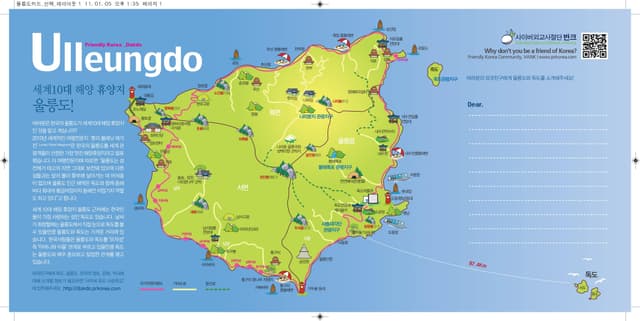
Ulleungdo is a volcanic island in the East Sea. With a total area of 72.86km2, it is the nineth largest
island in Korea. It consists mainly of rugged mountains and steep coastal cliffs.
Ulleungdo was incorporated into Silla in 512 by General Yi Sabu. The story goes that General Yi Sabu faced strong resistance from the people of the Usan kingdom (modern-day Ulleungdo). However, his fire-breathing wooden lions scared them off and they finally surrendered.
Despite Korea’s advanced transportation system, the way to Ulleungdo is still a long journey. Ulleungdo is 217km away from the port of Pohang. Even with the fast ferries, it takes more than 3 hours. Due to its remote location, Ulleungdo maintains its pristine natural features. The virgin forest near the top of Seonginbong, the highest peak (985 meters) on Ulleungdo, is home to rare native trees and plants that are only found there. The coastal trails of Ulleungdo offer magnificent views of virgin forest, rugged rock formations, steep cliffs, and the East Sea.
Because of its pristine natural landscape, Ulleungdo has become a popular attraction for nature seekers. Ulleungdo, the gateway to Dokdo, has a special place in the hearts of the Korean people.
더 보기 ▾